
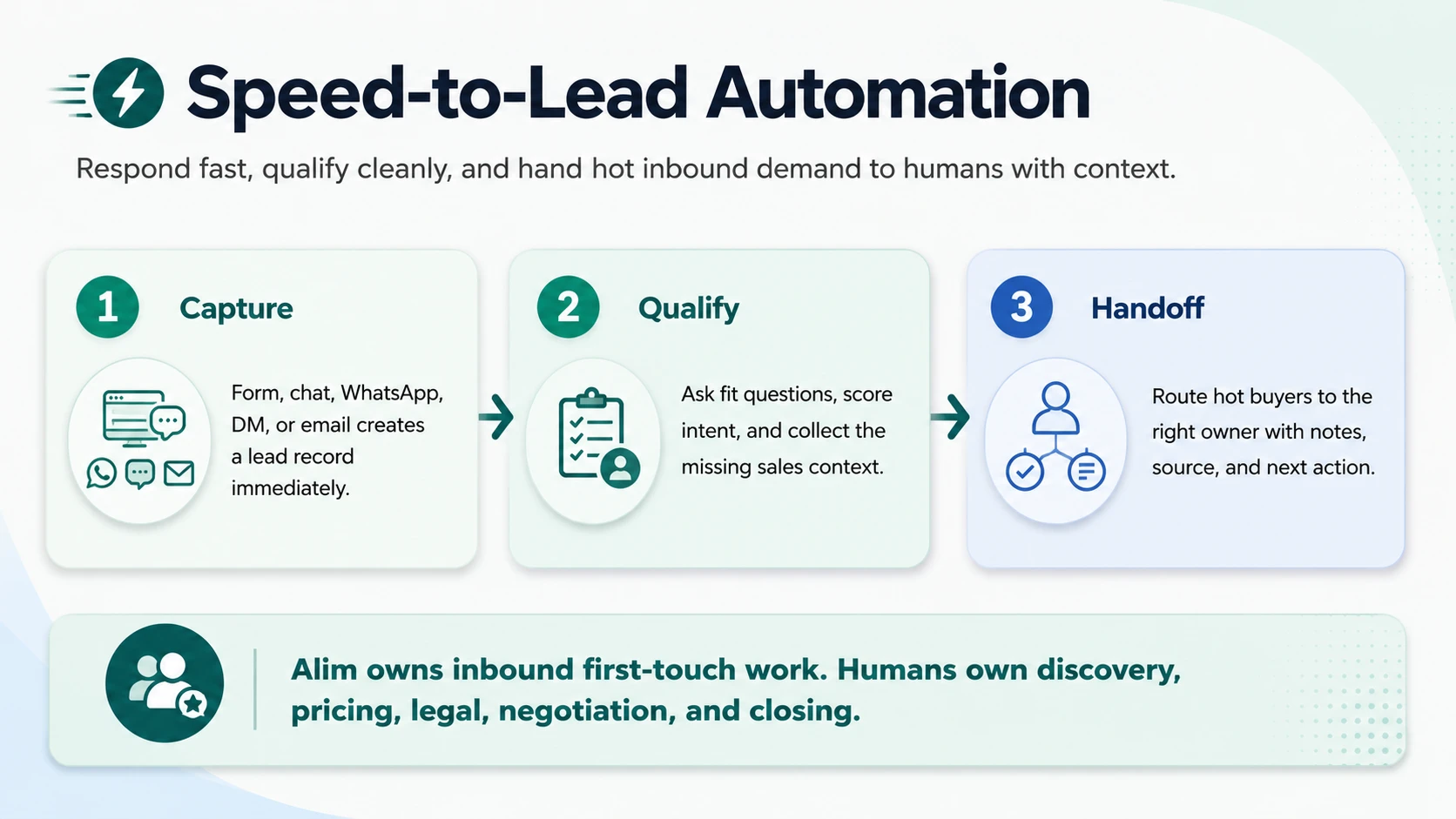
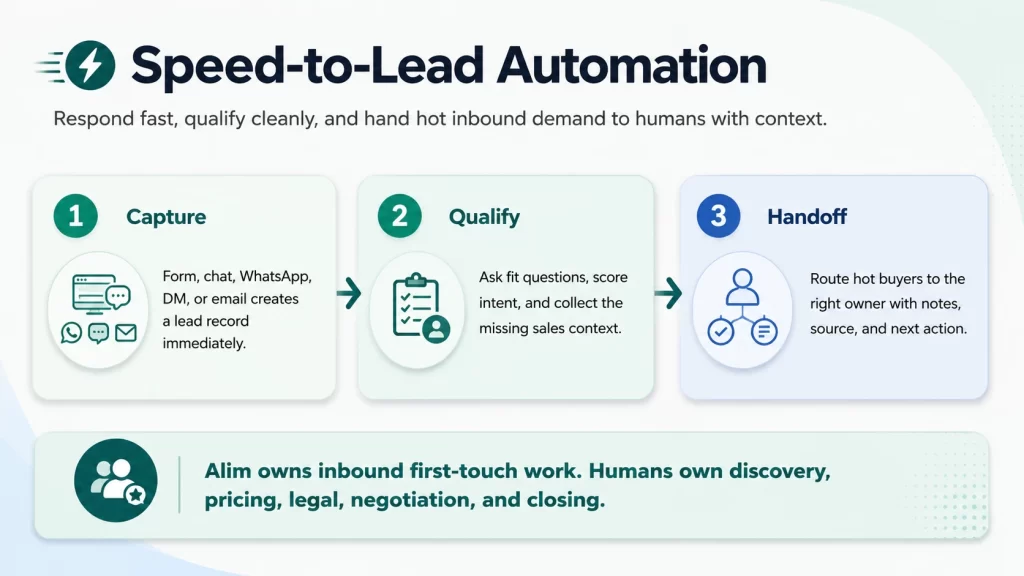
Speed-to-lead automation is the system that responds to an inbound lead immediately, qualifies intent, routes the buyer to the right owner, and updates the CRM before the opportunity goes cold. It is not just a faster autoresponder. A useful speed-to-lead workflow captures the lead, asks the right qualification questions, creates a clean handoff, and leaves humans in charge of discovery, pricing, legal, negotiation, and closing.
For GrowthEffect, this is an Alim inbound AI sales representative problem. Alim handles inbound response, qualification, routing, booking, and CRM sync. Vera handles outbound pipeline creation. Mixing those jobs makes the operating model weaker.
Key Takeaways
– Speed-to-lead automation is about protecting buyer intent, not only answering faster.
– The workflow should move from instant acknowledgement to qualification, routing, booking, and CRM handoff.
– AI can own first-touch inbound work when rules, data, disqualification criteria, and escalation triggers are explicit.
– Humans should still own discovery, pricing, procurement, legal/security questions, negotiation, and closing.
– The right CTA for this topic is Alim for inbound qualification, with a revenue leak scan when the team does not yet know where the leak sits.
What Is Speed-to-Lead Automation?
Speed-to-lead automation is a repeatable inbound sales workflow that reduces the time between a buyer raising their hand and the first useful sales response.
A useful response is not just “Thanks, we got your form.” It should do at least four things:
- confirm the buyer’s request;
- identify source, intent, urgency, and fit;
- decide whether to route, book, nurture, or disqualify;
- write the right context back to CRM for the human owner.
This matters because inbound demand has a short attention window. The MIT/InsideSales lead response study found that contacting web-generated leads within five minutes performed materially better than waiting 30 minutes for both contact and qualification rates. The same study examined more than 15,000 leads and more than 100,000 call attempts, which is why it is still widely cited in speed-to-lead conversations.
The exact multiplier should not be treated as a universal promise for every industry, channel, or offer. The useful operating lesson is simpler: if a buyer asks for help and your team waits hours, the buyer has time to forget the problem, contact a competitor, or lose urgency.
Why Inbound Leads Still Go Cold
Most companies do not lose inbound leads because nobody cares. They lose them because the process depends on a chain of manual steps.
Common failure points:
- form submission goes to a shared inbox;
- owner assignment waits for a manager;
- sales responds after the buyer has already compared other options;
- the first reply asks generic questions the buyer already answered;
- hot leads and low-fit leads receive the same response;
- CRM notes are missing, so the human closer repeats discovery;
- after-hours leads wait until the next working day;
- handoff rules are unclear when pricing, procurement, legal, or security questions appear.
That is why speed-to-lead should be treated as an operating system, not a notification setting.
Salesforce’s 2026 State of Sales announcement also shows why teams are moving in this direction. Salesforce reported that 87% of sales organizations use AI in some form for work such as prospecting, forecasting, lead scoring, or email drafting, and that 94% of sales leaders with agents say agents are critical for meeting business demands. The point is not that every sales workflow should become fully autonomous. The point is that first-touch capacity is becoming a systems problem.
The Speed-to-Lead SLA: What Should Happen First?
A practical inbound SLA should define what happens in the first minute, the first five minutes, and after the initial qualification window.
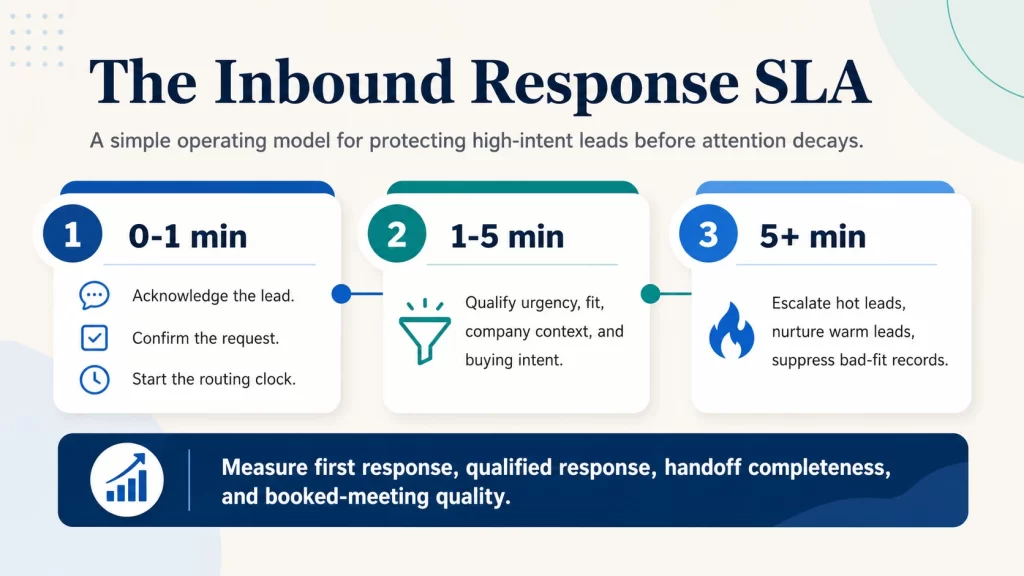
| Time window | What should happen | AI role | Human role |
|---|---|---|---|
| 0-1 minute | Acknowledge the lead, capture source, confirm the request, start the routing clock | Respond instantly, identify channel, create or update CRM record | None unless the lead is strategic or sensitive |
| 1-5 minutes | Ask qualification questions, collect missing context, detect urgency, score fit | Run the inbound qualification logic and classify lead temperature | Review exceptions or high-value accounts |
| 5-15 minutes | Route hot leads, book qualified meetings, nurture warm leads, suppress bad-fit leads | Assign owner, propose slots, write handoff notes, trigger follow-up | Take qualified conversations and handle buyer-specific questions |
| Same day | Audit handoff quality and incomplete records | Flag missing fields and unresolved conversations | Fix process gaps and update rules |
This is where many teams make the wrong automation decision. They automate the notification but not the workflow. A Slack alert that says “new demo request” is useful, but it does not qualify the lead, decide routing, or prepare the seller.
What AI Should Automate and What Should Stay Human
AI should automate the repetitive, time-sensitive work around inbound first touch. Humans should keep the work that requires judgment, trust, and commercial accountability.
| Workflow step | Automate with AI? | Why |
|---|---|---|
| Lead acknowledgement | Yes | Speed matters and the response can be controlled |
| Source and channel capture | Yes | This should be structured data, not manual notes |
| Basic qualification | Yes | Fit, urgency, role, company, and problem can follow a defined logic |
| Routing | Yes, with rules | Owner, territory, segment, and urgency can be mapped |
| Meeting booking | Yes, for qualified leads | Calendar flow can be automated after qualification |
| CRM sync | Yes | Humans should not retype first-touch context |
| Pricing questions | Human handoff | Pricing depends on fit, scope, packaging, and negotiation context |
| Procurement, legal, and security | Human handoff | These are risk-bearing conversations |
| Complex discovery | Human owned | AI can prepare context, but humans should run discovery |
| Negotiation and closing | Human owned | The buyer relationship and commercial commitment stay human |
For GrowthEffect, the clean split is:
- Alim handles inbound response, qualification, routing, booking, and CRM handoff.
- Vera handles outbound sourcing, enrichment, research, scoring, personalized outreach, follow-up, and outbound CRM handoff.
If the lead came from a form, website chat, WhatsApp, DM, or inbound email, start with Alim. If the company needs to create new pipeline from target accounts, that is Vera.
Related GrowthEffect Workflow
If your inbound leads wait too long, reach sales without context, or fall between owners, Alim is the GrowthEffect AI sales representative built for instant response, qualification, routing, meeting booking, and CRM handoff.
Use this path when the leak is not “we need more leads.” Use it when existing demand is already arriving but the first-touch process is too slow or too inconsistent.
If you are not sure whether the leak is inbound response, outbound execution, qualification, CRM handoff, or follow-up, start with the GrowthEffect revenue leak scan before buying another tool.
The Readiness Checklist Before You Automate
Speed-to-lead automation fails when companies automate a messy process. Before adding an AI inbound sales agent, write down the rules a strong human SDR would follow.
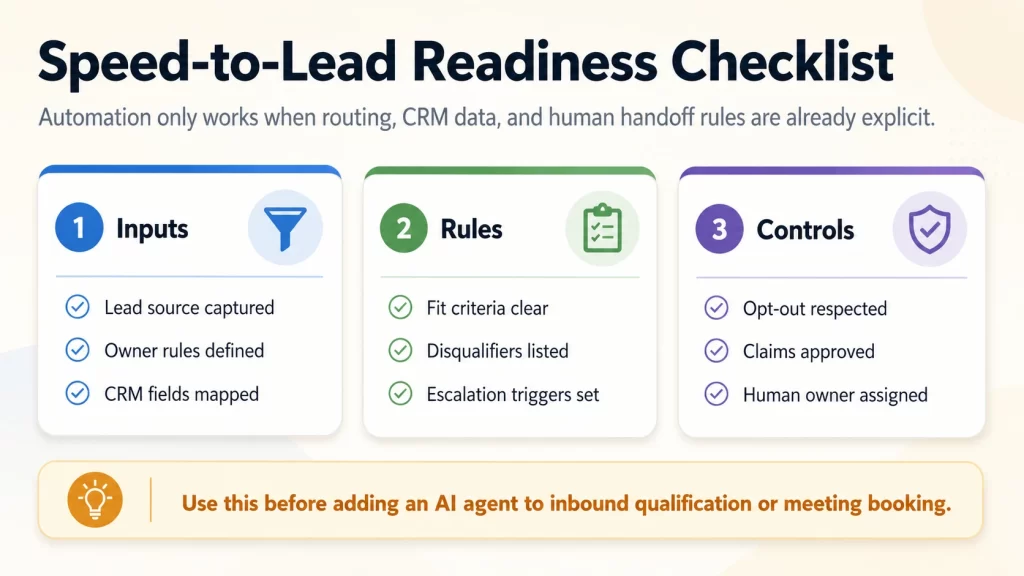
Use this checklist:
- Lead source is captured for every form, chat, WhatsApp message, DM, and inbound email.
- CRM creates or updates one clean lead or contact record instead of duplicates.
- Required fields are clear: company, role, channel, source, pain, urgency, fit, owner, and next step.
- Hot, warm, cold, and bad-fit criteria are documented.
- Routing logic is defined by segment, geography, account owner, product interest, or urgency.
- Calendar booking is allowed only after minimum qualification criteria are met.
- Pricing, legal, procurement, security, discount, and enterprise-account questions escalate to humans.
- Opt-out and suppression rules are respected.
- The AI is not allowed to invent discounts, integrations, results, certifications, or commitments.
- Every handoff note includes what the buyer asked, what was answered, what is missing, and what should happen next.
Google’s Gmail sender guidelines are relevant when automated follow-up uses email, because sender authentication, spam-rate control, message quality, and unsubscribe handling affect deliverability. For commercial email in the United States, the FTC CAN-SPAM guide also requires accurate sender information, non-deceptive subject lines, a way to opt out, prompt opt-out handling, and accountability for vendors acting on your behalf.
This is not legal advice. The operational point is that speed cannot come at the cost of routing accuracy, buyer trust, or compliance controls.
How to Measure Speed-to-Lead Automation
Do not measure speed-to-lead automation only by average response time. That metric is necessary, but it can hide weak qualification.
Track the full inbound path:
| Metric | What it tells you | Bad version |
|---|---|---|
| First response time | How quickly the buyer receives a useful first touch | Fast autoresponder with no qualification |
| Qualified response time | How quickly the system collects enough context to route or book | AI asks generic questions and creates friction |
| Hot lead routing time | How quickly qualified demand reaches the right human owner | Lead goes to the wrong rep or shared inbox |
| Handoff completeness | Whether sales receives source, pain, intent, questions, and next action | Seller repeats discovery from zero |
| Meeting booking rate | Whether qualified buyers actually reach the calendar | Calendar link is sent to bad-fit or unqualified leads |
| Disqualification quality | Whether bad-fit leads are exited cleanly | Sales wastes time on low-fit conversations |
| CRM field accuracy | Whether automation improves pipeline visibility | Records are fast but messy |
The best speed-to-lead system makes the sales team calmer. Reps know which leads matter, why they matter, what happened before handoff, and what they should do next.
A Practical Workflow: From Form Fill to Human Handoff
Here is a simple version of the workflow:
- A buyer submits a demo form, starts chat, sends a WhatsApp message, or replies through another inbound channel.
- The system creates or updates the CRM record and captures source, campaign, page, channel, and timestamp.
- Alim acknowledges the request and asks the minimum useful qualification questions.
- The lead is scored by fit, urgency, company type, role, problem, and source.
- Bad-fit leads are politely exited or routed to nurture.
- Warm leads receive follow-up or are routed to the right sequence.
- Hot leads are booked or sent to the right human owner with context.
- The CRM record is updated with the conversation summary, qualification fields, and next action.
- The human closer handles discovery, pricing, procurement, legal/security, negotiation, and closing.
- The team reviews incomplete or low-quality handoffs and updates the rules.
This workflow is intentionally boring. That is the point. Inbound revenue is usually lost in boring operational gaps, not in dramatic strategy failures.
When Speed-to-Lead Automation Is Not the Right First Fix
Do not start with automation if the sales process is not ready for it.
Fix these first:
- no clear ICP;
- no defined owner for inbound leads;
- no routing rules;
- no CRM field discipline;
- no agreement on what makes a lead qualified;
- no human capacity to take hot conversations;
- no approved answers for common product, pricing, or security questions;
- no opt-out or suppression process for follow-up.
AI can make a clear process faster. It can also make a broken process fail faster. If your team cannot define who should get a lead and why, the first project is not automation. It is routing design.
Conclusion: Speed Is Only Useful When the Handoff Is Clean
Speed-to-lead automation should help a buyer feel handled, not rushed. The job is to protect intent, qualify the conversation, and send human sellers better opportunities with better context.
For inbound workflows, Alim is the right GrowthEffect path. Alim responds to inbound leads, qualifies intent, routes or books qualified buyers, and syncs context to CRM. Humans still own discovery, pricing, procurement, legal/security, negotiation, and closing.
If this is a real bottleneck in your funnel, book a GrowthEffect demo and bring your current lead sources, routing rules, CRM fields, and average response time. Those four inputs usually reveal whether the leak is speed, qualification, routing, or handoff.
Recommended lead magnet: Inbound Lead Response Scorecard. The follow-up path should ask the reader to score current response time, qualification quality, owner assignment, CRM completeness, and hot-lead handoff quality before the demo.
FAQ
What is speed-to-lead automation?
Speed-to-lead automation is a system that responds to inbound leads quickly, qualifies their intent, routes them to the right owner, books meetings when appropriate, and updates CRM with clean handoff context.
Is speed-to-lead only about replying faster?
No. A fast reply is only the first step. The better metric is how quickly the team can produce a qualified response and hand the buyer to the right human with useful context.
Can AI handle inbound lead qualification?
Yes, if the qualification rules, disqualification criteria, routing logic, CRM fields, escalation triggers, and approved claims are clear. AI should not handle pricing, legal, procurement, negotiation, or closing on its own.
How is Alim different from Vera in this workflow?
Alim handles inbound response, qualification, routing, booking, and CRM handoff. Vera handles outbound sourcing, enrichment, research, personalized outreach, follow-up, and outbound pipeline creation.
What should a sales team measure after launching speed-to-lead automation?
Measure first response time, qualified response time, hot lead routing time, handoff completeness, booking quality, disqualification quality, and CRM field accuracy. Average response time alone is not enough.
Source List
- MIT / InsideSales.com, Lead Response Management Study
- Salesforce, State of Sales Report for 2026 announcement
- Google, Email sender guidelines
- Federal Trade Commission, CAN-SPAM Act compliance guide
- GrowthEffect, Alim inbound AI sales representative
- GrowthEffect, Inbound AI sales agents article
Leave a Reply