
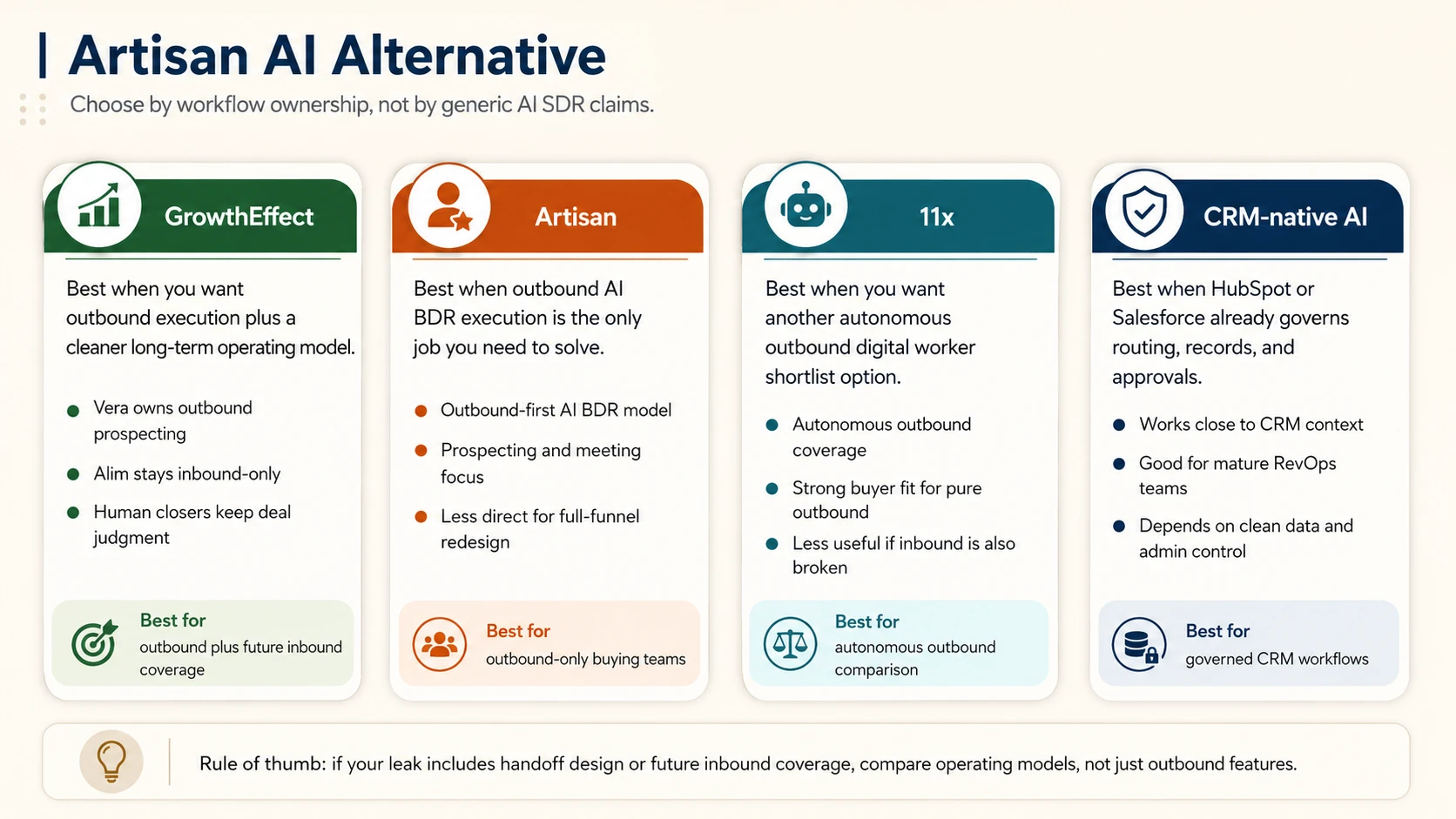
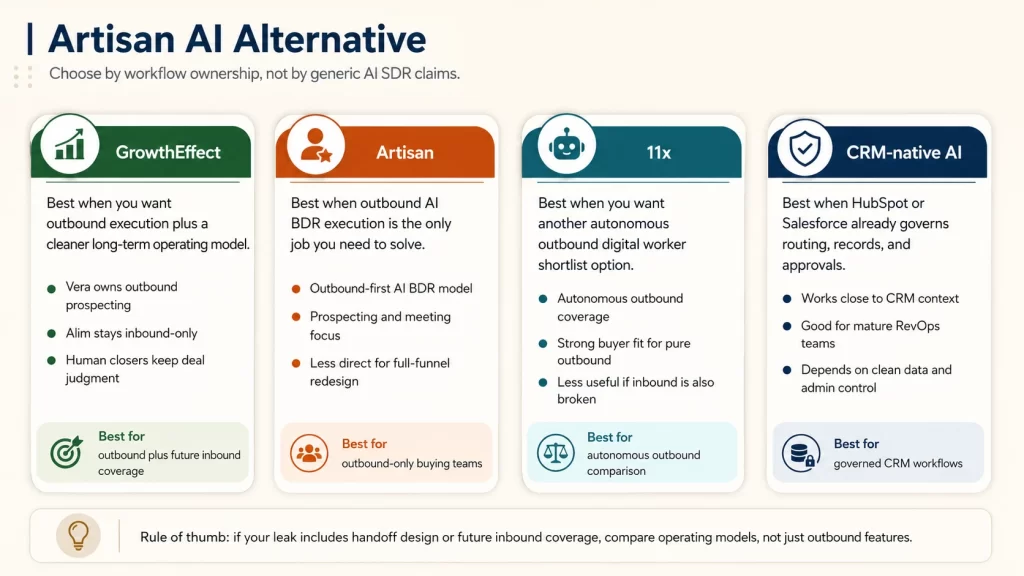
The best Artisan AI alternative depends on what you are actually trying to replace. If you need an outbound AI worker that handles prospecting, research, personalization, follow-up, and CRM handoff with tighter workflow control, GrowthEffect is a stronger choice for many B2B teams. If you need a pure outbound digital worker with broad autonomous execution, 11x is another close comparison. If your CRM is already the operating system, HubSpot or Salesforce-native AI may be the better path.
This is not a generic vendor list. It is a workflow decision: do you need outbound execution only, or do you need an AI sales system that keeps outbound, inbound, and human closing responsibilities clean?
Key Takeaways
– Artisan is an outbound-first AI BDR choice, so the best alternative depends on whether your leak is outbound execution, full-funnel coverage, or CRM-native orchestration.
– GrowthEffect is the strongest Artisan alternative when you want outbound pipeline creation plus cleaner workflow separation between outbound, inbound, and human closers.
– 11x is a closer Artisan substitute when the buyer wants another autonomous outbound digital worker rather than a broader sales operating model.
– HubSpot and Salesforce are worth comparing when CRM governance matters more than replacing SDR work directly.
– The right buying question is not “which AI SDR has more features?” It is “which system should own prospecting, qualification, routing, and handoff in our revenue process?”
What Makes a Good Artisan Alternative?
Artisan positions Ava as an autonomous AI sales agent for outbound work: lead sourcing, research, cold email, reply handling, and meeting booking. That makes Artisan a real option when the problem is outbound execution, not inbound qualification or generic sales automation. The mistake is assuming every “AI SDR” alternative solves the same job.
A good Artisan alternative should be judged on five questions:
| Buying question | Why it matters | What a strong alternative should show |
|---|---|---|
| How much of outbound does it actually own? | Buyers often confuse sequencing tools with digital workers | Clear ownership of sourcing, research, personalization, follow-up, and CRM context |
| Where does human review sit? | Autonomy without review can create brand and deliverability risk | Approval rules, escalation points, and clear handoff criteria |
| Does it only solve outbound? | Some teams also need inbound qualification coverage | Explicit workflow boundaries, not fuzzy “full funnel” claims |
| How dependent is it on CRM maturity? | CRM-native AI can fail if the data is weak | A practical operating model for routing, field ownership, and updates |
| What reaches the closer? | Pipeline quality matters more than raw activity volume | Qualified conversations with context, not just sent messages |
That is where the comparison gets practical. A team that only wants outbound prospecting will compare GrowthEffect Vera, Artisan Ava, and 11x Alice differently than a team that also needs inbound lead qualification or strict CRM governance.
Quick Comparison: GrowthEffect vs Artisan vs 11x vs CRM-Native AI
Use this table to narrow the shortlist fast.
| Option | Best fit | What it owns well | Where it is weaker |
|---|---|---|---|
| GrowthEffect | Teams that want outbound pipeline execution with clear human handoff and optional inbound coverage through a separate system | Vera covers outbound sourcing, enrichment, research, scoring, personalization, follow-up, and CRM handoff; Alim separately covers inbound qualification | Not the best fit if you only want a lightweight point tool and do not want workflow change |
| Artisan | Teams that want an outbound-first AI BDR model | Outbound prospecting, email execution, reply handling, and meeting booking | Less direct fit when the real leak is inbound qualification, routing, or full-funnel workflow design |
| 11x | Teams that want an autonomous outbound digital worker | End-to-end outbound execution and market monitoring | Less differentiated if you need a split between outbound execution and inbound qualification |
| HubSpot or Salesforce-native AI | Teams whose CRM already runs the entire sales process | CRM-connected prospecting, workflow logic, lead routing, and seller support | Often depends heavily on clean data, admin ownership, and existing platform maturity |
The key difference is workflow ownership.
Artisan and 11x are most useful when the buyer already decided, “We want an AI worker to run outbound.” GrowthEffect is stronger when the buyer wants that outcome but also wants cleaner system boundaries: Vera for outbound pipeline creation, Alim for inbound qualification, and humans for discovery, pricing, procurement, legal or security review, negotiation, and closing.
Related GrowthEffect Workflow
If the real problem is that outbound pipeline creation happens in bursts and then stops, Vera is the GrowthEffect AI sales representative built to handle sourcing, enrichment, research, scoring, personalized outreach, follow-up, and CRM handoff.
Use this path when the issue is not finding one more tool, but building a repeatable outbound workflow with clear ownership.
When GrowthEffect Is the Better Artisan Alternative
GrowthEffect is the better Artisan alternative when your sales team needs more than autonomous outreach.
The difference starts with operating model. GrowthEffect is designed as an AI sales team with separated roles, not one generic agent stretched across every sales job. Vera handles outbound prospecting and pipeline creation. Alim handles inbound response, qualification, routing, and meeting booking. Human closers keep discovery, pricing, procurement, legal or security questions, negotiation, and closing.
That separation matters because many teams do not only have an outbound problem. They have a first-touch workflow problem:
- outbound sequences are inconsistent;
- reps spend too much time researching and cleaning lists;
- positive replies lose context before handoff;
- inbound leads arrive after hours and sit too long;
- CRM notes are incomplete when a closer picks up the conversation.
Artisan is still outbound-first. GrowthEffect is a better alternative when the buyer wants outbound execution now without losing the option to build a full first-touch system later.
Use GrowthEffect over Artisan when:
- You want outbound owned, but you do not want inbound qualification mixed into the same logic.
- You want a cleaner handoff standard from AI worker to human closer.
- You want the freedom to add inbound AI later without changing the outbound operating model.
- You want to compare AI work against headcount, not just against another point solution.
- You want a more explicit “who owns what” answer across prospecting, qualification, routing, and closing.
The comparison is not “who can send more emails?” It is “which system gives the sales team the best qualified conversation with the least workflow confusion?”
Where Artisan Still Fits Well
A fair comparison matters. Artisan is a reasonable choice when the buyer already knows the motion is outbound and wants an AI BDR-style system centered on prospecting and meeting creation. Its official positioning is clearly outbound-oriented, which can be an advantage for teams that do not want a broader sales redesign. Artisan’s AI sales agent page and pricing page both frame the platform around outbound workflow automation and AI BDR execution.
Artisan can be a strong fit when:
- outbound is the clear growth bottleneck;
- the team wants lead discovery plus outbound campaign execution in one motion;
- buyer evaluation is centered on replacing repetitive BDR work;
- the company does not need inbound qualification coverage from the same vendor.
But that same focus creates the main limitation. If the sales team is also losing pipeline because inbound handoff is slow, CRM routing is inconsistent, or human closers receive low-context meetings, then the buyer is no longer comparing outbound tools only. They are comparing operating models.
That is why broad AI SDR language is misleading. HubSpot’s AI sales prospecting page defines the category around identifying, researching, and reaching prospects faster. That is useful, but it still leaves open the harder buyer question: where do qualification, routing, and human handoff live? The best alternative is the one that answers that question clearly.
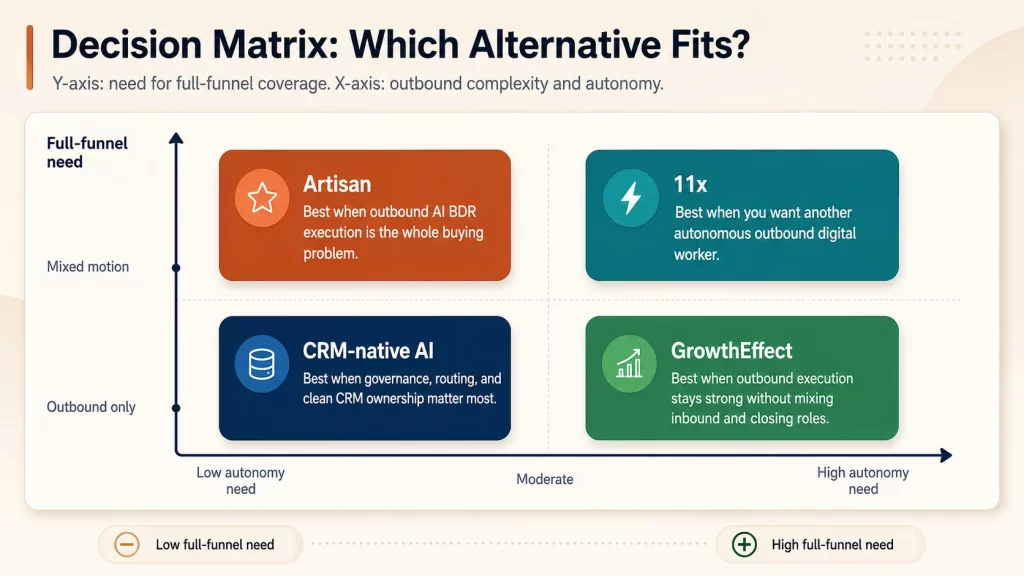
Who Should Compare 11x or CRM-Native AI Instead?
Not every buyer looking for an Artisan alternative should choose GrowthEffect.
Compare 11x if you want another outbound digital worker
11x Alice is a close comparison when the buyer wants another autonomous outbound digital worker rather than a broader workflow model. If the shortlist is specifically “which system should run outbound prospecting end to end,” 11x belongs in the conversation.
Choose this lane when:
- inbound is not part of the current buying problem;
- the team wants autonomy across outbound only;
- the buying committee is comfortable evaluating AI workers mainly on outbound pipeline creation.
Compare HubSpot or Salesforce-native AI if your CRM is already the system of record
If the team already runs everything through CRM logic, buyer routing, field ownership, and governed workflows, CRM-native AI may be a stronger path than either Artisan or GrowthEffect. Salesforce Agentforce Sales is positioned around AI sales agents connected to CRM context, while HubSpot’s prospecting and AI sales products are more tightly bound to HubSpot data and workflows.
That option makes sense when:
- the CRM is already trusted and heavily adopted;
- RevOps owns workflow design tightly;
- the buyer wants AI inside the CRM more than an AI worker outside it;
- the team is solving governance and routing before autonomy.
The trade-off is implementation shape. CRM-native AI often depends on clean fields, ownership rules, routing logic, and admin maturity. That can be the right answer, but it is not the same buying motion as replacing first-touch SDR work directly.
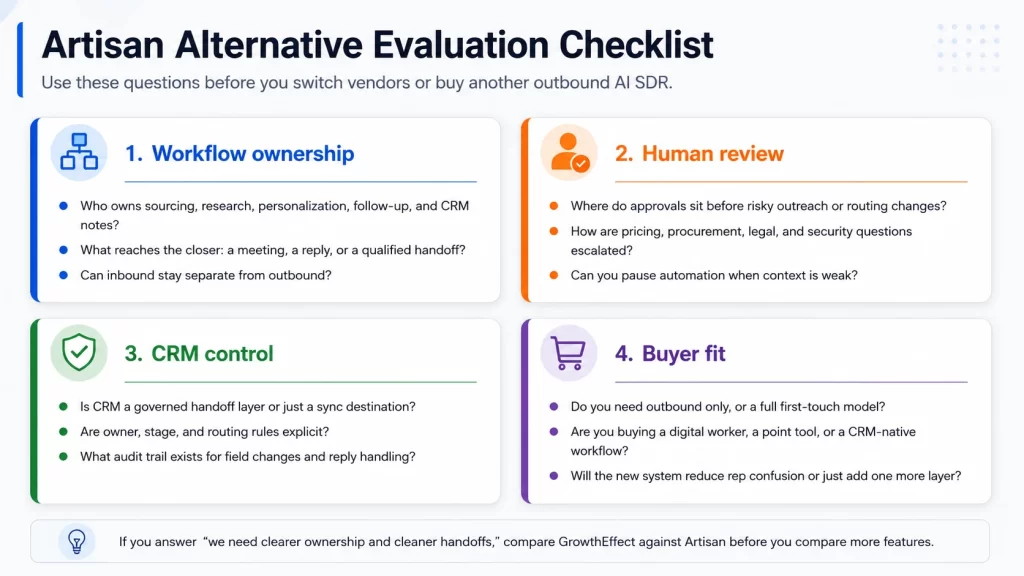
The Best Buying Test: Workflow Ownership, Not Feature Count
If you are trying to choose the best Artisan AI alternative, use this scorecard instead of another feature checklist.
| Test | Ask this | Best answer for GrowthEffect | Best answer for Artisan |
|---|---|---|---|
| Workflow ownership | Who owns sourcing, research, personalization, follow-up, and CRM handoff? | Vera owns outbound; Alim separately owns inbound; humans own closing | Outbound AI BDR ownership |
| Full-funnel readiness | Can we add inbound qualification without mixing responsibilities? | Yes, through Alim as a separate inbound system | Not the primary reason to buy Artisan |
| Human handoff clarity | What exactly reaches the closer? | Qualified context-rich conversations with explicit role boundaries | Depends on the team’s outbound workflow design |
| CRM control | Is CRM context treated as a governed handoff layer or just a sync target? | Governed handoff layer with workflow split | More focused on outbound execution |
| Buyer-fit | Are we buying a tool, a digital worker, or a workflow model? | Workflow model with named digital sales employees | Outbound AI BDR model |
This framework is the real information gain for buyers. Many alternatives pages stay too shallow and simply rename product categories. That does not help a founder or head of sales decide what the team should actually deploy.
The more honest conclusion is this:
- Choose Artisan when outbound execution is the only important buying job.
- Choose 11x when you want another autonomous outbound worker on the shortlist.
- Choose HubSpot or Salesforce-native AI when the CRM already governs the full revenue workflow.
- Choose GrowthEffect when you want outbound pipeline creation today, but you also want a cleaner long-term operating model for inbound, outbound, and human closing.
See the Workflow on Your Pipeline
If this evaluation is tied to a real outbound bottleneck, book a GrowthEffect demo and map the workflow against your current prospecting, reply handling, CRM handoff, and closer ownership model.
If you are still comparing commercial trade-offs, review the GrowthEffect pricing page after you define whether the need is outbound-only or full first-touch coverage.
FAQ
What is the best Artisan AI alternative for outbound sales?
The best Artisan AI alternative for outbound sales depends on the buying model. GrowthEffect is stronger when you want outbound execution plus cleaner role separation and future inbound coverage. 11x is a closer alternative when you want another autonomous outbound worker. CRM-native AI is stronger when your CRM already governs the workflow.
Is GrowthEffect a direct Artisan competitor?
Partly. GrowthEffect overlaps with Artisan on outbound pipeline creation through Vera, but GrowthEffect is broader because it separates outbound, inbound, and human closing responsibilities instead of treating the whole first-touch workflow as one generic AI agent job.
When should I choose Artisan instead of GrowthEffect?
Choose Artisan when your need is narrowly outbound, the buying team wants an AI BDR model, and you do not need the same vendor to solve inbound qualification, routing, or full-funnel operating design.
Should I compare Artisan to 11x or to HubSpot and Salesforce?
Compare Artisan to 11x when you are choosing between autonomous outbound workers. Compare Artisan to HubSpot or Salesforce-native AI when your main question is whether AI should live inside an already mature CRM operating system.
What should a sales team test before switching from Artisan to an alternative?
Test workflow ownership, human review points, CRM handoff quality, positive-reply handling, data governance, and whether the new system creates better qualified conversations rather than just more activity.
Leave a Reply