Can you replace an SDR with AI? You can delegate parts of the workload, but deciding whether to replace a role requires evidence from your own sales process. Start with a specific bottleneck, measure the work that remains for people, and keep a named person accountable for the buyer relationship.
This guide is for B2B sales leaders deciding whether to hire, redistribute work, or introduce an AI sales agent. The framework below is a recommended evaluation method, not a claim that a particular company has eliminated SDR roles or achieved a revenue result.
Separate the capacity question from the headcount question
“We need more pipeline” can describe several different problems. Your team might lack suitable accounts, spend too long researching them, struggle to explain the offer, or fail to follow up on interested replies. Each problem calls for a different intervention.
Before buying software or changing the team, record one representative week of work. For each activity, capture the volume, time spent, recurring errors, dependencies, and person responsible. Include time spent checking AI output if an agent is already in use.
The result should identify a bounded job: for example, “prepare source-backed account briefs for approved targets.” That is specific enough to evaluate. “Replace sales development” leaves too many decisions and exceptions undefined.
A task-ownership test for your SDR workflow
For each job, ask four questions:
- Is the input clear? Can a reviewer identify the correct account, source material, and instructions?
- Can you recognize an acceptable result? Define what must be accurate and what evidence must accompany it.
- What happens if it is wrong? Distinguish a draft you can discard from an external message or record change.
- Who handles uncertainty? Specify an owner and a point at which the agent should stop.
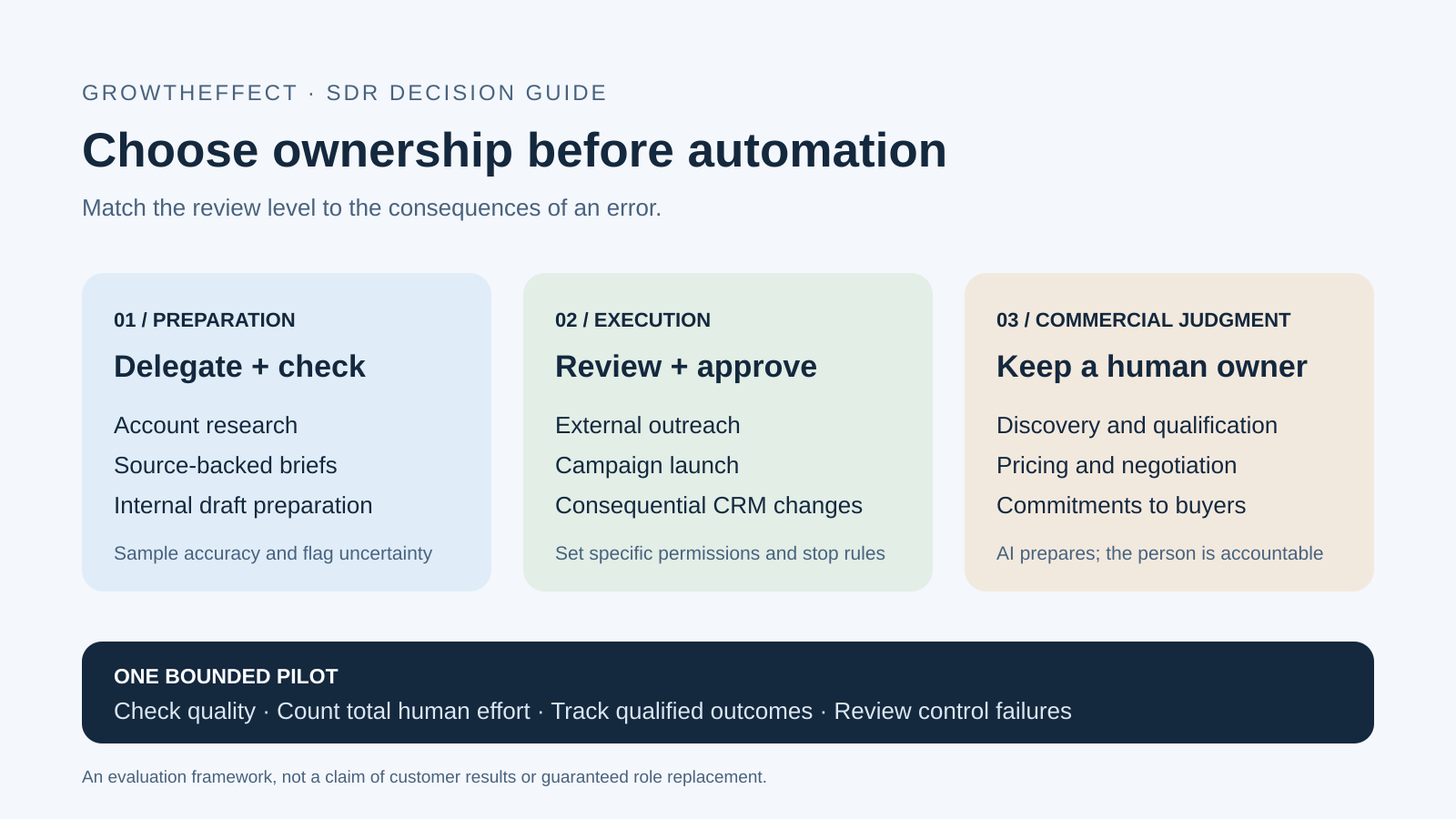
A clear input alone does not justify autonomous execution. Use the consequences of an error to choose the review level.
Delegate preparation with sampled quality checks
Account research and briefing are useful candidates when the output stays internal. Require links to the underlying sources, separate facts from inferences, and flag missing or conflicting information. Review a sample before expanding the workload.
For example, an account brief can record a company’s published product, target customer, and relevant announcement. “Likely to buy this quarter” is a hypothesis, not a fact that follows from those observations.
Require approval before consequential execution
A relevant draft can still contain a wrong recipient, an unsupported promise, or an inappropriate reference. Review recipient identity, fit, wording, and allowed next steps before a pilot sends anything externally.
Apply separate controls to CRM changes. Adding research notes is different from changing an opportunity stage, assigning an owner, or starting a campaign. Specify the permitted fields and actions instead of granting a general instruction to “keep the CRM updated.”
Keep commercial decisions with a person
Assign a human owner to discovery, qualification judgments, pricing exceptions, negotiation, and commitments about implementation or security. AI can prepare context and suggest questions. The person owns what the business promises and whether an opportunity deserves further investment.
If no one can promptly handle an interested reply, fixing that gap matters more than generating additional outreach.
When to hire, assist, or automate
- Consider additional human capacity when qualified conversations are waiting, existing staff cannot cover discovery, or your market requires substantial relationship building.
- Use AI assistance when experienced sellers spend significant time preparing research, organizing context, or drafting routine follow-ups but must still judge each case.
- Test bounded automation when the task has stable rules, reliable inputs, a reviewable outcome, and an effective way to pause or escalate exceptions.
- Fix the process first when the team disagrees about its ICP, offer, qualification criteria, or ownership of replies.
These choices can coexist. A team may automate research preparation while investing in a seller who can convert qualified interest into a real opportunity.
Run a pilot that can change your decision
1. Define a narrow comparison
Choose one segment, one offer, and one workflow. Document inclusion and exclusion criteria before selecting accounts. Avoid comparing easy accounts assigned to AI with difficult accounts assigned to people.
Where practical, compare similarly selected accounts over the same period. Record differences in sender, account quality, seasonality, and follow-up time. A small pilot gives directional evidence, not proof of causation.
2. Set acceptance rules before looking at results
Write down what a reviewer must check: correct company and person, supported claims, relevant offer, no duplicate contact, and a clear escalation route. Define what will trigger a pause, such as repeated identity errors or a failure to respect suppression instructions.
Agree separately on the commercial threshold needed to continue. Use your existing baseline and economics rather than an arbitrary industry benchmark.
3. Count the remaining human work
Track setup, review, corrections, exception handling, and management time. Record rejected drafts as well as approved ones. If research becomes faster but checking every brief takes longer, the bottleneck has moved rather than disappeared.
4. Allow enough time for the outcome you measure
You can assess research accuracy before you can assess qualified pipeline. Decide when the first quality review happens and when the sales-cycle review becomes meaningful. Do not label an unanswered message a failure before the normal follow-up window has elapsed, or a booked meeting a qualified opportunity before discovery.
5. Decide what to change
At the review, choose a specific action: continue unchanged, narrow the segment, revise the instructions, retain human approval, expand a proven task, or stop. Delay headcount conclusions until you understand the workload that remains, including exceptions and coverage when the system is unavailable.
A fictional example: research capacity at a B2B services firm
Illustrative scenario only. The company, quantities, and schedule below are invented to explain the method; they are not GrowthEffect customer results.
A consulting firm has one sales lead and two account executives. Its proposed pilot covers 40 target companies in one market. The team asks an agent to prepare account briefs and first-message drafts. No outreach is authorized automatically.
The sales lead defines the fit criteria and approved offer. A reviewer checks each brief against its sources, approves or rejects the draft, and records correction time. The account executives own interested replies and qualification.
The first review happens after the briefs are prepared. The team asks whether the research is usable and whether total preparation plus review time is lower than its recorded manual baseline. A later review examines conversations and opportunities after the normal response window.
No result is assumed. If briefs are accurate but the offer fails to resonate, the next step is to reconsider the offer. If the drafts repeatedly invent account details, the team pauses that task. If the work passes its checks, the team can test a larger batch without concluding that a sales role is no longer needed.
Measure qualified progress, not just activity
Keep four groups of measures separate:
- Workload: total preparation, review, correction, and administration time per accepted output.
- Quality: source accuracy, ICP fit, rejection reasons, and the share of outputs that need substantive correction.
- Commercial outcomes: relevant replies, held meetings, and opportunities accepted against your documented qualification criteria.
- Control failures: unauthorized actions, duplicate contacts, missed suppression requests, and exceptions without an owner.
Show counts alongside rates. Two positive replies from ten contacts and twenty from one hundred share the same rate but support different levels of confidence. Keep account-level and contact-level denominators distinct.
For cost, add subscription and usage charges, data or connected-tool costs, and staff time. Divide by accepted outputs or qualified opportunities only when that denominator is meaningful. If there are no qualified opportunities yet, report cost and activity separately instead of presenting a fictional cost per opportunity.
Where Vera fits in this decision
Vera is GrowthEffect’s AI sales agent. Its scope includes customer research, outreach, signals, pipeline-related work, and recurring processes across connected tools. Company Brain provides business context; access and action rules determine what it can do.
For an SDR-focused pilot, the Vera outbound workflow covers account qualification, decision-maker research, personalized email and LinkedIn outreach, and follow-up. Research can run while outreach waits for review. Confirm the connections, plan availability, and exact approval boundaries for your workspace before enabling execution.
The public pricing page lists Vera Solo at $99 per user per month and Vera Team at $149 per user per month, with Team starting at three users. These are listed subscription prices checked on October 21, 2026, not an all-in pilot cost or a forecast of savings. Check the current plan and usage terms before purchasing.
Review the security and data information as part of procurement. Permissions and approval controls do not, by themselves, establish compliance with your organization’s requirements. Confirm processing, retention, and contractual needs for the intended deployment.
Questions to answer before replacing SDR capacity
Can AI handle the whole SDR role?
Do not assume that because one task works, the entire role can be delegated. Evaluate prospecting, preparation, execution, reply handling, and qualification separately. Make human ownership explicit wherever commercial judgment or a commitment is involved.
Should a small team hire an SDR or buy AI software?
Identify the constraint first. Software may help a team with repeatable preparation work. A team with more qualified buyer conversations than it can handle may need additional people. Compare total operating cost and the skills required, not a salary against a subscription alone.
What is a sensible first pilot?
Start with source-backed account briefs and draft outreach for a tightly defined segment, with external sending held for approval. This lets you assess output quality and review effort before increasing the consequences of mistakes.
Bring one bottleneck to the conversation
Choose a real task, describe what an acceptable result looks like, and identify who will review it. Book a Vera demo around that workflow to discuss what the agent could take on and what your team should retain. Example or anonymized data is enough for the initial discussion.
Leave a Reply