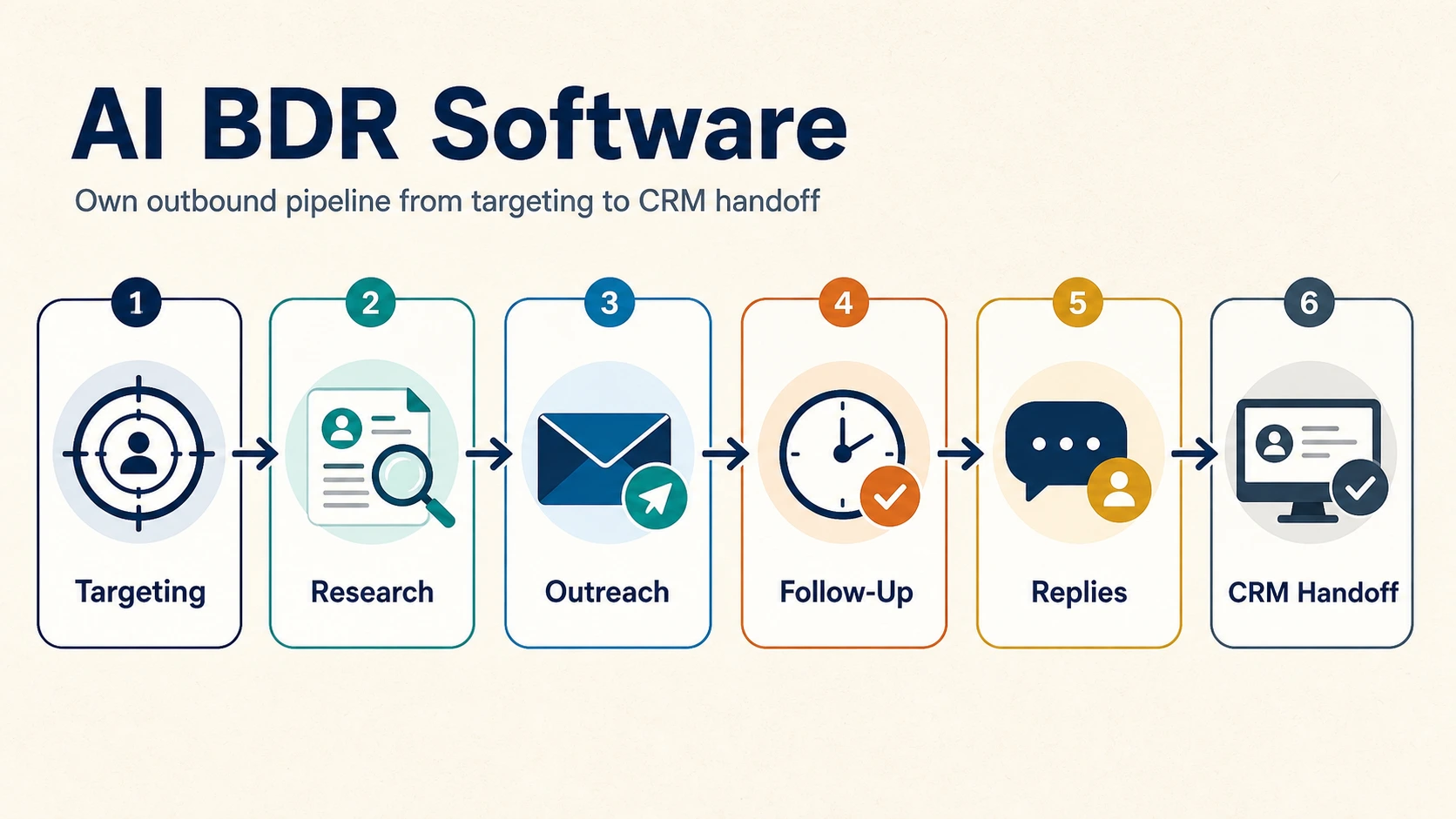
AI BDR software is best when it owns repeatable outbound work: targeting, research, personalized outreach, follow-up, reply handling, and CRM handoff. If it only helps a rep write drafts or manage a cadence, it is useful software, but it is not really owning the BDR job.
The better buying question is not “which tool has the most AI?” It is “which platform can own enough outbound work to create pipeline without breaking handoff, governance, or deliverability?”
Key Takeaways
– The best AI BDR software owns outbound workflow execution, not only message drafting.
– AI BDR software is different from inbound AI SDRs, sequencing tools, and CRM-only workflow automation.
– The safest way to evaluate the category is with five ownership tests: targeting, research, execution, handoff, and governance.
– GrowthEffect Vera is the cleanest fit when the leak is outbound pipeline creation, while Alim should stay reserved for inbound qualification and routing.
– Buyers should compare human-review controls, CRM context, deliverability rules, and handoff quality before they compare vendor feature counts.
What AI BDR Software Actually Means
AI BDR software should behave like an outbound digital worker. It should decide who to contact, why now, what angle is safe, how to follow up, and when to hand a conversation to a human seller.
Salesforce describes AI sales agents as autonomous applications that can handle top-of-funnel work like lead nurturing, outreach, and meeting booking. That is useful category context, but it still leaves one important question open: does the product own outbound pipeline creation, or does it just support a rep who still owns the workflow?
That difference is where buyers usually get stuck.
An AI BDR should own outbound jobs like:
- account and contact targeting
- enrichment and research
- personalized message creation
- follow-up sequencing
- reply classification
- CRM updates and handoff notes
It should not own:
- pricing negotiation
- procurement or legal review
- deep discovery
- closing
Humans still own those.
AI BDR Software Is Not The Same As Inbound AI SDR Or Sales Automation
Buyers use these labels loosely, but the workflow boundaries matter.
| Category | Primary job | Good fit | What it should not be confused with |
|---|---|---|---|
| AI BDR software | Outbound sourcing, research, personalization, follow-up, and pipeline creation | Teams that need more outbound conversations without adding more junior BDR workload | Inbound qualification or CRM-only automation |
| Inbound AI SDR | Lead response, qualification, routing, meeting booking, CRM sync | Teams losing demand because inbound leads wait too long or get poorly qualified | Outbound pipeline creation |
| Sequencing tool | Rep-led cadence consistency | Teams that already have humans doing the work but need structure | Workflow ownership |
| CRM workflow automation | Routing, field updates, triggers, and process control | Teams with messy RevOps or lifecycle rules | Human-like outbound execution |
This separation is important for GrowthEffect too.
- Vera is the outbound AI sales representative for sourcing, enrichment, research, scoring, personalized outreach, follow-up, and CRM handoff.
- Alim is the inbound AI sales representative for response, qualification, routing, meeting booking, and CRM sync.
If the real leak is inbound qualification, an AI BDR page is the wrong answer. If the real leak is outbound pipeline creation, an inbound AI SDR page is the wrong answer.
Use The Five Outbound Ownership Tests Before You Buy
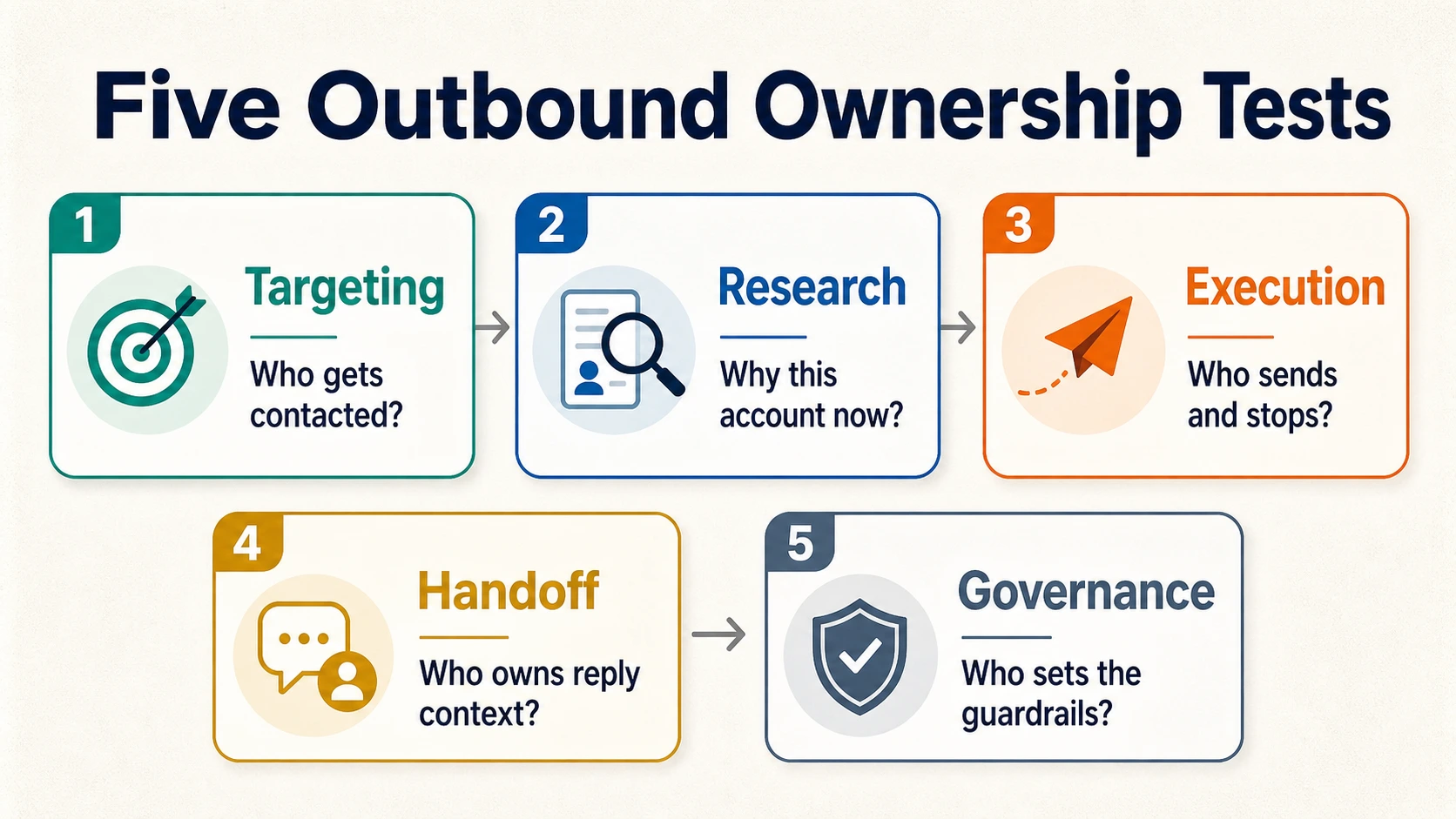
Most teams compare AI BDR software with a feature checklist. That is too shallow. Use five ownership tests instead.
1. Targeting ownership
Who decides which accounts and contacts get touched, and who gets suppressed?
A useful AI BDR should not contact everyone in a database. It should apply ICP logic, exclusions, CRM status, and channel rules before outreach starts.
2. Research ownership
Who turns company context into a safe message angle?
The best AI BDR software should use account context, signal data, and CRM history to create a reason for outreach. It should not fake familiarity or invent urgency.
3. Execution ownership
Who actually sends, follows up, and stops?
If a human still has to manually push every message, the system is closer to rep-assist software than a true AI BDR.
4. Handoff ownership
Who classifies replies and passes clean context to the human seller?
This is the point where many tools fail. Activity is not enough. The handoff needs buyer intent, account context, prior touches, and the correct next action.
5. Governance ownership
Who defines review rules, deliverability guardrails, escalation points, and approval boundaries?
Google’s sender guidelines and the FTC’s CAN-SPAM guide make this practical, not theoretical. Outbound AI only works at scale when authentication, unsubscribe behavior, suppression logic, and commercial-email rules are treated as part of the workflow.
Which AI BDR Software To Compare First
Not every platform in this market owns the same job.
Use this buyer map:
| Platform type | Best when the team needs… | Workflow shape |
|---|---|---|
| GrowthEffect Vera | an outbound digital worker that owns first-touch pipeline creation | outbound worker with explicit human handoff |
| 11x Alice | a broader autonomous outbound SDR model | outbound-first digital worker |
| Artisan Ava | a more all-in-one AI BDR model with outbound execution in one system | outbound-first AI BDR |
| AiSDR | AI SDR workflow support around prospecting, outreach, and reply handling | AI SDR / AI BDR hybrid |
| HubSpot Prospecting Agent | prospecting inside a HubSpot-centered workflow | CRM-native prospecting layer |
| Salesforce Agentforce Sales | AI sales work grounded in Salesforce CRM data | CRM-native AI sales layer |
The important thing is not whether these products all use the word AI. The important thing is whether you want:
- outbound workflow ownership;
- CRM-native orchestration;
- rep support inside an existing platform; or
- a split model where inbound and outbound stay separate.
HubSpot says its prospecting agent can monitor buying signals, source contacts, and draft personalized outreach. That is useful for CRM-centered prospecting. It is not the same buying decision as a platform whose main promise is autonomous outbound pipeline creation.
GrowthEffect Vera: Best When The Real Leak Is Outbound Pipeline Creation
GrowthEffect is strongest here when the team already knows outbound matters, but execution is inconsistent.
Vera should be evaluated when the team needs:
- sourcing tied to a clear ICP
- enrichment and scoring before outreach
- account research before personalization
- message creation that reflects the buyer and offer
- follow-up discipline
- reply classification
- CRM handoff with context
This is different from buying more list data or another cadence layer. It is a decision to assign first-touch outbound work to a digital worker.
Related GrowthEffect Workflow
If outbound pipeline is the bottleneck, see how Vera builds outbound pipeline. If the buying question is really about whether AI is cheaper than adding another rep, compare the workflow against the GrowthEffect pricing page.
If you are still not sure whether the leak is outbound execution, inbound response, or CRM handoff, use the GrowthEffect revenue leak scan before you buy another platform.
When AI BDR Software Beats Hiring Another BDR
AI BDR software usually wins when the process is defined, but human execution is too expensive, too inconsistent, or too bursty.
That often looks like this:
- outbound happens for two weeks and then disappears;
- reps skip research when the pipeline gets busy;
- follow-up quality drops after the first touch;
- managers cannot tell which positive replies need immediate attention;
- CRM handoff notes are too thin for the closer to act confidently.
In those conditions, an AI BDR can create leverage because it keeps the workflow moving.
It is the wrong first purchase when:
- ICP is still vague.
- CRM stages and field ownership are still broken.
- Deliverability basics are weak.
- Nobody agrees on the human handoff point.
- Leadership wants AI to compensate for an undefined outbound strategy.
The workflow has to exist before the worker can own it.
The Buying Checklist For AI BDR Software
Before you shortlist vendors, answer these questions:
| Question | Why it matters |
|---|---|
| Do we need outbound ownership or just better cadence execution? | This separates workers from sequence tools. |
| Can the system suppress bad-fit or risky contacts before send? | Weak suppression breaks deliverability and brand trust. |
| Can the system research before it personalizes? | Generic AI outreach burns domains and conversations. |
| Can the system classify replies and update CRM cleanly? | Pipeline value comes from handoff, not just sending. |
| Can humans define approval and escalation rules? | Governance decides whether scale stays safe. |
| Is the problem outbound, inbound, or both? | This decides Vera, Alim, or a different stack. |
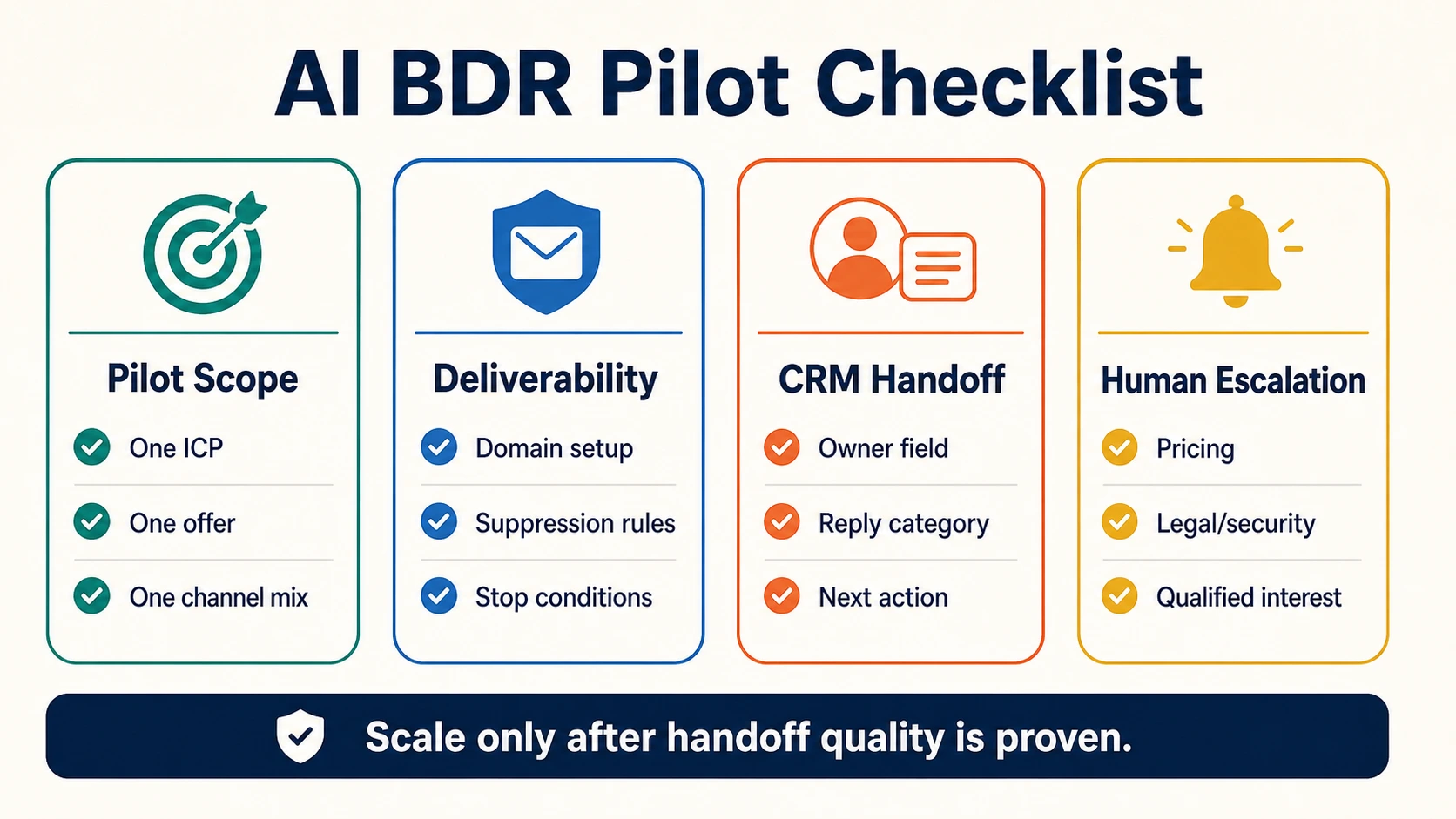
The best buying path is usually a narrow pilot:
- one ICP
- one offer
- one outbound lane
- one CRM handoff rule
- one human owner for escalation
That tells you quickly whether the software is creating qualified conversations or just more activity.
See The Workflow On Your Pipeline
If you want to compare AI BDR software against your current outbound process, book a GrowthEffect demo and map the workflow against your current targeting, handoff, and CRM rules.
If the real issue is outbound execution, start with Vera. If you discover the real leak is cost or staffing tradeoff, use the pricing page. If the leak turns out to be inbound qualification instead, route the conversation to Alim instead of forcing an outbound-first tool into the wrong job.
Lead magnet recommendation: AI SDR Readiness Checklist
Follow-up path:
- Name the exact outbound job you want owned.
- Define the minimum CRM context a closer must receive.
- Run one narrow pilot before expanding message volume or channels.
FAQ
What is AI BDR software?
AI BDR software is software that automates repeatable outbound business development work such as account targeting, prospect research, personalized outreach, follow-up, and CRM handoff.
Is AI BDR software the same as AI SDR software?
Not always. Buyers often use the terms interchangeably, but AI BDR usually points more directly to outbound pipeline creation, while AI SDR can include inbound qualification too.
When should a company buy AI BDR software?
Buy it when outbound strategy is already defined but human execution is inconsistent, expensive, or too slow to maintain.
What should humans still own in an AI BDR workflow?
Humans should still own pricing, procurement, legal or security review, negotiation, deep discovery, and closing.
What is the main implementation mistake?
The biggest mistake is buying AI BDR software before ICP, deliverability, CRM ownership, and handoff rules are clear.
Leave a Reply