
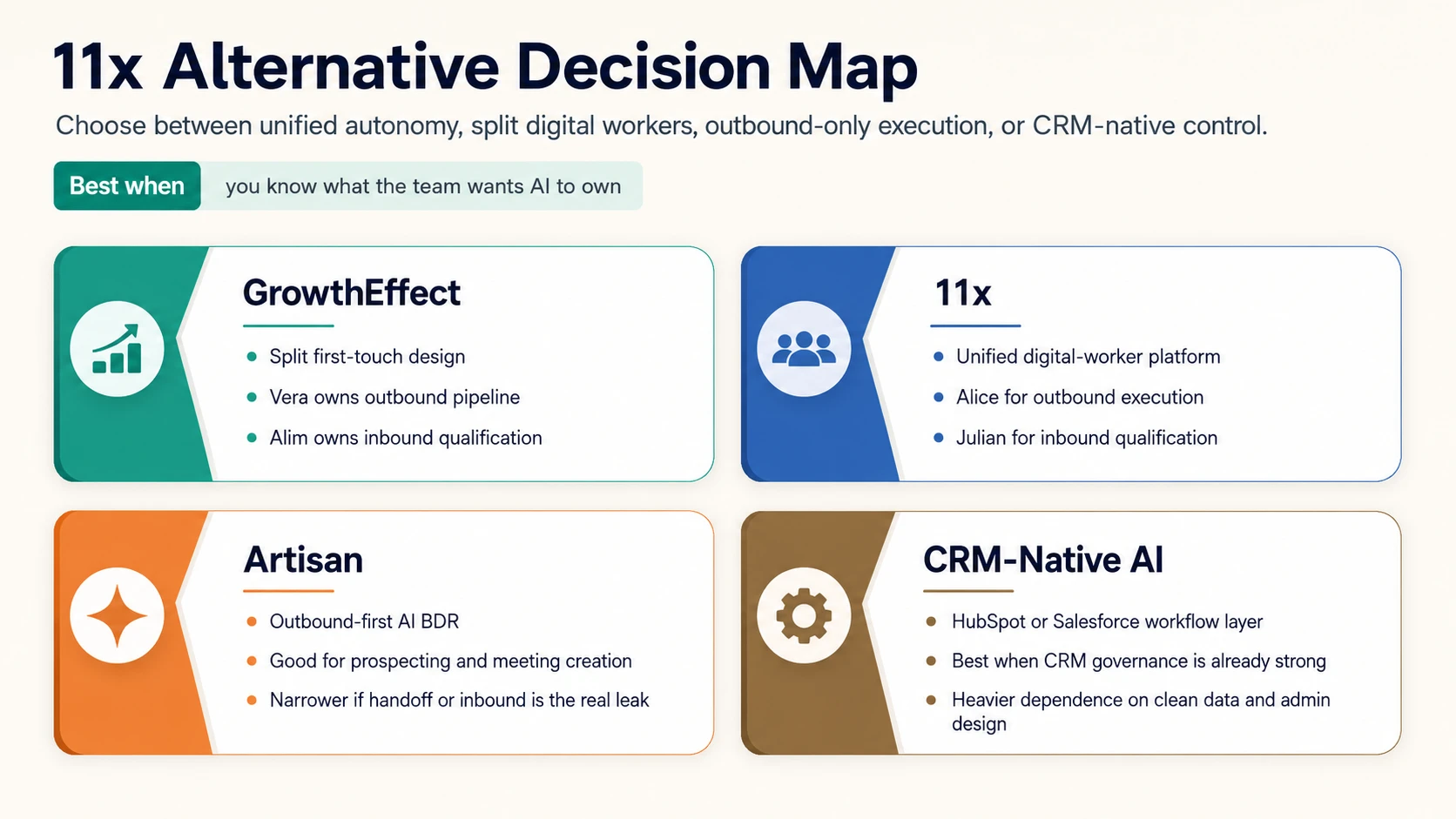
The best 11x alternative depends on what you want to own with AI. If you want outbound pipeline creation with clearer workflow boundaries, GrowthEffect is the strongest 11x alternative for many B2B teams. If you want another autonomous outbound digital worker, Artisan is the closest substitute. If your CRM already governs routing, data quality, and seller workflows, HubSpot or Salesforce-native AI may be the better path.
The real buying question is not “what else looks like 11x?” It is “do we want one AI GTM engine, or do we want a cleaner split between outbound, inbound, and human closing?”
Key Takeaways
– 11x is a real category leader for autonomous digital-worker positioning, so the best alternative depends on whether you want another unified AI worker model or a cleaner role split.
– GrowthEffect is the best 11x alternative when you want outbound pipeline execution through Vera, optional inbound coverage through Alim, and tighter workflow ownership between AI and human closers.
– Artisan is the closest alternative when the buyer wants another outbound-first AI BDR instead of a broader first-touch operating model.
– HubSpot and Salesforce are better comparisons when AI must stay tightly inside existing CRM governance.
– The most useful buying test is not feature count. It is whether your team wants unified autonomy, split digital workers, or CRM-native control.
What Makes a Good 11x Alternative?
11x Alice is positioned as an outbound digital worker that tracks buyers, researches accounts, personalizes outreach, handles follow-up, and books meetings. On the same public product surface, 11x also presents Julian as an inbound qualification layer for voice, chat, WhatsApp, and SMS. That means buyers are not only comparing tools. They are comparing operating models.
A good 11x alternative should answer five questions clearly:
| Buying question | Why it matters | What a strong alternative should show |
|---|---|---|
| Do we want one AI engine or separate role ownership? | First-touch sales work breaks when outbound, inbound, and closing responsibilities blur | Clear boundaries for outbound, inbound, CRM handoff, and human escalation |
| How much of outbound does it really own? | “AI SDR” can mean anything from copy generation to full prospecting execution | Sourcing, research, personalization, follow-up, reply handling, and CRM context |
| Where does inbound qualification live? | Many teams buy for outbound and then discover the real leak is slow inbound follow-up | Explicit answer on routing, booking, and qualification ownership |
| How dependent is it on CRM maturity? | CRM-native AI can be excellent or frustrating depending on data quality | Honest fit for governed workflows, field ownership, and admin overhead |
| What reaches the closer? | Activity volume is not the same as qualified pipeline | Context-rich handoff, not just sent-message counts |
That is the difference between a superficial alternatives page and a useful one. A founder comparing 11x with GrowthEffect, Artisan, HubSpot, and Salesforce is not only choosing software. They are choosing where AI work should live in the revenue process.
Quick Comparison: GrowthEffect vs 11x vs Artisan vs CRM-Native AI
Use this table to narrow the shortlist fast.
| Option | Best fit | What it owns well | Where it is weaker |
|---|---|---|---|
| GrowthEffect | Teams that want outbound pipeline execution with optional inbound coverage through a separate system | Vera handles outbound sourcing, enrichment, research, scoring, personalization, follow-up, and CRM handoff; Alim separately handles inbound response, qualification, routing, and booking | Not the lightest fit if you only want one narrow point tool |
| 11x | Teams that want broad autonomous digital workers across outbound and qualification motions | Alice covers outbound automation; Julian covers real-time inbound qualification; 11x positions the platform as a unified GTM engine | Less ideal when the buyer wants stricter role separation and human-review checkpoints across first-touch work |
| Artisan | Teams that want an outbound-first AI BDR alternative | Lead sourcing, personalized sequences, objection handling, meeting booking, and deliverability for outbound | Less direct when the buyer wants a full first-touch operating model or CRM-governed qualification |
| HubSpot or Salesforce-native AI | Teams whose CRM already runs routing, governance, and seller workflows | CRM-connected prospecting, prioritization, qualification logic, and seller support | Heavier dependency on clean CRM data, admin ownership, and existing platform maturity |
The most important distinction is architecture.
11x is attractive to buyers who want one vendor to own more of the GTM execution layer. GrowthEffect is stronger when the buyer wants a cleaner structure: Vera for outbound pipeline creation, Alim for inbound qualification, and humans for discovery, pricing, procurement, legal or security review, negotiation, and closing.
Related GrowthEffect Workflow
If the real problem is that outbound execution is inconsistent, Vera is the GrowthEffect AI sales representative built to handle sourcing, enrichment, research, scoring, personalized outreach, follow-up, and CRM handoff.
Use this path when the issue is not finding another AI SDR brand name, but building a repeatable outbound workflow with clear ownership.
When GrowthEffect Is the Better 11x Alternative
GrowthEffect is the better 11x alternative when the team wants control through role separation.
That does not mean less automation. It means clearer ownership.
GrowthEffect treats first-touch sales work as two distinct operating problems:
- outbound pipeline creation through Vera;
- inbound response and qualification through Alim.
That split is useful because many B2B teams do not fail from lack of autonomy alone. They fail because:
- outbound research and follow-up happen in bursts;
- inbound leads wait too long after hours;
- positive replies lose context before handoff;
- CRM notes are incomplete when a closer picks up the deal;
- one generic system is expected to do prospecting, qualification, routing, and closing support without clear boundaries.
GrowthEffect is stronger than 11x when:
- You want outbound owned without mixing it into inbound qualification logic.
- You want separate buyer journeys for cold pipeline creation and warm inbound conversion.
- You want a tighter human-handoff standard from AI worker to closer.
- You want to compare digital workers against headcount and workflow ownership, not only against another autonomous platform.
- You want the option to expand from outbound into inbound without forcing one AI layer to govern everything.
This is where the GrowthEffect model differs from a unified GTM engine pitch. It is built for teams that want automation, but do not want fuzzy accountability.
That makes GrowthEffect especially relevant for companies that already know the next hire would otherwise be another junior SDR or BDR, but also know that inbound leakage and CRM context matter just as much as outbound volume.
If you are already comparing vendor alternatives, the related commercial context is not only “which tool sends more outreach?” It is also “which system gives human closers better conversations?” That is why our best AI sales agents guide and Artisan alternative guide both keep coming back to workflow ownership instead of feature sprawl.
When 11x Still Fits Well
A fair alternative page should say when the incumbent-style product still makes sense.
11x is a strong fit when the buyer explicitly wants a high-autonomy digital-worker model across prospecting and qualification. The public 11x surface positions Alice around outbound lead generation, multi-channel engagement, research, personalization, and always-on prospecting. It also positions Julian around real-time inbound qualification across voice, chat, WhatsApp, and SMS. That is a coherent story for teams that want one vendor to consolidate more of the first-touch stack.
11x still fits well when:
- the buying team wants broad autonomous ownership more than role separation;
- outbound is mature enough that the team can evaluate AI mainly on execution scale;
- leadership is comfortable giving one platform more responsibility across first-touch motions;
- the company wants a GTM engine narrative more than a split-worker design.
That same strength is also the core trade-off.
When one platform stretches across outbound, inbound, and qualification, the buyer has to be stricter about governance:
- who approves risky messaging;
- how routing logic is defined;
- what context reaches the CRM;
- where humans step in on edge cases;
- how closing-stage work stays separate from first-touch automation.
If your team can answer those questions cleanly, 11x may remain a strong option. If those questions are exactly what the team is struggling with, a clearer split model is often easier to operate.
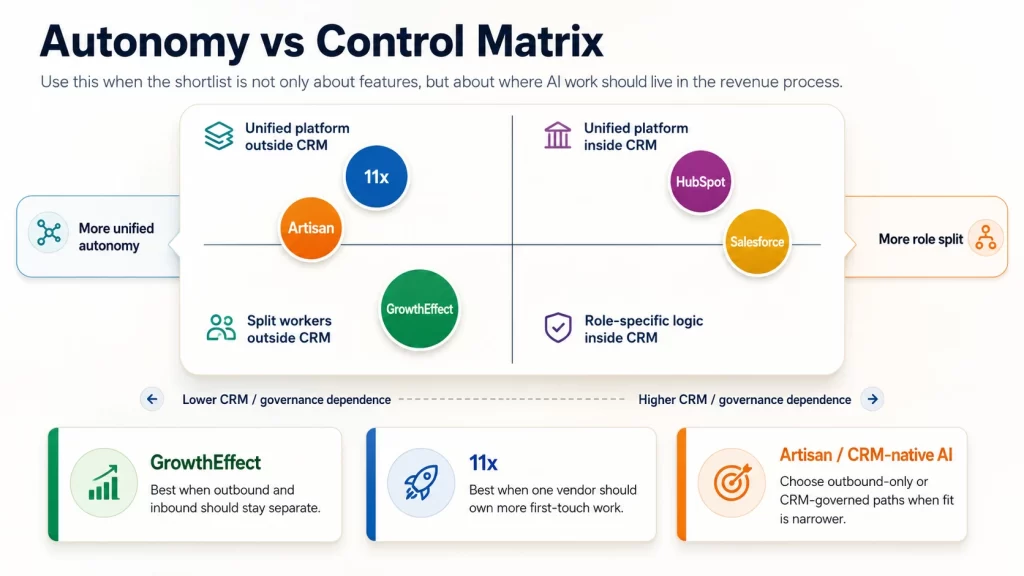
Who Should Compare Artisan or CRM-Native AI Instead?
Not every buyer evaluating an 11x alternative should choose GrowthEffect.
Compare Artisan if you want another outbound-first AI BDR
Artisan Ava is a closer alternative when the buyer wants another outbound-first AI worker. Artisan’s public positioning centers on lead finding, personalized multi-channel sequences, objection handling, meeting booking, and deliverability for outbound.
Choose Artisan over GrowthEffect when:
- the buying motion is outbound-only;
- inbound qualification is not part of the current vendor decision;
- the team wants an AI BDR model more than a split first-touch architecture;
- the buyer values all-in-one outbound execution over role-specific system design.
Compare HubSpot or Salesforce if your CRM is already the operating system
HubSpot’s prospecting agent is positioned around monitoring buying signals, sourcing contacts, and drafting outreach inside HubSpot workflows. Salesforce Agentforce Sales is positioned around qualified lead prioritization, follow-up, and around-the-clock AI sales support tied to CRM data.
That path makes sense when:
- RevOps already owns routing, permissions, and field governance tightly;
- the CRM is trusted and heavily used;
- AI should operate inside existing seller workflows rather than as a separate digital worker layer;
- the real purchase is CRM-native intelligence, not SDR replacement alone.
The trade-off is practical. CRM-native AI depends heavily on data quality, admin structure, and operating discipline. For some teams, that is the right answer. For others, it is too much dependency on a system that is still messy.
The Buyer Scorecard: Unified Engine vs Split Roles vs CRM-Native Control
Use this scorecard before replacing 11x with anything else.
| Test | Ask this | Best answer for GrowthEffect | Best answer for 11x | Best answer for CRM-native AI |
|---|---|---|---|---|
| Role design | Do we want one AI layer or explicit role ownership? | Separate outbound and inbound digital workers | Unified digital-worker platform | AI embedded inside existing platform roles |
| Outbound ownership | Who owns sourcing, research, personalization, follow-up, and CRM handoff? | Vera owns outbound pipeline creation | Alice owns high-autonomy outbound execution | Seller plus CRM agent workflows |
| Inbound handling | Where do response, qualification, and routing live? | Alim as a separate inbound layer | Julian inside the same vendor ecosystem | CRM-native forms, routing, and agent workflows |
| Human escalation | How clear are the boundaries before closing-stage work? | Explicit split between AI first touch and human closing | Needs stronger governance design from the buyer | Often clearer if CRM workflow rules are mature |
| Data dependence | How much CRM maturity is required before rollout works? | Moderate; handoff matters, but the model is not only CRM-native | Moderate to high depending on workflow depth | High |
This is the core information gain for the article.
Most comparison posts stop at “these are similar vendors.” That does not help a buyer decide whether they need an autonomous GTM engine, a split-worker model, or AI inside the CRM. The higher-quality buying decision is to choose where sales work should live first, then pick the vendor that fits that shape.
See the Workflow on Your Pipeline
If this evaluation is tied to a real outbound bottleneck, book a GrowthEffect demo and map the workflow against your current prospecting, reply handling, inbound qualification, CRM handoff, and closer ownership model.
If the decision is still commercial, review the GrowthEffect pricing page after you decide whether your team needs unified autonomy, split digital workers, or CRM-native control.
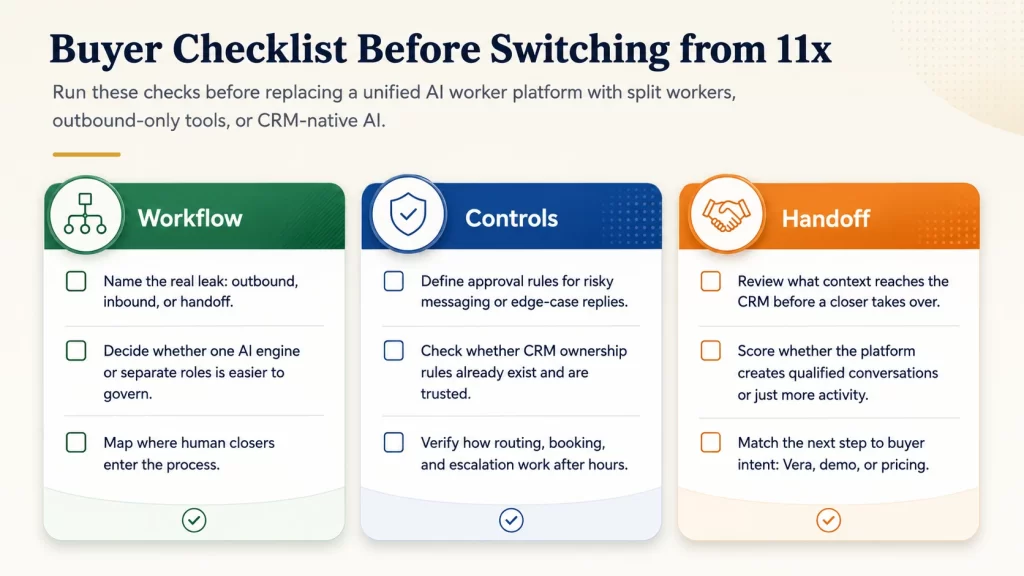
The right follow-up for this topic is an Outbound Pipeline Audit. That conversation should answer four things before you switch platforms:
- Which motion is actually leaking: outbound, inbound, or handoff?
- Where should human approval sit?
- What context must reach the CRM before a closer takes over?
- Do you want one AI owner, or named role ownership across the funnel?
FAQ
What is the best 11x alternative for outbound sales?
The best 11x alternative for outbound sales depends on your operating model. GrowthEffect is stronger when you want outbound execution with clearer handoff and role separation. Artisan is closer when you want another outbound-first AI BDR. CRM-native options are stronger when the CRM already governs the workflow.
Is GrowthEffect a direct 11x competitor?
Partly. GrowthEffect overlaps with 11x on outbound pipeline creation through Vera, but the bigger difference is architecture. GrowthEffect separates outbound, inbound, and human closing responsibilities instead of treating the whole first-touch layer as one vendor-owned engine.
When should I choose 11x instead of GrowthEffect?
Choose 11x when the buying team explicitly wants broad autonomous digital workers across first-touch GTM motions and is comfortable governing more of that work inside one vendor ecosystem.
Should I compare 11x to Artisan or to HubSpot and Salesforce?
Compare 11x to Artisan when you are choosing between outbound-first AI worker models. Compare 11x to HubSpot or Salesforce when your main question is whether AI should live inside an already mature CRM operating system.
What should a sales team test before switching away from 11x?
Test outbound ownership, inbound qualification design, human-review checkpoints, CRM handoff quality, and whether the new system gives closers better context instead of only creating more activity.
Leave a Reply