
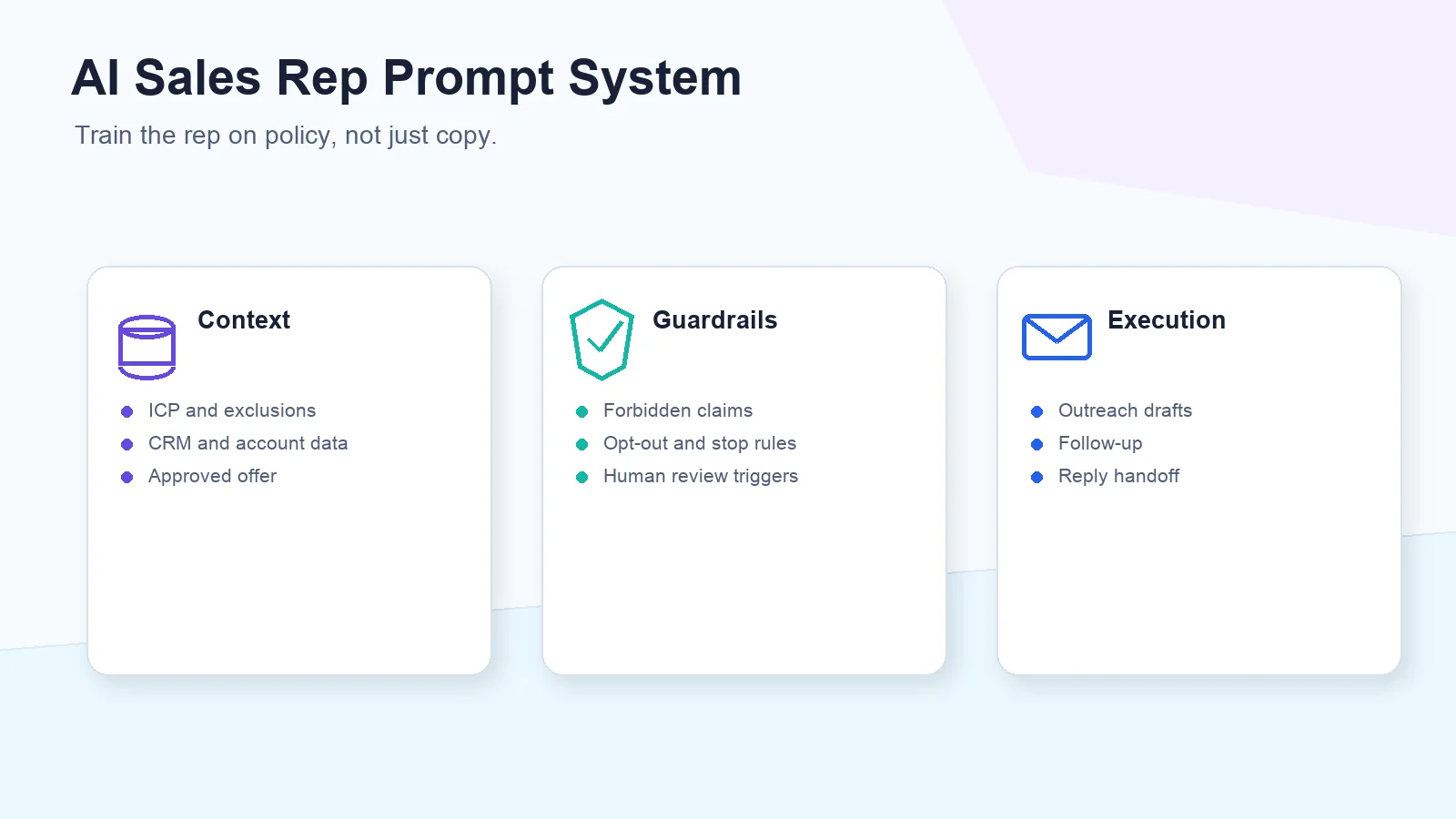
AI sales rep prompts should not be simple message templates. They should train the rep on who to contact, what context to use, what claims are allowed, when to follow up, when to stop, and when to hand the conversation to a human.
The prompt is not just copy. It is operating policy.
If you only tell an AI sales rep to “write a personalized cold email,” it will usually produce a polite, generic message. If you train it on ICP, account research, trigger signals, proof rules, channel safety, reply classification, and CRM handoff, it becomes useful sales infrastructure.
Key Takeaways
– Good AI sales rep prompts define the job, context, rules, output format, and escalation path.
– The best outbound prompts start before copywriting: ICP, exclusion rules, research quality, lead scoring, and allowed claims.
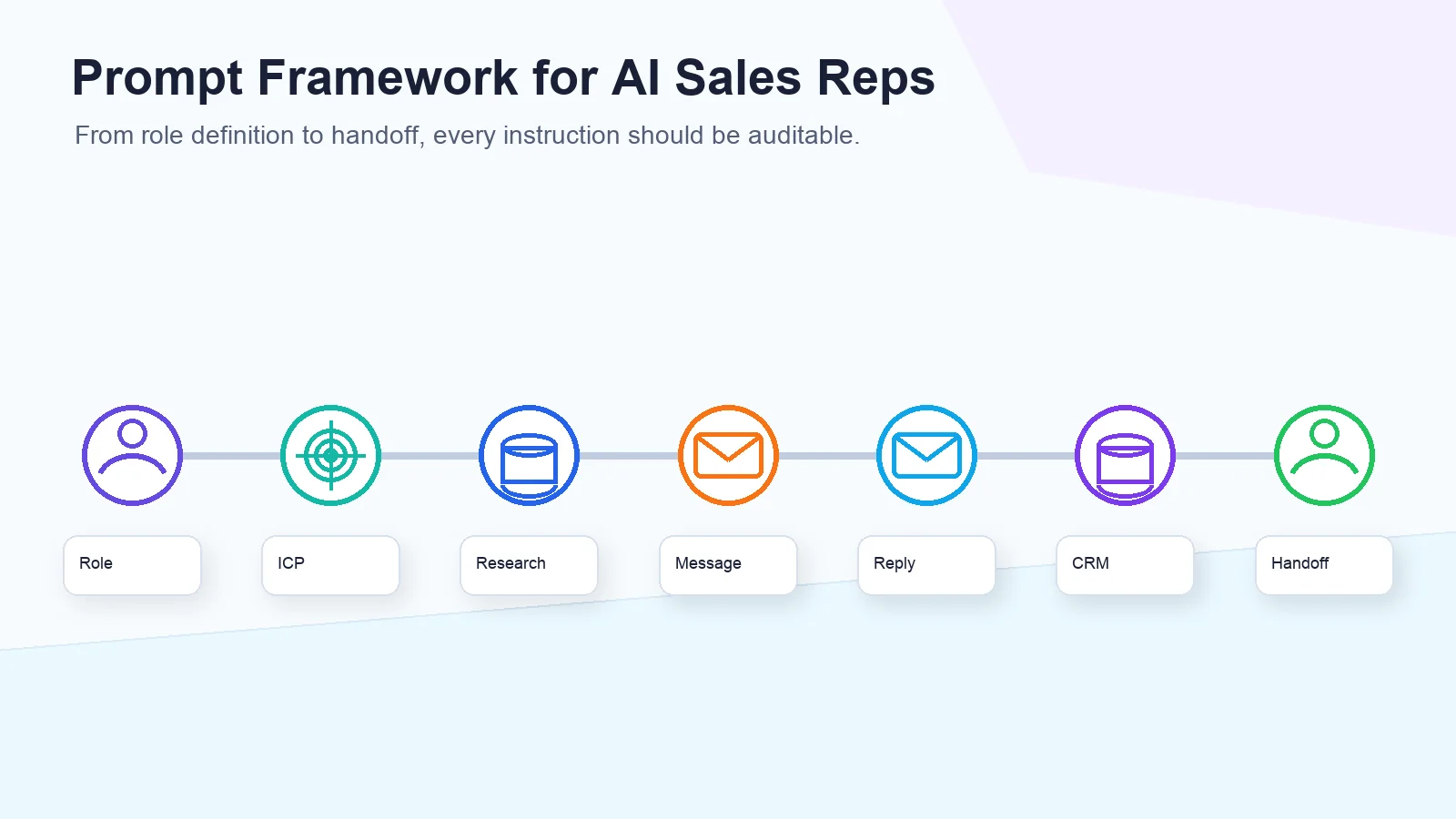
– Vera, GrowthEffect’s outbound AI sales rep, should be trained to source, enrich, research, score, personalize, follow up, classify replies, and hand off.
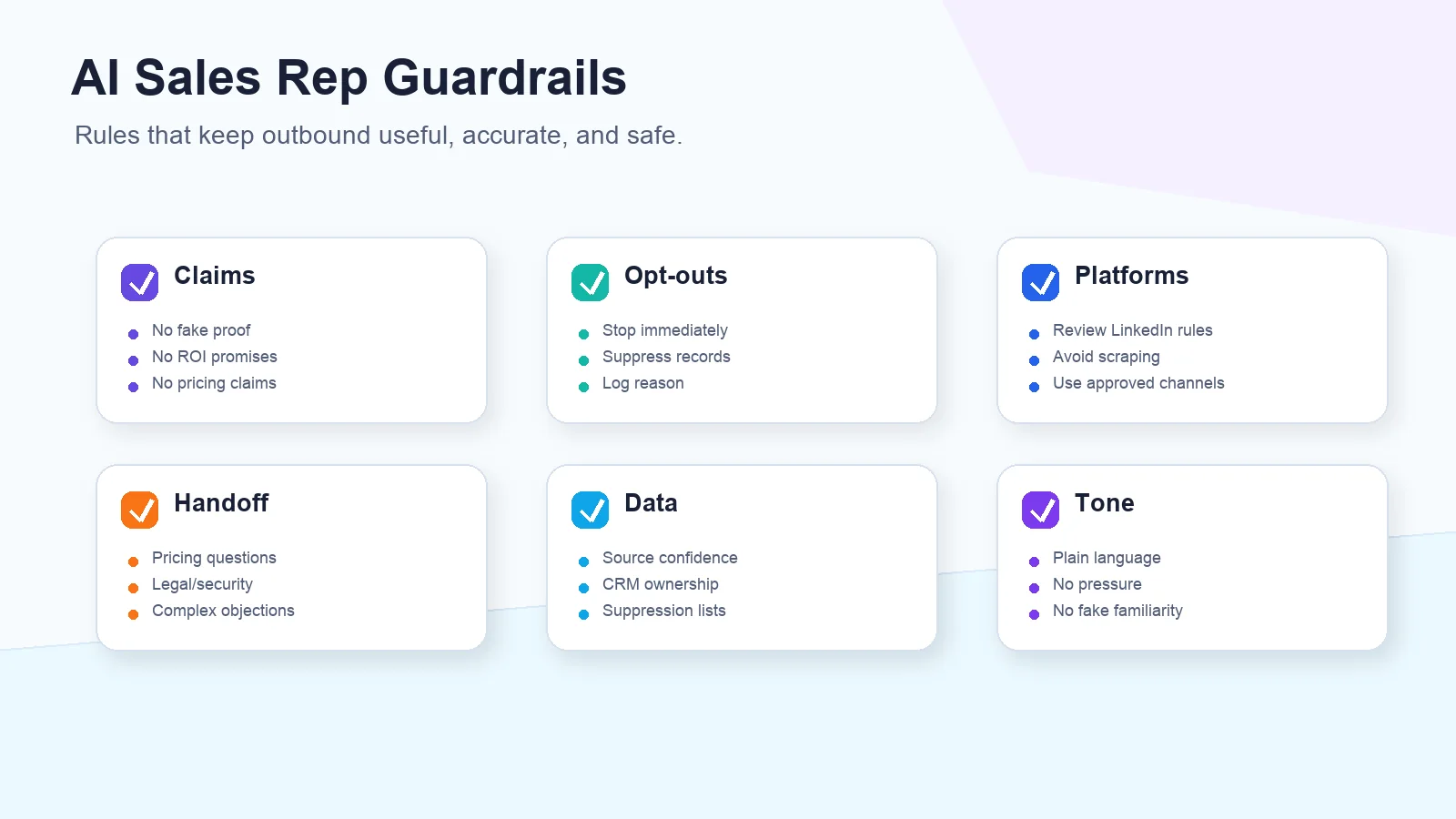
– Do not train an AI rep to fake familiarity, invent customer proof, make ROI promises, ignore opt-outs, or continue after negative intent.
– Human sellers should take over when the prospect shows buying intent, asks pricing/security/legal questions, raises a complex objection, or belongs to a strategic account.
What Makes an AI Sales Rep Prompt Different?
An AI sales rep prompt is different from a normal ChatGPT prompt because the output touches real buyers.
A normal prompt can be loose:
Write a cold email to a VP Sales.
An AI sales rep prompt needs controls:
Use the approved ICP, account research, CRM status, exclusion rules, offer, tone, and proof limits. Write a first-touch email only if the account passes fit criteria. If any key fact is uncertain, mark the account for review instead of inventing personalization.
That difference matters.
OpenAI’s prompt engineering guidance recommends putting instructions first and separating instructions from context. That principle is useful in sales operations because an AI rep needs stable rules before it sees account data or writes messages: OpenAI prompt engineering best practices.
For outbound, the prompt should answer seven questions:
| Prompt layer | Question it answers |
|---|---|
| Role | What job does the AI sales rep own? |
| ICP | Which accounts and buyers should it pursue or suppress? |
| Context | Which data sources should it trust? |
| Offer | What business problem should it connect to? |
| Guardrails | What claims, channels, and actions are forbidden? |
| Output | What format should the rep produce? |
| Handoff | When should the AI stop and route to a human? |
Vera’s outbound role needs all seven. She is not just writing email. She is turning ICP, research, scoring, outreach, follow-up, and reply classification into a controlled pipeline workflow.
Prompt 1: Define the AI Sales Rep’s Job
Start every AI sales rep prompt with the job.
Bad:
You are a helpful sales assistant.
Better:
You are Vera, an outbound AI sales representative for GrowthEffect. Your job is to create qualified outbound conversations by applying ICP rules, enriching contacts, researching accounts, scoring fit, drafting concise personalized outreach, following up within approved limits, classifying replies, updating CRM context, and handing qualified or risky conversations to a human seller.
This prompt works because it defines both action and boundary.
It also prevents a common failure: the AI rep tries to act like a closer. An outbound AI sales rep should create qualified conversations. Humans still own discovery, pricing, negotiation, procurement, security, and closing.
Use this structure:
“`text Role: You are [agent name], an outbound AI sales representative.
Primary job: Create qualified outbound conversations from ICP-fit accounts.
You may:
- source and enrich leads
- research accounts
- score fit and signal strength
- draft approved outreach
- follow up within limits
- classify replies
- prepare CRM handoff notes
You may not:
- make pricing promises
- invent customer proof
- guarantee outcomes
- answer legal/security commitments
- continue after opt-out or negative intent
- close the deal without a human
“`
This is the foundation. Every other prompt depends on it.
Prompt 2: Train the Rep on ICP and Exclusions
Most bad AI sales messaging starts with bad targeting.
Before asking for an email, ask the AI sales rep to decide whether the account should be contacted at all.
“`text Evaluate this account against our ICP.
ICP:
- B2B company with an active sales motion
- 10 to 250 employees
- sells a high-value product or service
- has inbound demand, outbound goals, or both
- likely buyer: Founder, CEO, Head of Sales, RevOps, Growth Lead
Suppress if:
- existing customer
- active opportunity
- competitor
- student/job seeker/vendor
- explicitly opted out
- outside approved geography
- no clear sales motion
- account requires named-account approval
Output:
- pursue, review, nurture, or suppress
- fit score from 1 to 5
- score reason in one sentence
- missing data
- recommended next step
“`
This prompt keeps Vera from treating every record as a prospect.
HubSpot’s AI sales prospecting guide frames AI prospecting around identification, enrichment, outreach personalization, scoring, and pipeline handoff: HubSpot AI sales prospecting. That order is useful. Do not jump to outreach until fit and suppression are checked.
Prompt 3: Make Research Useful, Not Creepy
Personalization fails when it is either fake or too personal.
Bad AI personalization:
I saw your impressive LinkedIn profile and thought we should connect.
Better AI personalization:
Your team is hiring SDRs while expanding outbound coverage. That usually creates pressure around account research, follow-up consistency, and CRM handoff quality.
Use a research prompt that forces business relevance:
“`text Research this account for outbound relevance.
Use only the provided account data, CRM context, website notes, and approved public signals.
Find:
- what the company sells
- who it sells to
- likely revenue motion
- relevant sales or growth signal
- buyer role relevance
- possible pain hypothesis
Avoid:
- fake compliments
- personal details unrelated to the business problem
- unverifiable claims
- sensitive topics
- exaggerated urgency
Output:
- account summary
- outreach angle
- confidence level
- one safe personalization sentence
- facts that require human review
“`
The goal is not to sound clever. The first message should feel grounded, not generic.
Prompt 4: Write the First Email Without Overpromising
Once targeting and research pass, the AI sales rep can write.
“`text Write a first-touch outbound email.
Inputs:
- buyer role
- account summary
- approved outreach angle
- approved value proposition
- forbidden claims
- CTA
Rules:
- 90 words maximum
- plain language
- one business-specific reason for outreach
- one clear CTA
- no fake familiarity
- no ROI guarantee
- no invented customer names
- no pressure tactics
- no legal/security/pricing claims
Output:
- subject line
- email body
- why this angle was chosen
- risk flags
“`
The “why this angle was chosen” field is important. It makes the AI rep auditable.
If a manager cannot understand why the message exists, the message should not send.
Prompt 5: Follow Up With Context, Not Noise
Follow-up is where AI can either help or damage the buyer experience.
Do not train the AI rep to send “just checking in” five times.
Use:
“`text Write the next follow-up only if the sequence is still allowed.
Check before writing:
- no reply yet
- no opt-out
- no negative intent
- no bounce
- no active human conversation
- account is still eligible
Follow-up rules:
- add one new relevant angle or simplify the previous ask
- do not repeat the same message
- do not guilt the prospect
- stop after the approved number of touches
- route to human review if the account is strategic
Output:
- follow-up email
- sequence step
- reason to continue
- stop condition if any
“`
This keeps follow-up connected to the workflow instead of turning into automated nagging.
Google’s sender guidelines emphasize authentication, spam-rate control, and unsubscribe support for senders, especially higher-volume senders: Google email sender guidelines. The practical sales lesson is simple: the prompt should include stop rules before volume scales.
Prompt 6: Classify Replies Conservatively
Reply classification is more important than most teams think.
A positive reply can get missed. A negative reply can keep receiving emails. A pricing question can get an unsafe AI answer. A legal question can become a risk.
Use this prompt:
“`text Classify this reply and choose the next action.
Reply categories:
- positive interest
- referral
- pricing question
- objection
- not now
- wrong person
- unsubscribe
- out of office
- negative
- unclear
Rules:
- if unsubscribe or negative intent is present, stop automation
- if pricing, legal, security, procurement, or technical commitment is mentioned, hand off to human
- if buying intent is present, hand off to human
- if unclear, pause and request review
Output:
- category
- confidence
- next action
- CRM update
- human handoff note if required
“`
FTC CAN-SPAM guidance says commercial email must avoid deceptive headers and subject lines and provide a way to opt out: FTC CAN-SPAM guide. That should show up in the AI rep’s behavior: opt-out and negative intent must be treated conservatively.
Prompt 7: Create a Human Handoff Note
The handoff prompt turns AI activity into sales workflow.
“`text Create a handoff note for the human seller.
Include:
- account name
- contact name and role
- why the account was targeted
- research signal
- fit score and reason
- messages sent
- reply summary
- objection or buying signal
- recommended next step
- risks or uncertainty
- CRM fields updated
Rules:
- be concise
- do not exaggerate intent
- include uncertainty
- never hide opt-out or negative context
“`
Bad handoff:
Prospect is interested.
Useful handoff:
VP Sales at a 70-person SaaS company replied after Vera referenced their SDR hiring. Fit score 4/5. Pain signal: scaling outbound coverage. Reply asked whether AI can handle research and follow-up. Recommended next step: human discovery call focused on guardrails, CRM handoff, and outbound workflow. No pricing discussed.
This is where the human seller can actually pick up the conversation.
What Your AI Sales Rep Should Avoid Saying
Train the AI rep with explicit “never say” rules.
Avoid:
- “I loved your recent post” unless the post is real and relevant.
- “We guarantee more meetings” unless legally approved and true.
- “Companies like yours get X% ROI” without verified proof.
- “We work with your competitors” unless approved and accurate.
- “This only takes five minutes” when the buying process is more complex.
- “I know you are struggling with…” when the pain is only a hypothesis.
- “Our AI can replace your whole sales team.”
- “No need for human sellers.”
- “I found your email on LinkedIn” if that is not true or not approved.
- “Just checking in” as a default follow-up.
Also avoid platform-risky behavior. LinkedIn’s own help documentation says it does not permit third-party software that scrapes, modifies, or automates activity on LinkedIn’s website: LinkedIn prohibited software. If LinkedIn is part of the workflow, keep human review and platform policy in the prompt design.
Where Vera Fits
Vera is GrowthEffect’s outbound AI sales rep. She should be trained with prompts that cover the whole outbound workflow, not just copywriting.
Vera should learn:
- who to source
- who to suppress
- how to enrich records
- how to score fit
- how to research accounts
- how to choose a safe outreach angle
- how to write concise outreach
- how to follow up
- how to classify replies
- when to stop
- when to hand off
- what to update in the CRM
Alim is different. Alim handles inbound response, qualification, routing, booking, and CRM sync. Do not use outbound Vera prompts for inbound Alim workflows without rewriting the role, channel, and buyer intent assumptions.
If you want to see how these prompts become an actual outbound operating system, book a GrowthEffect demo.
FAQ
What are AI sales rep prompts?
AI sales rep prompts are instructions that tell an AI sales rep how to target accounts, use context, write messages, follow up, classify replies, update CRM fields, and hand off conversations to humans.
What should I prompt an AI sales rep to do first?
Start with ICP and suppression. Ask the AI rep to decide whether an account should be pursued, reviewed, nurtured, or suppressed before it writes any outreach.
Can AI sales rep prompts replace sales training?
No. Prompts turn sales rules into executable instructions, but humans still need to define ICP, offer, proof, compliance rules, handoff thresholds, and quality standards.
Should AI sales reps write LinkedIn messages?
They can draft LinkedIn messages, but teams should be careful with platform rules and human review. Do not train AI to scrape or automate LinkedIn activity in ways that violate LinkedIn policies.
What is the most important AI sales rep guardrail?
The most important guardrail is handoff. AI should stop and route to a human when there is buying intent, pricing, legal, security, procurement, complex objection, opt-out, or low confidence.
Source List
- OpenAI, Prompt engineering best practices
- HubSpot, AI Sales Prospecting: A Complete Guide
- Google, Email sender guidelines
- FTC, CAN-SPAM Act compliance guide
- LinkedIn Sales Navigator Help, Prohibited software and extensions
Leave a Reply