
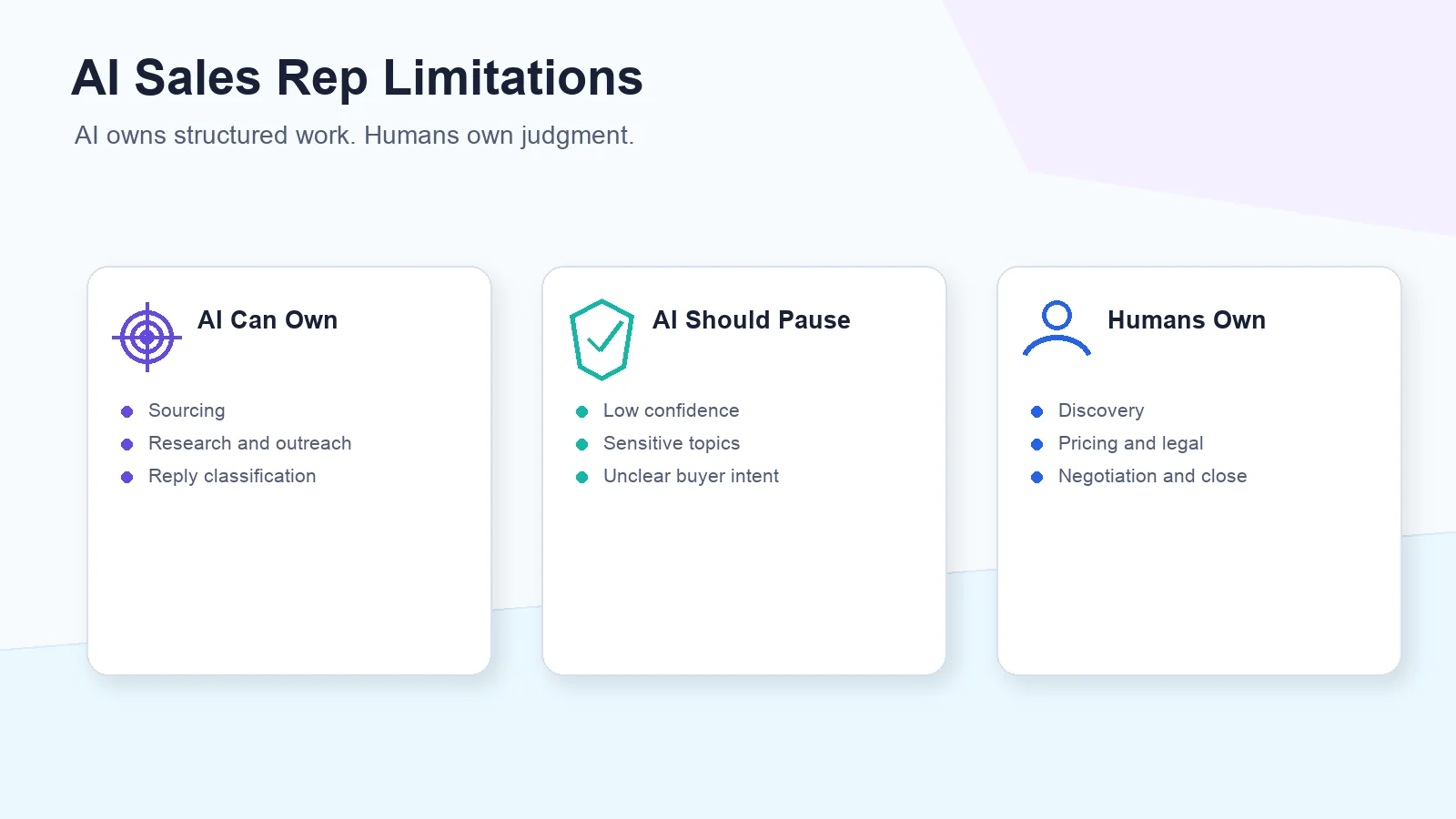
The biggest AI sales rep limitations is not writing ability. It is judgment. AI can source accounts, enrich leads, research context, draft messages, follow up, classify replies, and prepare CRM handoffs. It still should not own trust-heavy sales moments such as discovery, pricing, security, procurement, negotiation, strategic account strategy, or closing.
That is not a weakness of AI sales reps. It is the operating model.
Use AI for repetitive first-touch sales work. Use humans when the conversation requires commercial judgment, trust, ambiguity, relationship context, or accountability.
Key Takeaways
– AI sales reps are strongest in structured, repeatable, high-volume workflows.
– AI sales reps are weakest when the task requires judgment, negotiation, trust, legal/security accuracy, or multi-stakeholder context.
– Vera should own outbound first-touch work: sourcing, enrichment, scoring, research, outreach, follow-up, reply classification, and handoff.
– Alim should own inbound first response, qualification, routing, booking, and CRM sync.
– Humans should own complex discovery, pricing, procurement, objections, closing, and strategic relationships.
What AI Sales Reps Are Good At
AI sales reps work well when the workflow has clear rules.
That includes:
- identifying ICP-fit accounts
- enriching contact and company data
- scoring leads
- researching public account context
- summarizing CRM history
- drafting outbound emails
- drafting LinkedIn messages for human review
- following up within approved limits
- classifying replies
- preparing handoff notes
- updating low-risk CRM fields
- routing inbound leads
- booking meetings when criteria are met
HubSpot’s AI sales prospecting guide describes AI prospecting across lead identification, enrichment, personalization, scoring, and pipeline handoff: HubSpot AI sales prospecting. That is the right category of work: structured, repetitive, and measurable.
The problem starts when teams ask AI to act outside that structure.
Limitation 1: AI Does Not Know Your Real Sales Strategy Unless You Teach It
AI can write a polished email with weak strategy.
It does not automatically know:
- which accounts are strategic
- which industries are bad fit
- which claims legal has approved
- which competitors should not be mentioned
- which buyer roles actually own the problem
- which customers should be suppressed
- which segments are high priority this quarter
- which accounts already have a human relationship
If the ICP is vague, the AI sales rep will scale vague targeting.
Fix:
- document ICP and exclusions
- define pursue/review/nurture/suppress rules
- connect CRM ownership data
- give the AI approved value propositions
- require human review for strategic accounts
Vera is strongest when outbound strategy is clear enough to operationalize. If your team cannot describe the target account, buyer, problem, offer, and stop rules, start there before launching AI outreach.
Limitation 2: AI Can Personalize Incorrectly
AI personalization can sound confident even when the underlying fact is weak.
Common failure modes:
- fake compliments
- incorrect company assumptions
- outdated trigger signals
- irrelevant LinkedIn references
- overpersonalization from weak data
- invented pain points
- misread job titles
- generic “saw you’re growing” language
The fix is not more creative copy. The fix is source-aware research.
Use this rule:
| Personalization type | AI can use? | Condition |
|---|---|---|
| Company website fact | Yes | If current and relevant |
| CRM history | Yes | If record ownership and status are clear |
| Hiring or expansion signal | Yes | If verified and not overstated |
| Prospect personal life | No | Not relevant for B2B outbound |
| Competitor claim | Review | Human approval required |
| ROI claim | Review | Only if approved and verified |
| Security/legal claim | No | Human must handle |
This protects the buyer experience.
Limitation 3: AI Should Not Handle Pricing Alone
Pricing is not just a number.
Pricing conversations involve:
- package fit
- buyer urgency
- procurement process
- discount policy
- contract terms
- implementation scope
- competitive pressure
- account value
- negotiation leverage
An AI sales rep can collect pricing intent or route a pricing question. It should not negotiate.
Bad AI response:
We can give you a discount if you book this week.
Better AI behavior:
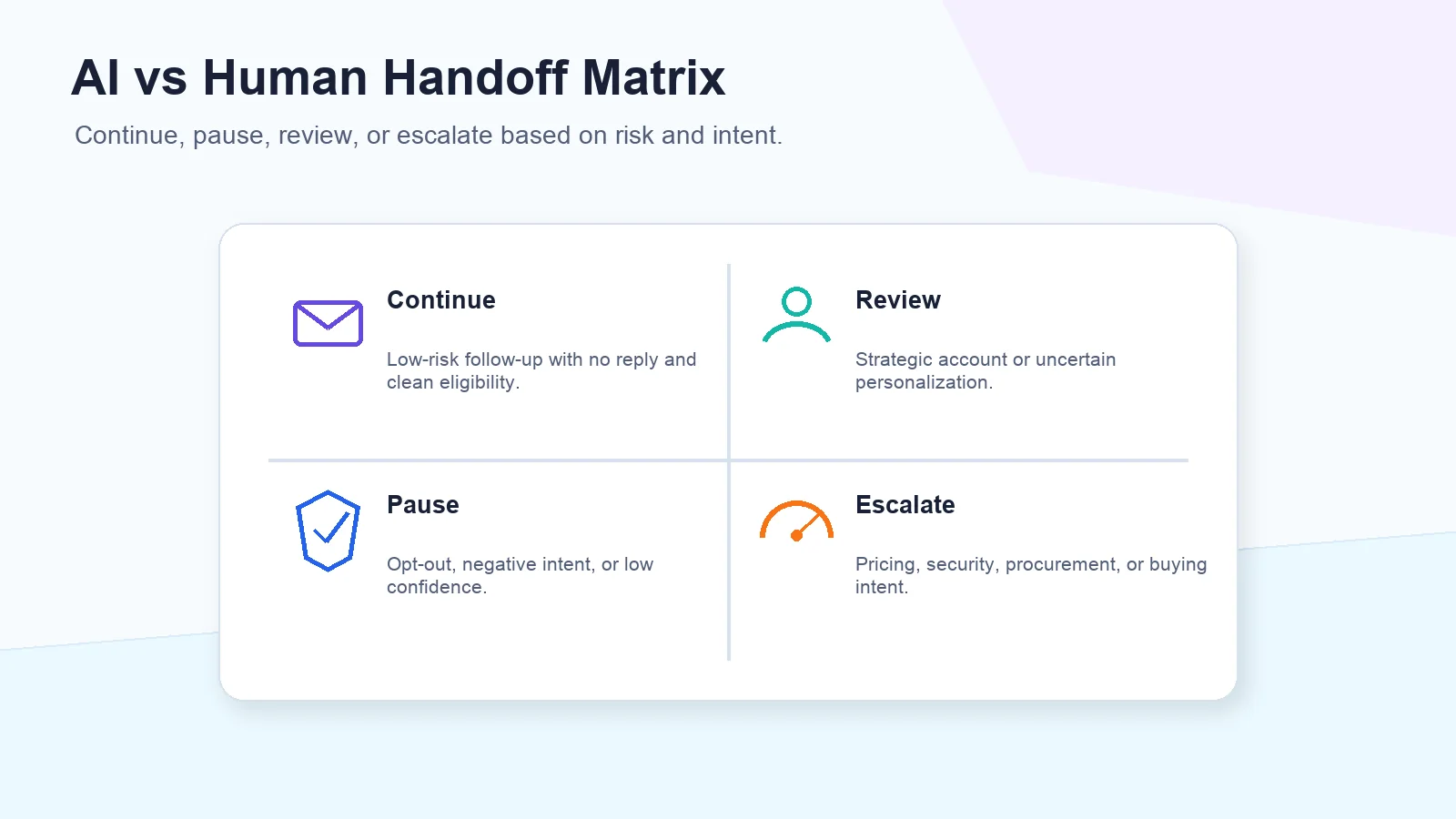
This is a pricing-related question. Pause automation, summarize context, and route to the human owner.
Humans should own pricing because pricing shapes trust and deal quality.
Limitation 4: AI Should Not Answer Legal, Security, or Procurement Commitments
AI can draft a response, but it should not make commitments.
Questions that require human review:
- Do you support our security requirements?
- Can you sign our DPA?
- Are you SOC 2 certified?
- Can you meet this SLA?
- Can procurement pay net 60?
- Can you guarantee data residency?
- Can we use this for regulated data?
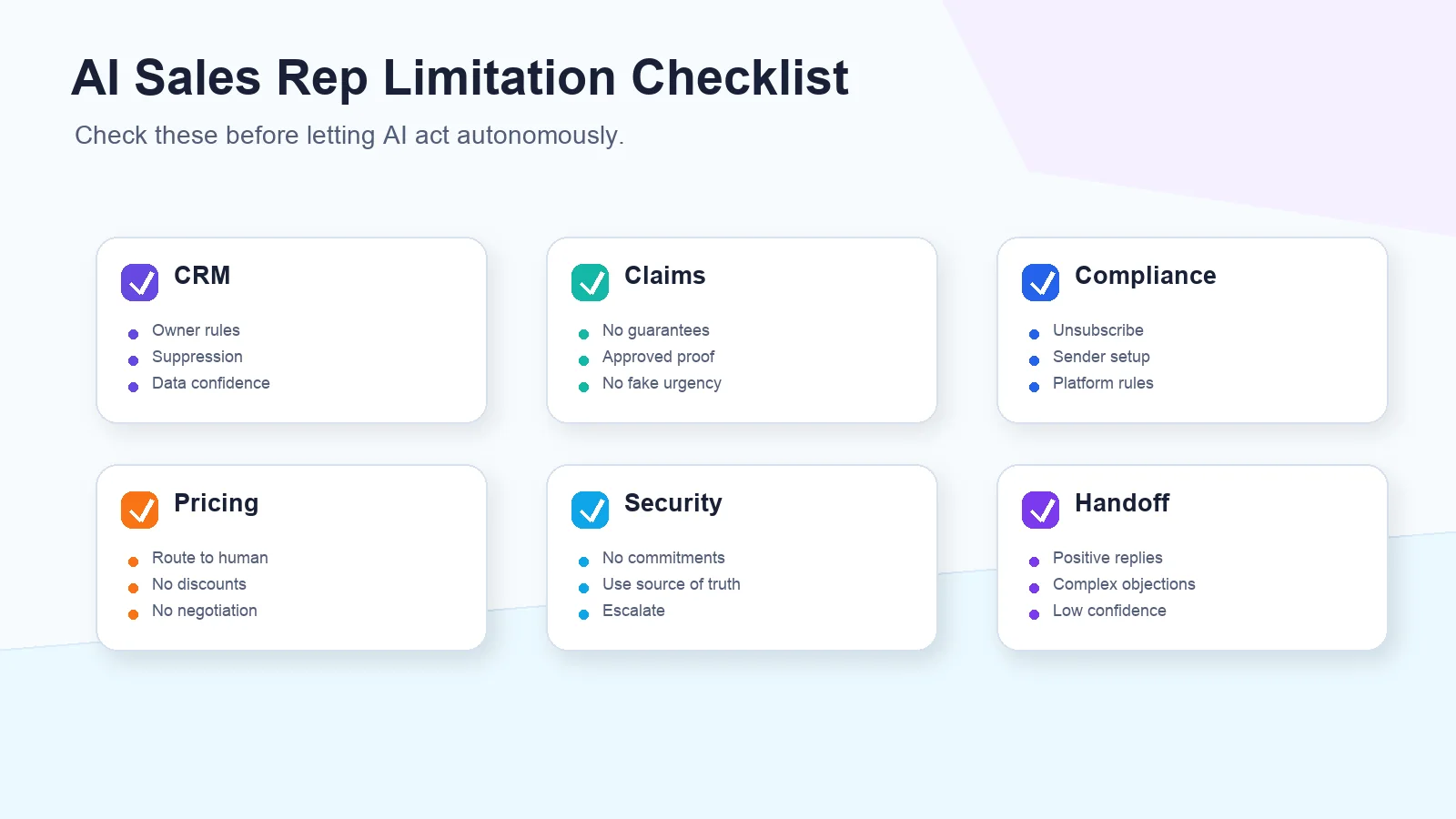
Unless the answer is approved, current, and mapped to a source of truth, the AI sales rep should not answer directly.
This is where prompt guardrails matter:
“text If the prospect asks about legal, security, compliance, procurement, pricing, contract terms, or implementation commitments, do not answer directly. Summarize the question, pause automation, and hand off to a human. “
Limitation 5: AI Can Misread Buyer Intent
Buyer replies are messy.
Examples:
- “Send info” might be interest or polite dismissal.
- “Maybe later” might mean next quarter or never.
- “Talk to my team” might be a referral or a brush-off.
- “We already use something” might be an objection or a buying signal.
- “Stop” might be unsubscribe, frustration, or just stop this thread.
AI can classify replies, but low-confidence replies should not stay automated.
Use conservative categories:
| Reply type | AI action | Human action |
|---|---|---|
| Clear positive | Pause and hand off | Respond personally |
| Pricing question | Pause and hand off | Handle commercial detail |
| Legal/security | Pause and hand off | Use approved answer |
| Objection | Draft but route | Decide response |
| Unclear | Pause | Review manually |
| Negative | Stop | None |
| Opt-out | Suppress | None |
The cost of over-automation is high: missed opportunities, annoyed buyers, and messy CRM state.
Limitation 6: AI Cannot Build Trust by Itself
B2B buyers still care about human judgment.
Gartner predicts that by 2030, 75% of B2B buyers will prefer sales experiences that prioritize human interaction over AI, especially as stakes rise: Gartner B2B buyers and human interaction.
That does not mean buyers hate AI. It means AI should remove friction before the human conversation, not pretend to replace the whole relationship.
Humans are still better at:
- reading political context
- handling emotional resistance
- navigating buying committees
- building executive trust
- interpreting unstated objections
- negotiating trade-offs
- deciding when to walk away
- shaping the deal around the real business problem
AI can prepare the human. It should not impersonate the human.
Limitation 7: AI Can Create Compliance and Platform Risk
AI sales reps often touch email and LinkedIn.
That creates operational risk.
Email programs should follow Google sender guidelines, which recommend or require authentication practices such as SPF, DKIM, and DMARC depending on sender type and volume. Google also emphasizes unsubscribe support and spam-rate control: Google email sender guidelines.
For US commercial email, the FTC CAN-SPAM guide requires truthful header and subject information, identification, a valid physical address, opt-out handling, and honoring opt-outs: FTC CAN-SPAM guide.
LinkedIn separately states that it does not permit third-party software that scrapes, modifies, or automates activity on LinkedIn’s website: LinkedIn prohibited software.
AI sales reps should therefore have channel rules:
- no outreach after opt-out
- no deceptive subject lines
- no unsupported sender identity
- no scraping behavior that violates platform rules
- no automated LinkedIn behavior without policy review
- no high-volume sending before domain and deliverability checks
This article is not legal advice. The operating point is simple: compliance and platform safety belong in the workflow, not in a post-campaign cleanup.
Limitation 8: AI Cannot Fix a Broken CRM
AI depends on data quality.
If the CRM is messy, the AI sales rep may:
- contact customers
- duplicate outreach
- assign wrong owners
- ignore active opportunities
- overwrite useful fields
- route replies to the wrong person
- use outdated lifecycle status
- miss opt-out history
Salesforce’s 2026 State of Sales announcement highlights data quality as a major focus for sales teams trying to get value from AI: Salesforce State of Sales 2026.
The fix is data governance:
- required fields
- source confidence
- suppression lists
- ownership rules
- duplicate handling
- activity logging
- audit trail
- human approval for high-impact fields
AI should improve CRM hygiene, not hide CRM problems.
When to Use AI vs. When to Use a Human
Use this decision table.
| Sales task | AI sales rep | Human seller |
|---|---|---|
| ICP sourcing | Own, with rules | Define strategy |
| Enrichment | Own, with confidence | Review uncertain data |
| Account research | Own summary | Interpret strategic meaning |
| First-touch outbound | Draft/send if approved | Approve high-risk accounts |
| Follow-up | Own within limits | Step in on replies |
| Reply classification | Own first pass | Review ambiguity |
| Inbound qualification | Alim can own | Handle complex intent |
| Pricing | Route only | Own |
| Legal/security | Route only | Own |
| Discovery | Prepare notes | Own |
| Negotiation | Do not own | Own |
| Closing | Do not own | Own |
This is the GrowthEffect model.
Vera creates outbound pipeline. Alim captures and qualifies inbound demand. Humans close.
Where GrowthEffect Fits
GrowthEffect is built around a human-plus-AI sales model.
Vera handles outbound first-touch work:
- sourcing
- enrichment
- research
- scoring
- personalized outreach
- follow-up
- reply classification
- CRM handoff
Alim handles inbound first-touch work:
- lead response
- qualification
- routing
- meeting booking
- CRM sync
Humans handle:
- discovery
- strategy
- pricing
- procurement
- negotiation
- closing
- relationship management
That separation is the reason GrowthEffect should not be described as “AI replaces every salesperson.” The stronger claim is more realistic: AI removes repetitive first-touch work so human sellers spend more time with qualified buyers.
If you want to map which parts of your sales process should be AI-owned and which should stay human, book a GrowthEffect demo.
FAQ
What are the main AI sales rep limitations?
The main limitations are judgment, trust, pricing, legal/security accuracy, procurement, complex discovery, negotiation, strategic accounts, compliance risk, and messy CRM data.
Can an AI sales rep replace an SDR?
It can replace repetitive SDR tasks such as sourcing, enrichment, research, scoring, outreach drafts, follow-up, reply classification, and CRM handoff. It should not replace human judgment in complex conversations.
When should a human take over from an AI sales rep?
A human should take over when there is buying intent, pricing, legal, security, procurement, complex objection, strategic account value, unclear reply intent, or low AI confidence.
Is AI sales outreach risky?
It can be risky if the team ignores email compliance, opt-outs, sender authentication, LinkedIn rules, unsupported claims, or CRM suppression lists. The risk is manageable when guardrails are built into the workflow.
How does GrowthEffect handle AI sales limitations?
GrowthEffect separates responsibilities. Vera handles outbound first-touch work, Alim handles inbound qualification, and humans handle trust-heavy sales moments such as discovery, pricing, negotiation, and closing.
Source List
- HubSpot, AI Sales Prospecting: A Complete Guide
- Gartner, B2B buyers and human interaction over AI
- Google, Email sender guidelines
- FTC, CAN-SPAM Act compliance guide
- LinkedIn Sales Navigator Help, Prohibited software and extensions
- Salesforce, State of Sales Report for 2026 announcement
Leave a Reply