
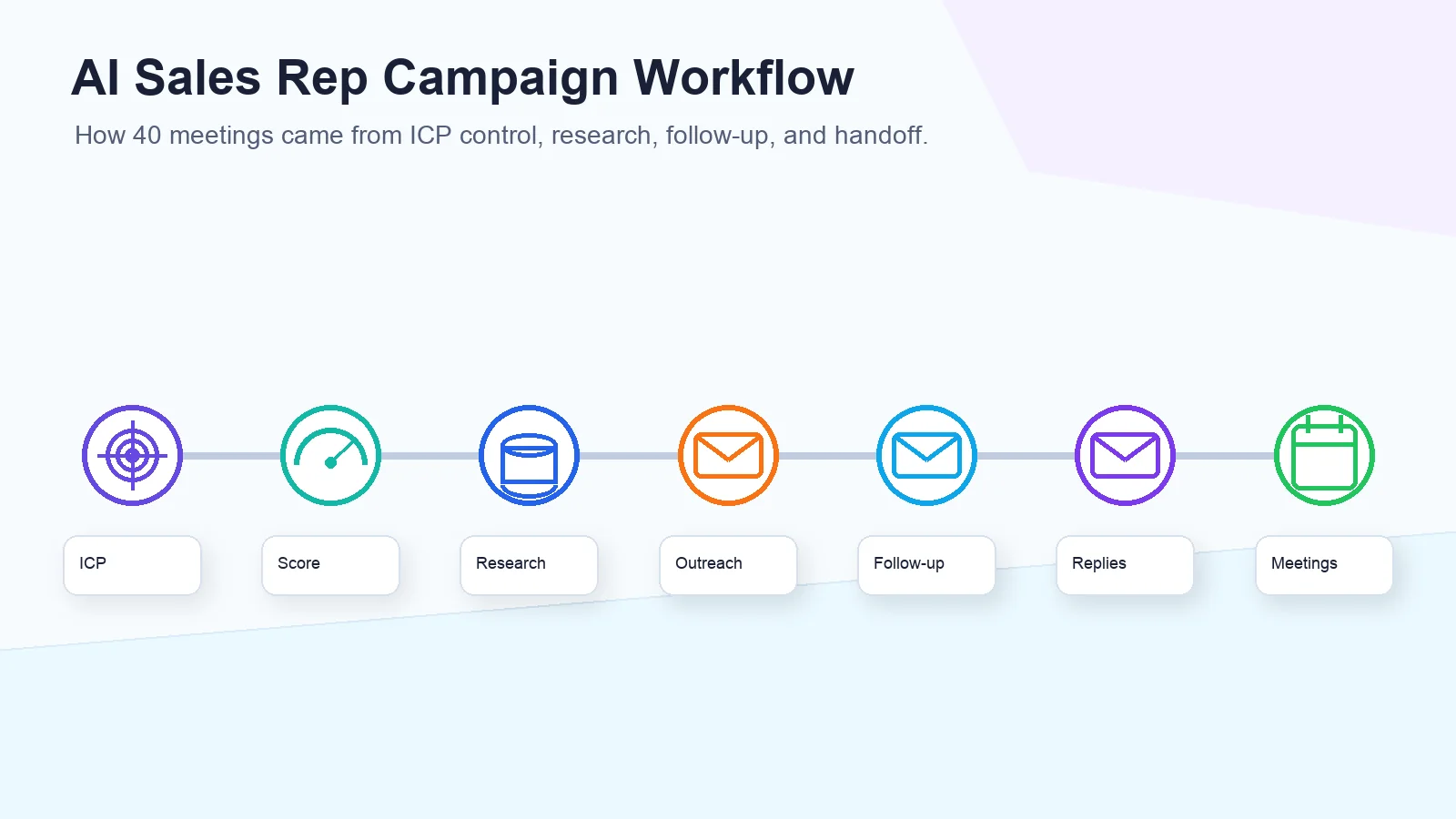
An AI sales rep case study is only useful if it shows the operating system behind the result. The headline number matters, but the real question is how the meetings were created: which ICP was targeted, how leads were scored, what research was used, how outreach was personalized, how follow-up worked, and when humans took over.
In this campaign, the result was 40 booked meetings in 30 days. The important lesson is not that AI magically books meetings. It is that a narrow ICP, clean suppression rules, account research, safe personalization, reply classification, and human handoff can turn an AI sales rep into a repeatable outbound pipeline worker.
Key Takeaways
– The 40-meeting result came from workflow discipline, not unsupervised email volume.
– The campaign started with ICP selection, exclusion rules, lead scoring, account research, and controlled messaging.
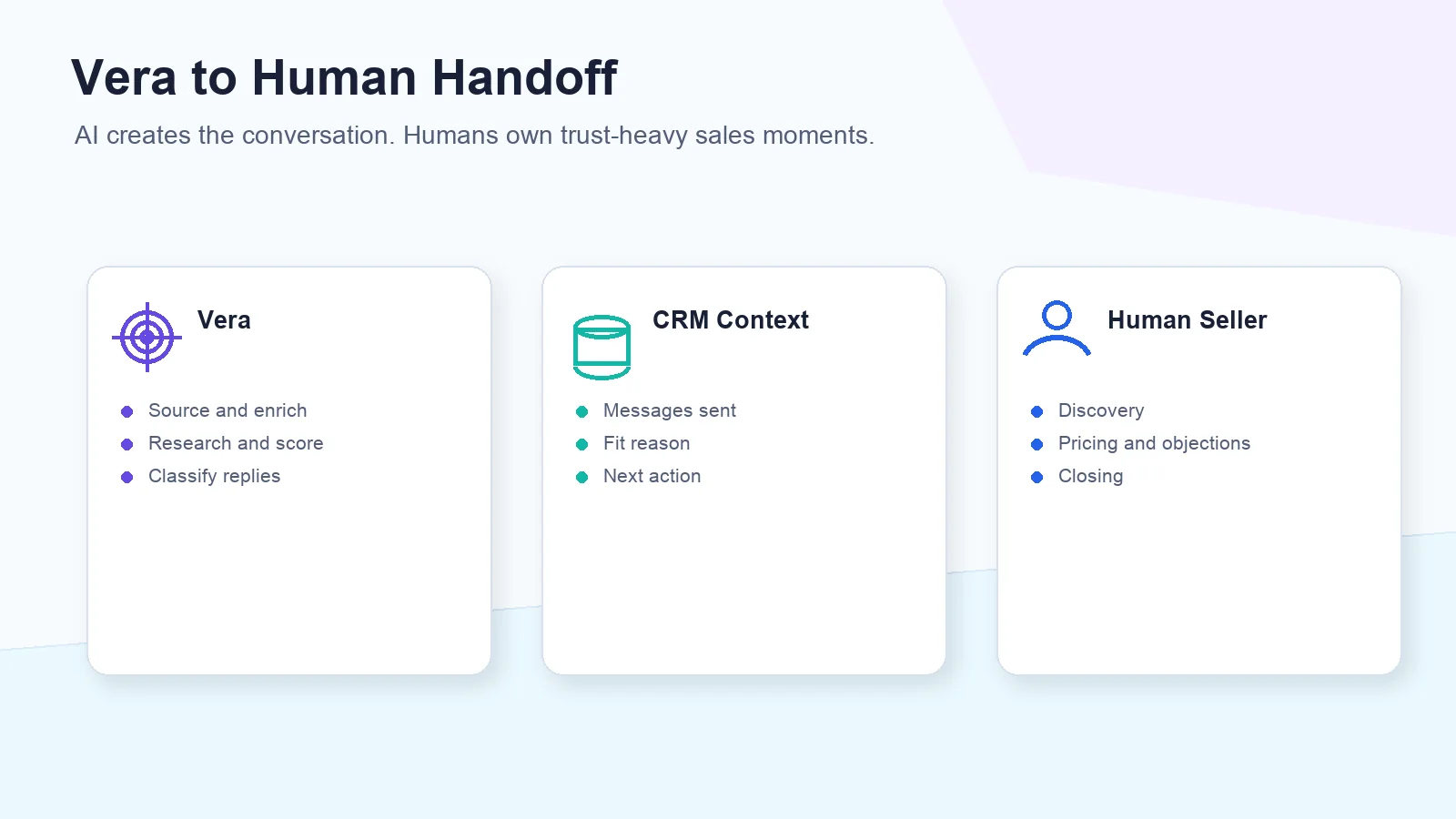
– Vera, GrowthEffect’s outbound AI sales rep, is the right worker for this kind of campaign: source, enrich, research, score, personalize, follow up, classify replies, and hand off.
– Human sellers still handled high-intent replies, pricing questions, complex objections, and closing.
– The case study should be read as a workflow teardown, not a universal promise that every campaign will book 40 meetings.
The Campaign Setup
The campaign was built around one operating decision: do not ask the AI sales rep to sell to everyone.
Instead of broad outbound, the team narrowed the motion:
| Campaign input | Decision |
|---|---|
| Motion | Outbound pipeline generation |
| Worker | Vera, outbound AI sales rep |
| Primary goal | Book qualified meetings |
| Channel | Controlled outbound email with human review rules |
| Human role | Own strategy, approve guardrails, handle qualified replies |
| AI role | Source, enrich, research, score, personalize, follow up, classify replies, update CRM |
| Success standard | Meeting quality and handoff accuracy, not just booked volume |
This matters because AI outbound fails when teams confuse automation with strategy. If the ICP is vague, the message is generic, the CRM is messy, and the handoff is undefined, an AI rep will simply scale the mess.
Salesforce’s 2026 State of Sales announcement says AI adoption in sales is already mainstream, including prospecting, lead scoring, and email drafting, and that sellers expect agents to reduce prospect research and email drafting time: Salesforce State of Sales 2026. That time saving only becomes pipeline when it is attached to a controlled workflow.
Step 1: Define the ICP Before Writing Any Copy
The first step was ICP control.
Vera was not trained to write emails first. She was trained to decide whether a lead should enter the campaign.
The targeting prompt used four layers:
- Company fit.
- Buyer role fit.
- Trigger or pain hypothesis.
- Suppression risk.
The suppression rules mattered as much as the positive ICP.
Suppress:
- existing customers
- open opportunities
- competitors
- opted-out contacts
- irrelevant titles
- accounts outside the target geography
- companies without a clear sales motion
- strategic accounts requiring human approval
- records with low confidence enrichment
This avoided the most common AI outbound problem: too many low-fit messages.
HubSpot’s AI sales prospecting guide describes AI prospecting as identifying, enriching, personalizing, scoring, and handing off pipeline: HubSpot AI sales prospecting. That order is the key. The campaign did not begin with copy. It began with lead quality.
Step 2: Score Leads Before Outreach
The campaign used a practical scorecard.
| Score area | What Vera checked |
|---|---|
| Company fit | Size, industry, region, sales motion, product/service type |
| Buyer fit | Role, seniority, likely ownership of pipeline or revenue |
| Signal strength | Hiring, expansion, sales process friction, visible growth trigger |
| Data confidence | Contact validity, company match, CRM conflict, suppression status |
| Outreach relevance | Whether the offer connected to a likely business problem |
The output was simple:
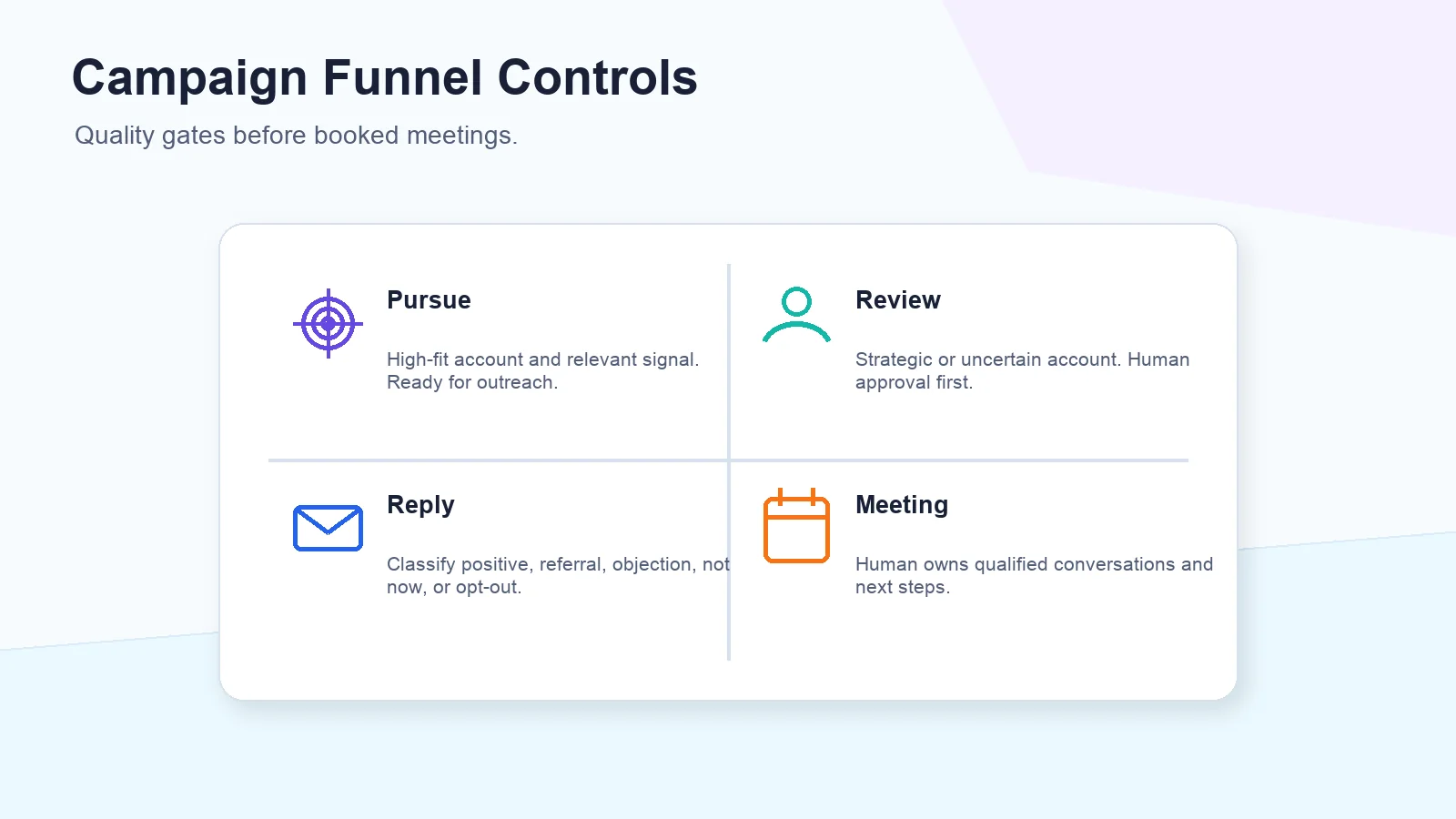
- Pursue: eligible for outreach.
- Review: needs human approval.
- Nurture: not ready now.
- Suppress: do not contact.
That system protected the campaign from volume addiction.
If an AI sales rep sends to every record, meeting count may rise temporarily, but buyer trust, domain reputation, and CRM quality suffer. The better goal is coverage of the right accounts.
Step 3: Research the Account Before Personalizing
The campaign did not use fake personalization.
Vera was trained to find business-relevant context:
- what the company sells
- who it sells to
- why the buyer role matters
- whether the account has a visible growth or sales signal
- what pain hypothesis is reasonable
- what claim should not be made
The outreach angle had to be explainable.
Bad:
I saw your company is doing great things.
Better:
Your team appears to be scaling outbound coverage. Teams at that stage often run into research, follow-up, and CRM handoff consistency problems before they solve headcount.
The message did not need to be long. It needed to be grounded.
Step 4: Write Short Outreach With Proof Rules
The outbound copy followed five rules:
- One reason for outreach.
- One buyer pain.
- One clear CTA.
- No invented proof.
- No aggressive pressure.
The AI sales rep was not allowed to use:
- unverified customer names
- ROI percentages
- guaranteed meeting claims
- competitor claims
- pricing promises
- legal or security claims
- fake familiarity
That last part matters. A lot of AI-generated outbound sounds polished but unsafe.
Google’s sender guidelines emphasize authentication, message quality, and unsubscribe support for senders: Google email sender guidelines. The FTC’s CAN-SPAM guide also requires commercial email to avoid deceptive headers and subject lines and include an opt-out method: FTC CAN-SPAM guide. Prompt rules should reflect those operating requirements before campaign volume increases.
Step 5: Follow Up Without Chasing Bad Intent
The campaign’s follow-up rule was not “send until they reply.”
Vera followed up only when:
- no reply had arrived
- no opt-out was present
- no negative intent was detected
- no bounce occurred
- no human conversation had started
- the account still matched the campaign
Follow-up messages had to add context or reduce friction. They could not repeat the same ask.
The stop rules were explicit:
- stop on opt-out
- stop on negative intent
- stop on a human-owned reply
- stop on low-confidence classification
- stop on pricing, procurement, legal, or security questions
This is why the campaign could scale without becoming sloppy.
Step 6: Classify Replies and Hand Off Fast
Booked meetings came from reply handling, not just outbound sending.
Vera classified replies into:
- positive interest
- referral
- objection
- pricing question
- not now
- wrong person
- out of office
- unsubscribe
- negative
- unclear
The handoff rule was conservative.
Hand off to a human when:
- the prospect asked for a meeting
- the reply showed buying intent
- the prospect asked about pricing
- the prospect raised legal, security, or procurement questions
- the account was strategic
- the reply was unclear but potentially valuable
- the AI confidence was low
The handoff note included account summary, contact role, why the account was targeted, research signal, messages sent, reply summary, recommended next step, and risk flags.
What Worked
The campaign worked because it treated Vera like a digital outbound worker, not an email writer.
The strongest parts were:
- narrow ICP
- clear suppression rules
- lead scoring before copy
- account research before personalization
- concise messaging
- conservative follow-up
- reply classification
- CRM notes
- human handoff
- daily review of early output
This is the difference between “AI writes sales emails” and “AI runs the first-touch outbound workflow.”
What Did Not Scale Automatically
The campaign still needed humans.
Humans handled:
- ICP selection
- offer positioning
- proof approval
- strategic account review
- pricing questions
- objections
- discovery calls
- negotiation
- closing
- feedback on message quality
That division is important.
Gartner has warned that as B2B buying stakes rise, buyers increasingly value human interaction; Gartner predicts that by 2030, 75% of B2B buyers will prefer sales experiences that prioritize human interaction over AI: Gartner B2B buyer preference. That does not make AI useless. It means AI should create the right conversations and humans should own the moments where trust matters.
How to Replicate the Workflow
Use this process:
- Pick one ICP segment.
- Define buyer roles and exclusions.
- Clean CRM conflicts and suppression lists.
- Score accounts before messaging.
- Research account-level business context.
- Write concise, safe outreach.
- Limit follow-up and define stop conditions.
- Classify replies.
- Hand off high-intent or risky replies.
- Review output daily for the first campaign.
Do not begin by asking, “How many emails can we send?”
Ask, “How many qualified conversations can we create without damaging buyer trust?”
Where GrowthEffect Fits
Vera is the GrowthEffect worker for this campaign type.
Vera handles:
- ICP-based sourcing
- enrichment
- hard scoring
- AI lead scoring
- filtering
- research
- positioning
- copywriting
- outreach
- follow-up
- reply classification
- learning
Alim is not the worker for this outbound case. Alim is for inbound response, qualification, routing, booking, and CRM sync.
The model is simple: Vera creates outbound conversations, Alim protects inbound demand, and humans close.
If you want to see whether this workflow can apply to your ICP, book a GrowthEffect demo. Bring your target segment, current outbound message, CRM status fields, and one example of a qualified meeting.
FAQ
Is this AI sales rep result guaranteed?
No. The 40-meeting result depends on ICP quality, offer relevance, data quality, campaign constraints, follow-up rules, and human handoff. It should not be treated as a universal guarantee.
What made the campaign work?
The campaign worked because the AI sales rep was trained on the whole outbound workflow: sourcing, scoring, research, personalization, follow-up, reply classification, CRM updates, and human handoff.
Did AI replace human salespeople?
No. AI handled repetitive first-touch outbound work. Humans still owned discovery, pricing, complex objections, negotiation, and closing.
What should teams copy from this campaign?
Copy the workflow: narrow ICP, suppression rules, score before send, research before personalization, safe copy rules, conservative follow-up, reply classification, and fast human handoff.
Which GrowthEffect product handles this workflow?
Vera handles outbound AI sales rep workflows. Alim handles inbound lead response and qualification. This campaign is a Vera-style outbound workflow.
Leave a Reply