AI Sales Rep Pricing: How Much Does It Cost in 2026?
If you are evaluating an AI sales rep for the first time, pricing is almost always the first question and the most misleading one. Vendors quote a monthly number, but the real comparison is between an AI sales rep and the fully loaded cost of the human SDR it replaces. Once you frame the decision that way, the economics shift dramatically.
This article breaks down the AI sales rep pricing landscape in 2026: what you actually get at each tier, what drives cost differences between vendors, and how to decide whether to start with outbound, inbound, or a full-funnel deployment.
Why AI Sales Rep Pricing Is Hard to Compare at Face Value
The AI SDR market is growing fast. According to MarketsandMarkets, the global AI SDR market is projected to rise from $4.12 billion in 2025 to $15.01 billion by 2030, at a 29.5% compound annual growth rate. As the market matures, pricing models are diverging sharply and comparing them at face value is one of the most common mistakes buyers make.
There are three fundamentally different things being sold under the “AI sales rep” label:
1. Workflow automation tools — Platforms like Apollo, Outreach, and Salesloft give your team better infrastructure. They are tools that still require human operators to run sequences, write copy, and review data. You buy the software and still need to hire someone to run it.
2. AI-augmented SDR seats — Some vendors sell AI assistants embedded inside your existing SDR workflow. The human still does the job; AI handles research, drafting, or logging. Pricing here is often per-user per month, typically ranging from $99 to $500/user/month.
3. Autonomous AI sales reps — A small number of vendors offer fully autonomous digital workers that source leads, write personalized outreach, qualify inbound inquiries, and book meetings without human involvement in each step. This is where the real cost comparison against human headcount becomes relevant.
GrowthEffect’s Vera (outbound) and Alim (inbound) fall firmly in the third category. They are not tools that need a human operator. They are the operator.
The Real Cost Baseline: What a Human SDR Actually Costs
Before comparing AI sales rep pricing, establish the correct baseline. Most discussions anchor on base salary alone which understates the true cost significantly.
A fully loaded SDR in the US market costs $60,000 to $90,000 annually in base salary before benefits, management overhead, tooling, and onboarding are factored in. According to Gartner, AI SDRs can deliver comparable output for 10 to 20% of that cost, with deployment measured in days rather than months.
Beyond the direct cost, there are three structural problems with the human SDR model that pricing alone does not capture:
- Ramp time. A new SDR typically takes 2 to 3 months to reach full productivity. During that period, pipeline generation is partially or fully paused.
- Turnover. Average SDR tenure is approximately 14 months. Each departure resets the clock on ramp, recruitment, and institutional knowledge.
- Coverage limits. A human SDR works roughly 8 hours per day on weekdays. Inbound leads arriving outside those hours go unanswered. According to Harvard Business Review, the average lead response time across industries is 47 hours and companies that respond within an hour are 7 times more likely to qualify the lead.
An AI sales rep eliminates all three. It runs 24/7/365, deploys in days, and never resigns.
AI Sales Rep Pricing Tiers in 2026
Here is how the market segments today, from tool-based solutions to fully autonomous AI SDRs.
Tier 1: Workflow Automation Platforms ($50–$250/user/month)
This tier includes tools like Apollo, Outreach, Salesloft, and similar platforms. They provide data enrichment, sequencing infrastructure, and analytics. The major constraint: they are platforms, not workers. You still need humans to operate them, write copy, make decisions, and manage the workflow. Pricing in this tier looks cheap on paper but requires headcount investment on top.
Tier 2: AI-Augmented SDR Tools ($99–$500/user/month)
Vendors in this tier embed AI assistance directly into the SDR workflow. Regie.ai, for example, positions its Force Multiplier Rep at $499/user/month. These tools accelerate what a human SDR can do but do not replace the SDR seat itself. ROI depends on whether the productivity gain justifies the additional software cost on top of existing payroll.
Tier 3: Autonomous AI SDR Agents
This is the category GrowthEffect operates in, alongside 11x, Artisan, and a small number of others. The key differentiator: there is no human operator required per lead or per sequence. The AI agent sources, enriches, scores, researches, personalizes, outreaches, follows up, qualifies, and books autonomously.
Pricing in this tier varies significantly:
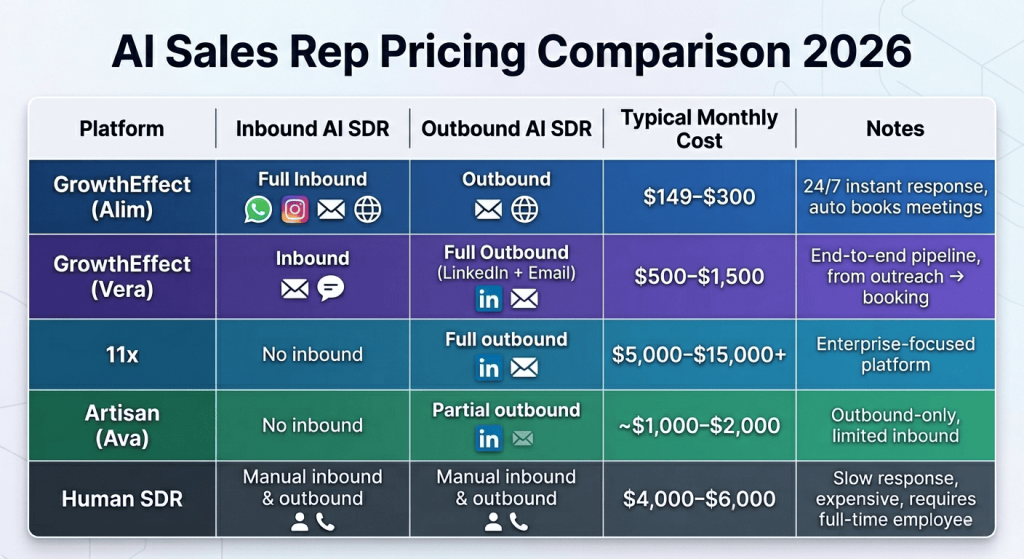
GrowthEffect is the only platform in this tier offering both inbound and outbound autonomous AI SDRs under one roof. No competitor currently offers a closed-loop system where the same platform fills the top of funnel via outbound and converts inbound leads simultaneously.
For full and current pricing details, visit the GrowthEffect pricing page.
How Vera Is Priced: Outbound AI Sales Rep
Vera is GrowthEffect’s outbound AI sales rep built to generate pipeline autonomously on LinkedIn and email, without requiring a human SDR to operate the workflow.
Vera’s pipeline execution order matters for understanding what you are actually paying for. She does not simply send templates at scale. The full workflow runs: ICP-based lead sourcing, firmographic and technographic enrichment, hard rule-based scoring, AI-powered soft scoring, lead filtering, individual prospect research, outreach angle positioning, unique message copywriting, multi-channel send, and automatic follow-up sequences. Dormant CRM leads are also re-engaged automatically turning existing data assets into active pipeline.
This is the work that, in a human-staffed model, would require a full-time SDR running tools like Apollo for sourcing, a copywriter or senior rep for personalization, and a manager overseeing sequence cadences. Vera runs that entire stack autonomously.
Who should start with Vera:
- Companies with insufficient outbound pipeline and no capacity to hire another SDR
- Teams where existing SDRs are burning out on manual prospecting and copy tasks
- Founders or heads of sales who need consistent pipeline generation without adding payroll
- Organizations entering new markets where local SDR hiring is impractical
According to Gartner, AI SDRs trained on a company’s own sales playbooks and ICP data consistently outperform generic automation models. Vera operates with a company-specific knowledge base and ICP criteria, not a generic list-blast model.
How Alim Is Priced: Inbound AI Sales Rep
Alim is GrowthEffect’s inbound AI sales rep. He handles every incoming lead across WhatsApp, Instagram DMs, Facebook Messenger, email, and web forms qualifying, classifying, and routing without human involvement in each step.
The most common inbound failure mode is speed. A mid-market SaaS company generating 200 or more inbound leads per month may have a structured sales team but still lose deals simply because response times are measured in hours, not seconds. Alim’s average response time is under 20 seconds.
Alim is also not a chatbot a distinction worth making explicitly because it is the most common objection from companies that have tested script-based tools before. Chatbots follow decision trees. Alim operates with natural language understanding, runs full BANT qualification (Budget, Authority, Need, Timeline), classifies leads as hot, warm, or cold, books meetings directly on the sales team’s calendar for hot leads, continues nurturing conversations for warm leads, and operates across 20+ languages.
Who should start with Alim:
- Companies generating inbound leads but losing them to slow or inconsistent follow-up
- Sales teams where reps are spending significant time qualifying leads that turn out to be cold
- Businesses operating across multiple time zones where after-hours coverage is a revenue problem
- Organizations running paid acquisition who cannot afford to waste ad spend on unconverted leads
The Full-Funnel Deployment: Vera and Alim Together
The most capital-efficient deployment is running both agents together as a closed-loop system.
Vera generates pipeline from outbound. When those prospects respond whether on LinkedIn, by email, or through an inbound form Alim qualifies them in real time. Human closers only enter the conversation at the meeting stage, talking exclusively to pre-qualified, meeting-ready leads.
This model addresses the two most common revenue leakage points simultaneously: insufficient top-of-funnel pipeline (Vera) and slow or inconsistent inbound qualification (Alim). Salesforce’s 2024 State of Sales Report found that 81% of sales teams are either experimenting with or have fully implemented AI. The gap between early adopters and laggards in pipeline efficiency is widening.
For companies with both a pipeline generation problem and an inbound conversion problem, deploying both agents under one platform is structurally cheaper than addressing each problem with separate vendors or separate headcount.
What Drives Cost Differences Between AI Sales Rep Vendors
When evaluating AI sales rep pricing, four factors determine whether a lower headline price is actually a better deal:
1. Channel coverage. Some vendors cover email only. Others add LinkedIn. Alim covers WhatsApp, Instagram, Facebook Messenger, email, and web forms natively. Broader channel coverage without additional per-channel fees changes the per-lead cost calculation.
2. Autonomy depth. How much human review is required per lead or per sequence? If a human needs to approve each message before send, the platform is augmentation, not automation. Vera writes and sends without per-message approval.
3. CRM integration quality. Poor CRM integration creates data hygiene problems downstream that cost sales ops significant time. Vera and Alim integrate natively with HubSpot, Salesforce, and Pipedrive, writing clean, structured data on every lead interaction.
4. Inbound capability. Most AI SDR vendors are outbound-only. If inbound qualification is a separate problem requiring a separate vendor, the total cost of the tech stack increases. GrowthEffect covers both with one contract.
Frequently Asked Questions
1. How long does it take to deploy an AI sales rep like Vera or Alim?
Deployment is measured in days, not months. There is no ramp period comparable to a human SDR. Vera and Alim are configured with your ICP criteria, company knowledge base, CRM integration, and channel access during onboarding. Once live, they begin executing immediately. Compare this to a human SDR, who typically reaches full productivity after 2 to 3 months.
2. Do I need technical resources to manage Vera or Alim?
No. Both agents are managed through GrowthEffect’s platform interface, not through developer configuration. CRM integrations are native and do not require custom development. For technical and RevOps-specific questions, visit the FAQ page.
3. What happens when a lead is ready to buy? Does the AI close the deal?
Neither Vera nor Alim is a closing tool. Vera generates pipeline and books meetings. Alim qualifies inbound leads and routes hot leads directly to a human closer or calendar booking. The human sales team handles all closing conversations the AI removes all pre-meeting work from the human’s plate.
4. Can Vera target a specific ICP, or does she send generic outreach?
Vera operates on ICP criteria you define: industry, company size, role, buying signals, firmographic filters, and more. Each message is unique to the prospect not a template. Vera researches each target’s company context, recent activity, and relevant pain points before writing the outreach angle. This is what distinguishes Vera from bulk email tools that simply personalize a first name.
5. Is GrowthEffect a fit for companies outside Turkey?
Yes. GrowthEffect’s current geographic focus is Turkey, the MENA region, Western Europe, and the US. Alim supports 20+ languages natively including Turkish, English, and Arabic. Vera operates on LinkedIn and email without geographic restrictions. For market-specific questions, book a demo to discuss your ICP and target region directly.
Ready to See How Vera and Alim Perform on Your Pipeline?
The right starting point depends on your immediate constraint. If outbound pipeline is insufficient or dependent on a small, overextended SDR team, start with Vera GrowthEffect’s outbound AI sales rep. If inbound leads are going unanswered or taking hours to qualify, start with Alim GrowthEffect’s inbound AI sales rep. If both are problems, deploy both. One platform, full outbound and inbound coverage.
- Vera Outbound AI Sales Rep — Autonomous prospecting, signal-based personalisation, multi-channel sequencing, self-learning architecture
- Alim Inbound AI Sales Rep — 24/7 qualification across WhatsApp, Instagram, email, and web forms
- Pricing — Full cost breakdown and plan details
- FAQ — Common questions on setup, ICP definition, and channel coverage
- Full AI Sales Rep Guide — What it is, how it works, and ROI breakdown
Sources: MarketsandMarkets AI SDR Market Report (2025); Gartner B2B Buyer Survey (2025); Harvard Business Review lead response time research; Salesforce State of Sales Report (2024); Gartner AI SDR cost benchmarks via Lyzr (2025).
Leave a Reply