AI Sales Agent: What It Is & How It Works
Introduction
An AI sales agent is the fastest-growing alternative to the traditional SDR – and for good reason. Your pipeline doesn’t have a data problem. It has a coverage problem.
Every day, companies lose deals not because they lack leads, but because no one responds fast enough. The average business takes 47 hours to follow up on an inbound inquiry – and by then, the deal has already moved somewhere else. So an AI sales agent closes that gap, not by automating a task, but by doing the entire job.
This article breaks down what an AI sales agent actually is, how the two core types work (inbound and outbound), and where the technology genuinely delivers results – versus where it doesn’t.
Table of Contents
- What Is an AI Sales Agent?
- Why Traditional SDRs Can’t Scale This Way
- The Two Types of AI Sales Agents
- How Inbound AI Sales Agents Work (Alim)
- How Outbound AI Sales Agents Work (Vera)
- How the Full-Funnel Model Works Together
- Real-World Use Cases
- Key Benefits – With the Numbers
- What AI Sales Agents Are Not
- Who This Is Not For
- FAQ
- Ready to See How Vera and Alim Perform on Your Pipeline?
- Conclusion
What Is an AI Sales Agent?
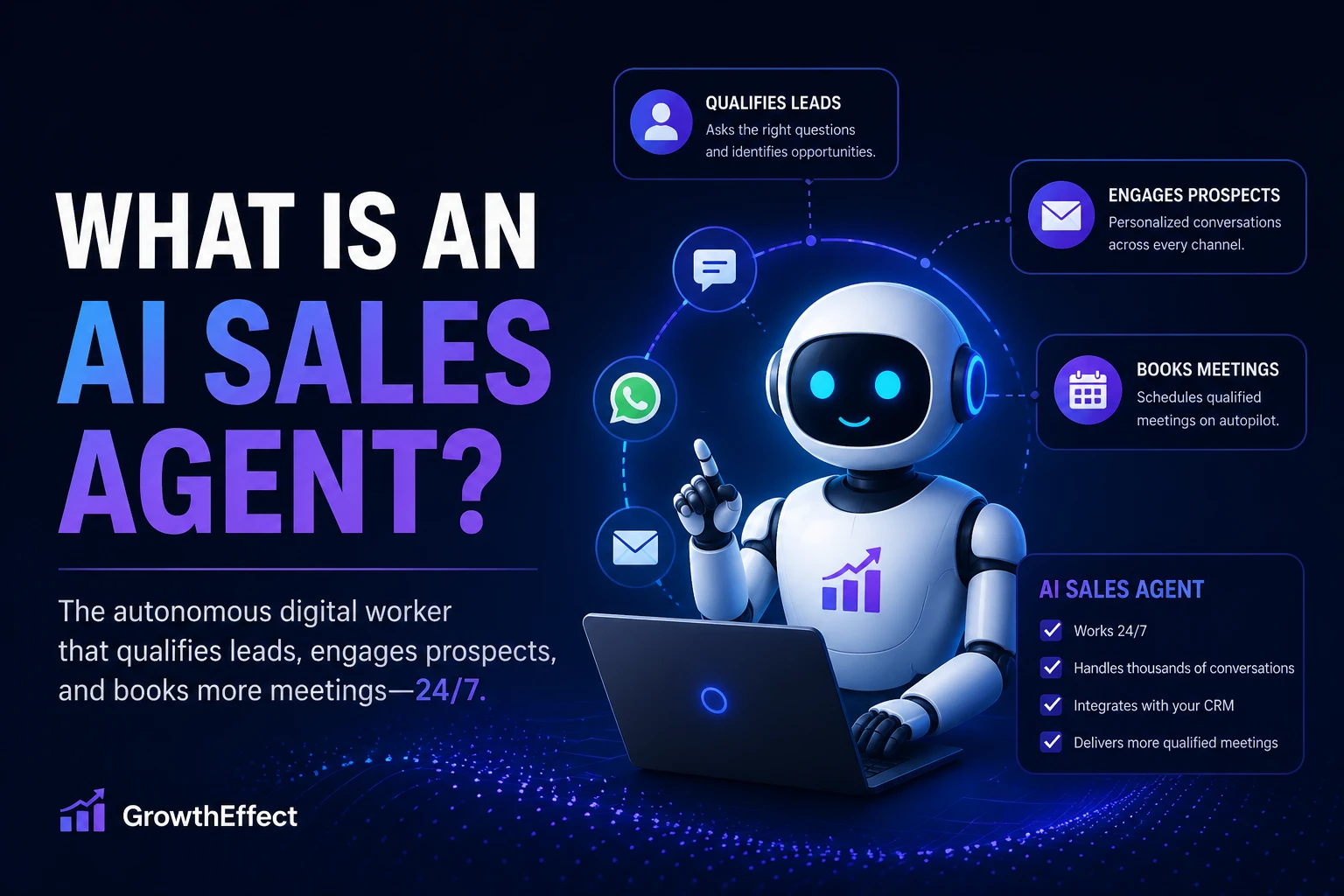
An AI sales agent is an autonomous digital worker that performs sales development functions without human input. It doesn’t assist a rep – instead, it replaces the rep’s first-touch responsibilities entirely.
Where a traditional SDR manually qualifies leads, writes outreach, follows up, and books meetings – an AI sales agent does all of this autonomously, at scale, across every channel, around the clock.
The distinction from older automation tools is important. Email sequences, CRM workflows, and chatbots are tools that still need a human to configure, monitor, and operate them. An AI sales agent, however, is the worker – not the workflow.
According to Gartner, by 2028 the majority of B2B sales interactions will be managed by AI – a shift that makes understanding this technology not optional, but essential.
Why Traditional SDRs Can’t Scale This Way
Human SDRs are expensive, inconsistent, and time-bound.
In Turkey, a fully-loaded SDR costs between $4,000 and $6,000 per month when salary, benefits, tools, and management time are included. In the US or Europe, that figure rises to $8,000-$12,000. Add a 2-3 month ramp period before they reach productivity, an average tenure of just 14 months before they leave, and the economics become difficult to justify.
The performance problem is just as significant. A human SDR works 8 hours a day on weekdays, while response quality varies by mood, fatigue, and workflow. Because of this, leads that arrive on a Saturday evening, or at 11pm after a product launch, go uncontacted until Monday morning – when the prospect has already moved on.
According to Harvard Business Review, the average lead response time across industries is 47 hours – and after just 5 minutes without a response, the probability of contacting that lead drops by 10 times. When 35-50% of deals go to the vendor that responds first, slow follow-up isn’t a minor inefficiency – it’s a direct revenue leak.
The Two Types of AI Sales Agents
There are two fundamentally different functions in sales development: inbound qualification and outbound prospecting. An AI sales agent is built to own one of them – or both.
Inbound AI sales agents handle every lead that comes in. They engage, qualify, and route or book – instantly, across all channels.
Outbound AI sales agents, however, go out and generate pipeline proactively. They source, enrich, research, and reach out to ideal-fit prospects through LinkedIn and email.
Most competitors in this space offer one or the other. But a complete AI sales team requires both – a closed-loop system where outbound generates interest and inbound converts it.
How Inbound AI Sales Agents Work (Alim)
The diagram below shows how an inbound AI sales agent qualifies and routes leads automatically.
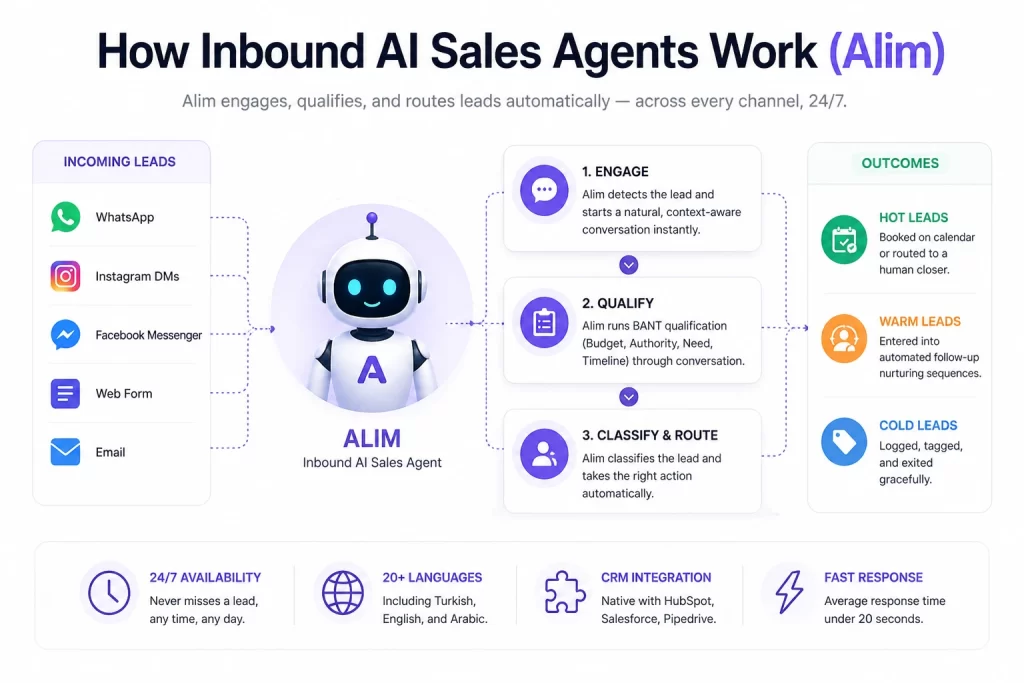
Alim is GrowthEffect’s inbound AI sales agent. When a lead arrives – through WhatsApp, Instagram DMs, Facebook Messenger, a web form, or email – Alim responds within seconds.
Here’s what happens at each stage:
Detection and engagement. Alim detects the incoming lead and opens a context-aware conversation. Rather than following a scripted response tree, it runs a natural exchange that adapts based on what the prospect actually says.
Qualification. Alim then runs BANT qualification (Budget, Authority, Need, Timeline) through conversation. Every lead gets the same rigorous qualification, regardless of what time they reach out or what channel they used.
Classification and routing. Based on qualification signals, Alim classifies the lead as Hot, Warm, or Cold:
- Hot leads get immediately booked on the sales team’s calendar or routed to a human closer.
- Warm leads receive follow-up nurturing sequences, automatically.
- Cold leads are logged, tagged, and exited gracefully – so a closer’s time is never wasted.
Alim operates 24/7, across 20+ languages including Turkish, English, and Arabic. It also integrates natively with HubSpot, Salesforce, and Pipedrive – so every lead handoff arrives with clean qualification data.
The average response time is under 20 seconds. The industry average, by contrast, is 47 hours.
How Outbound AI Sales Agents Work (Vera)
The diagram below shows how an outbound AI sales agent builds pipeline through automated prospecting and outreach.
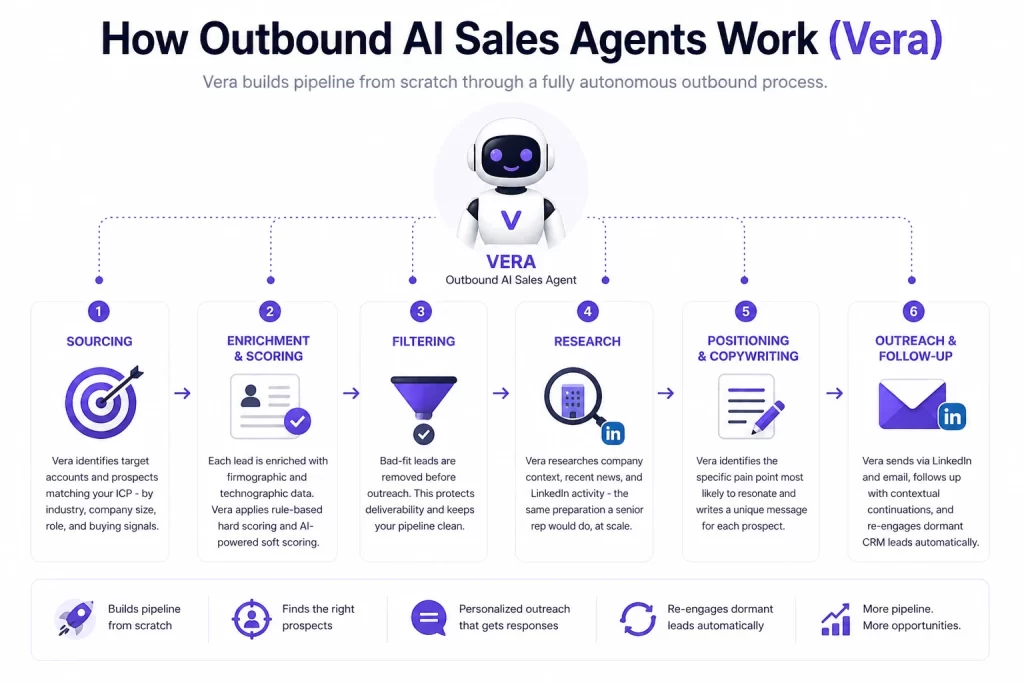
Vera is GrowthEffect’s outbound AI sales agent. While Alim handles what’s coming in, Vera builds pipeline from scratch.
Vera’s pipeline runs in this order:
Sourcing. Vera identifies target accounts and prospects matching your ICP – by industry, company size, role, and buying signals.
Enrichment and scoring. Next, each lead is enriched with firmographic and technographic data. Vera then applies both rule-based hard scoring and AI-powered soft scoring to prioritize the right prospects.
Filtering. Before any outreach happens, bad-fit leads are removed. This protects deliverability and keeps your pipeline clean.
Research. For every prospect that passes scoring, Vera researches their company context, recent news, and LinkedIn activity. Rather than surface-level data pulling, it does the same preparation a senior rep would do before personalized outreach – at scale.
Positioning and copywriting. After research, Vera identifies the specific pain point most likely to resonate with each prospect and writes a unique message – not a template with a name merged in.
Outreach and follow-up. Finally, Vera sends via LinkedIn and email, follows up with contextual continuations, and re-engages dormant CRM leads automatically.
This is the full outbound job – not a workflow tool that a human then executes, but the execution itself.
How the Full-Funnel Model Works Together
The diagram below shows how inbound and outbound AI sales agents work together to create a full-funnel sales system.
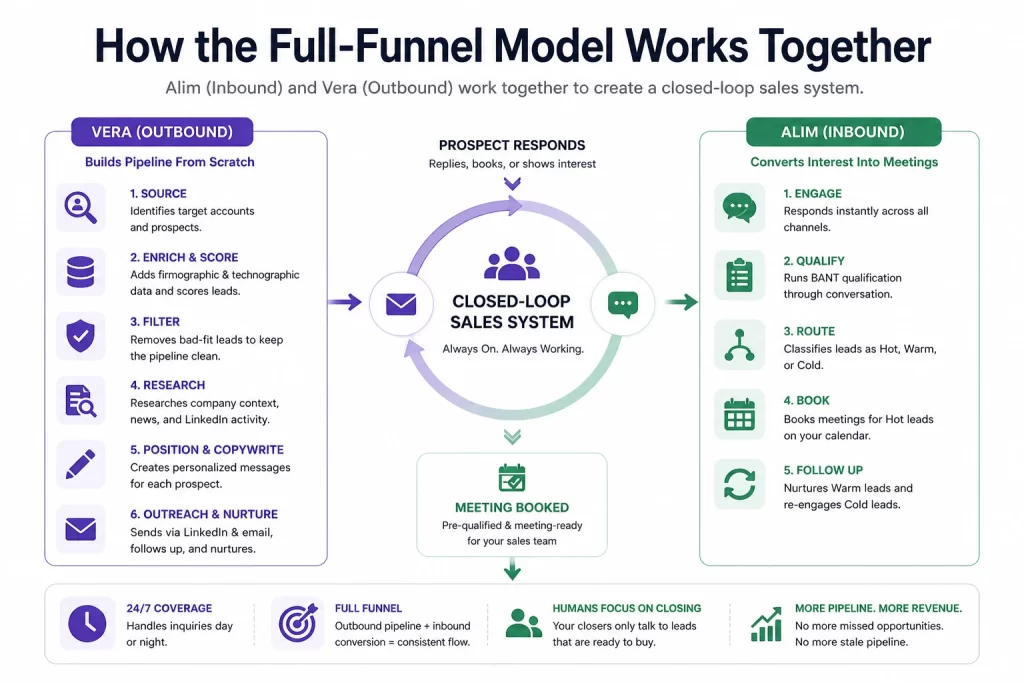
When Alim and Vera operate together, they form a closed-loop sales system.
Vera generates outbound pipeline – sourcing, reaching out, and nurturing until a prospect raises their hand. When that prospect responds, Alim takes over – qualifying, routing, and booking the meeting.
Because of this split, your human closers only enter the conversation when a lead is pre-qualified and meeting-ready. Cold inquiries at 2am get handled automatically. Stale form fills never pile up. Your closers focus entirely on closing.
This is the Human + AI split that makes the model work:
- AI handles: prospecting, qualification, first-touch, follow-up, scheduling, after-hours coverage
- Humans handle: closing, relationship building, complex negotiation, strategic accounts
While competitors focus on one side of the funnel, no other provider currently offers both inbound and outbound as a unified AI sales team.
Real-World Use Cases
The SaaS company with too many leads and too few reps.
A B2B SaaS company generating 200+ inbound leads per month can’t keep up with response volume. Leads arrive through WhatsApp, web forms, and email at all hours. As a result, response times stretch to hours or days. Alim responds to every lead in under 20 seconds, qualifies by BANT, and delivers only meeting-ready leads to the sales team.
The sales team running outbound on willpower alone.
An outbound function that depends on rep discipline and motivation creates inconsistent pipeline. When burn-out sets in, outreach volume drops. Vera, however, runs structured outbound every day – without volume decay and without morale risk.
The business missing after-hours opportunities.
A global or time-zone-distributed business is routinely losing leads that arrive outside working hours. Because Alim covers every time zone 24 hours a day, no lead goes uncontacted due to shift gaps.
The company with a CRM full of cold data.
A large CRM database with hundreds of dormant leads represents untapped pipeline. Instead of letting that data sit idle, Vera re-engages those leads automatically – turning existing contacts into new pipeline without additional sourcing cost.
The founder doing sales alone.
A CEO or founder personally handling qualification and outreach becomes a bottleneck to growth. Once Alim and Vera are deployed, they take over the first-touch SDR function entirely – freeing the founder to focus on closing.
Key Benefits – With the Numbers
| Dimension | Human SDR | AI Sales Agent |
|---|---|---|
| Response time | Hours to days (industry avg: 47 hours) | Under 20 seconds |
| Coverage hours | 8h/day, weekdays only | 24/7/365 |
| Ramp time | 2-3 months | Days |
| Turnover risk | High (avg tenure: 14 months) | Zero |
| Process consistency | Variable by rep and day | Identical across every lead |
| Language coverage | 1-2 languages typically | 20+ languages natively |
| CRM integration | Manual or inconsistent | Native (HubSpot, Salesforce, Pipedrive) |
What AI Sales Agents Are Not
Not a chatbot.
Chatbots follow script trees, so when a prospect says something unexpected, they fail. Alim, however, has natural language understanding and context awareness – running full BANT qualification and adapting to what the prospect actually says. The underlying technology and commercial outcome are completely different.
Not another Apollo or Outreach.
Those platforms give your team workflow software, but a human still has to operate them. Vera, on the other hand, IS the operation. You don’t need to hire someone to run Vera – Vera is the hire.
Not a marketing automation platform.
Email automation sends bulk sequences but doesn’t converse, qualify, or adapt. An AI sales agent, by contrast, has real-time conversational intelligence that responds to what the prospect actually says.
Not a full sales replacement.
AI sales agents handle first-touch – prospecting, qualification, and meeting booking. Closing, relationship development, and complex negotiation remain in human hands. The goal is simply to make sure your best salespeople only talk to pre-qualified leads.
Who This Is Not For
AI sales agents work best for post-revenue companies with an active sales function and consistent lead volume. If any of the following applies, however, this may not be the right fit right now:
- Pre-revenue companies that haven’t established product-market fit yet. AI scales the motion; it doesn’t create it.
- Companies with fewer than 5-10 leads per month. The volume simply doesn’t justify the infrastructure.
- Businesses selling entirely through channel or partner models with no direct sales function.
- Buyers looking for an assistant to co-pilot existing reps. AI sales agents replace the SDR role at first-touch – they don’t augment existing reps in the closing stage.
If your pipeline problem comes from not having a sales process yet, solve that first. Then deploy AI on top of it.
FAQ
Can an AI sales agent replace a human SDR entirely?
For first-touch functions – qualification, outreach, follow-up, and scheduling – yes. AI sales agents perform those functions autonomously at a consistency level that human SDRs can’t match across every hour of every day. What they don’t replace, however, is the closing stage, where relationship development and complex judgment are still done better by humans. The model works best when AI owns first-touch and human closers own everything after the meeting is booked.
What if the AI says something wrong to an important lead?
Alim operates within a company-specific knowledge base with defined guardrails. It doesn’t hallucinate offers, make promises outside its defined scope, or invent discounts. Because escalation rules determine exactly when a lead gets routed to a human, hot leads always reach a closer before any commitment is made.
Is this just a chatbot with a better name?
No. Chatbots are script trees: if the prospect says X, respond with Y. When a prospect deviates from the script, chatbots fail. Alim, by contrast, uses natural language understanding and context awareness. It runs full BANT qualification, adapts to what the prospect actually says, and books meetings end-to-end. So the technology and the outcome are completely different.
How does it integrate with our existing CRM?
Alim and Vera both integrate natively with HubSpot, Salesforce, and Pipedrive. Every lead qualification result, conversation log, and routing decision is written back to your CRM with clean, structured data. As a result, there’s no manual data entry and no broken handoffs.
How long does it take to get an AI sales agent running?
Unlike a human SDR who requires 2-3 months to reach productivity, Alim and Vera are operational within days. Onboarding involves setting up the knowledge base, qualifying criteria, CRM integration, and channel connections. Because setup is structured and guided, the ramp period is measured in days – not months.
Ready to See How Vera and Alim Perform on Your Pipeline?
GrowthEffect builds AI sales agents that own the first-touch SDR function end-to-end. Here’s what’s available:
- 👉 Vera, Outbound AI Sales Agent — Autonomous prospecting, hyper-personalized outreach, multi-channel sequencing via LinkedIn and email.
- 👉 Alim, Inbound AI Sales Agent — 24/7 qualification across WhatsApp, Instagram DMs, Facebook Messenger, web forms, and email.
- 👉 Pricing — Full cost breakdown and plan details
- 👉 FAQ — Common questions about setup, integration, and use cases
- 👉 Blog — More guides on pipeline generation, lead qualification, and AI sales
- 👉 Book a Demo — See Alim and Vera in a live conversation with your actual use case
Conclusion
An AI sales agent isn’t a productivity shortcut. It’s a staffing decision.
The question isn’t whether AI can qualify leads or run outbound – it can. But the more important question is whether your current pipeline coverage is actually competitive: the hours it operates, the consistency it delivers, and the speed at which it responds.
Forrester research consistently shows that revenue teams adopting AI for pipeline functions outperform peers on quota attainment and cost-per-meeting metrics. The gap between early adopters and laggards is widening.
If you’re losing deals to slow follow-up, burning out reps on outbound nobody wants to do, or watching leads go cold while your team catches up from yesterday’s queue, then the AI sales agent model is worth understanding in detail.
Alim handles what comes in. Vera builds what doesn’t exist yet. Together, they run a sales development function that doesn’t sleep, doesn’t ramp, and doesn’t quit.
Want more like this?
Explore our blog for guides on AI agents, sales automation, and inbound strategy.
Leave a Reply