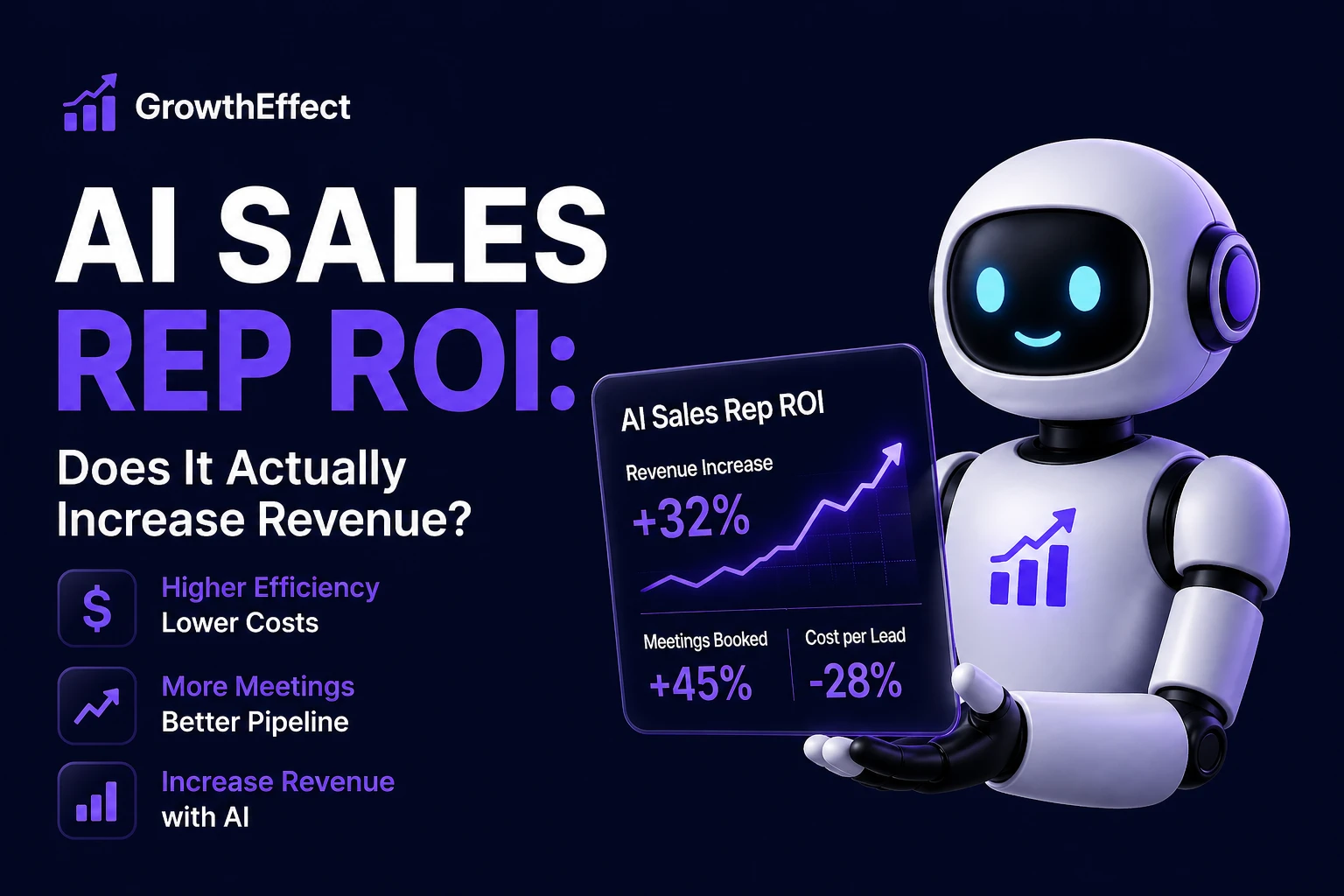
AI Sales Rep ROI: Does It Actually Increase Revenue?
Introduction
If you are evaluating AI sales rep ROI, you have probably heard the promises before faster pipeline, lower cost, 24/7 coverage. However, the real question is whether those promises hold up when you run the actual numbers. This article gives you the honest breakdown: where AI sales rep ROI comes from, what verified research says, and what companies can realistically expect when they deploy Alim and Vera from GrowthEffect.
Table of Contents
- What AI Sales Rep ROI Actually Means
- The Data on Lead Response Time Is Damning
- The True Cost of a Human SDR — What Most Teams Miss
- The Consistency Gap: Why Human Averages Are Misleading
- How Alim and Vera Generate AI Sales Rep ROI
- The Cost Comparison: AI Sales Rep ROI vs. Human SDR
- What You Can Realistically Expect
- Where AI Sales Rep ROI Breaks Down
- Who This Is NOT For
- FAQ
What AI Sales Rep ROI Actually Means
Understanding AI sales rep ROI requires looking beyond revenue and focusing on the core drivers that actually impact performance.
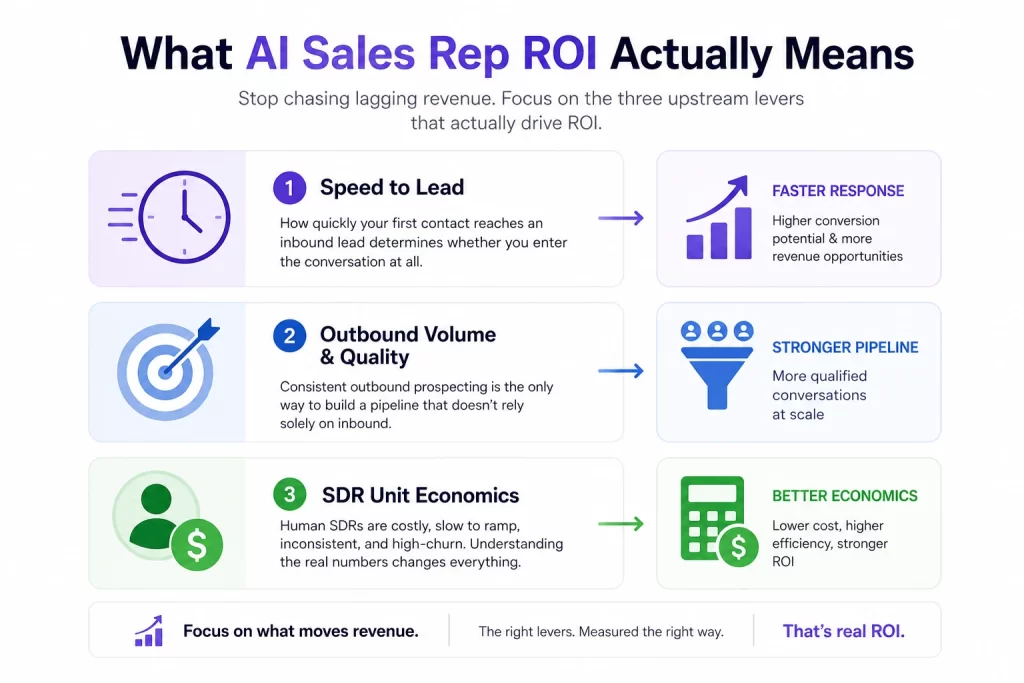
These three levers define how AI sales agents impact revenue more directly than traditional lagging metrics.
Most ROI conversations start in the wrong place. They try to measure “revenue generated by AI” but revenue is a lagging indicator. What you actually need to measure are the three upstream levers that drive it.
Lever 1: Speed to Lead. How quickly your first contact reaches an inbound lead determines whether you enter the conversation at all. This is the most immediate, most measurable ROI driver and the one backed by the most compelling research.
Lever 2: Outbound volume and quality. Consistent outbound prospecting is the only way to fill a pipeline that does not depend on inbound alone. The ROI question here is straightforward: what does it cost to run structured outbound at scale and what is the real alternative?
Lever 3: SDR unit economics. Human SDRs are expensive, slow to ramp, inconsistent in output, and high-churn. Because the fully loaded cost is rarely what the salary line shows, understanding the real number changes the comparison entirely.
Why All Three Levers Matter Together
Fix all three, and revenue follows. If you miss any one of them, the others cannot compensate. AI sales rep ROI is not a single metric it is the compounding effect of closing three structural gaps that most sales teams treat as unavoidable.
When you frame it this way, the evaluation becomes simpler. You are not asking “is AI better than my best SDR?” Instead, you are asking “is AI better than the average output I am currently getting at a predictable, fixed cost?” That question almost always has a clearer answer.
The Data on Lead Response Time Is Damning
The average lead response time across B2B companies sits at around 42–47 hours. That is almost two full working days of silence after a prospect raises their hand. By then, the lead has researched competitors, evaluated alternatives, and in many cases already made a preliminary decision.
A Harvard Business Review study that analyzed 2.24 million sales leads found that firms who tried to contact potential customers within an hour of receiving a query were nearly seven times as likely to qualify the lead as those who waited even 60 minutes. The same study showed that companies waiting 24 hours or more were 60 times less likely to qualify the lead compared to those who responded within the first hour.
Furthermore, research from MIT and InsideSales.com found that companies contacting leads within 5 minutes are 21 times more likely to qualify that lead compared to those who wait 30 minutes.
The Conversion Decay Curve
| Response Window | Conversion Impact |
|---|---|
| Under 5 minutes | 21x more likely to qualify than waiting 30 minutes (MIT / InsideSales.com) |
| Within 1 hour | 7x more likely to qualify than waiting longer (Harvard Business Review) |
| After 1 hour | Qualification odds begin declining sharply with every passing hour |
| After 24 hours | 60x less likely to qualify vs. responding within the first hour (Harvard Business Review) |
| Industry average (42–47 hours) | Lead has almost certainly moved on or made a preliminary decision |
According to multiple studies, 78% of buyers go with the first company that responds not the cheapest, not the most established. Simply the first one that answers.
The Revenue Leak You Are Not Tracking
Because 30% of leads are never contacted at all, three out of every ten prospects who expressed interest never received a reply. For a company generating 200 inbound leads per month, that is 60 leads per month evaporating before a human even sees them. If your average deal size is $10,000, that represents $600,000 in potential pipeline erased by silence every single month.
This is the core of the speed-to-lead AI sales rep ROI case. It is not about AI being smarter than your SDRs. It is about AI being available at 11 PM on a Friday when your SDRs are not and about the revenue difference that gap creates at scale.
The True Cost of a Human SDR What Most Teams Miss
When most leaders calculate SDR cost, they look at base salary. However, that is the wrong number and it understates the real figure by 2–3x.
Here is what a fully loaded SDR actually costs in 2025, based on published benchmarks from The Bridge Group’s SDR Metrics Report and SalesHive research:
| Cost Category | Turkey | US / EU |
|---|---|---|
| Base salary + OTE | Included in $4–6K/mo total | $80K–$85K/year total |
| Benefits + overhead | Included | +30–40% on top of salary |
| Sales tools (CRM, data, outreach platforms) | $2K–$8K/rep/year | $2K–$8K/rep/year |
| Management time (1 manager per 8–10 SDRs) | $15K–$18K/rep/year | $15K–$18K/rep/year |
| Recruiting + onboarding (per hire) | $5K–$10K | $5K–$10K |
| Ramp period (3.2 months at reduced productivity) | $22K–$38K in missed pipeline | $22K–$38K in missed pipeline |
| Fully loaded annual cost | $48K–$72K/year | $110K–$160K/year |
The Turnover Multiplier
That calculation still does not include turnover and turnover is where the economics truly deteriorate. According to The Bridge Group’s SDR Metrics & Compensation Report, the average SDR ramp time is 3.2 months, and average tenure sits at 14–16 months. In other words, for every SDR you hire, you get roughly 10–12 months of full productivity before the cycle restarts.
The cost of losing one SDR including recruiting fees, lost pipeline during the vacancy, the productivity drain on the team absorbing the gap, and ramp time for the replacement is commonly estimated at $100,000 or more per departure. For a 5-person SDR team with industry-average turnover, that translates to $260,000–$500,000 per year in costs that never appear as a single budget line item but show up in missed pipeline every quarter.
The Ramp Problem Has Gotten Worse
SDR ramp time has been increasing year over year. The Bridge Group’s research consistently shows SDRs averaging 3.2 months to reach full productivity, and full-cycle AE ramp times have extended to 5.7 months in 2025 up 32% from 2020. Every day a rep is not at full productivity is a day the business is paying for output it is not receiving. When you multiply that across a team with regular turnover, the drag on revenue becomes significant and largely invisible in standard reporting.
The Consistency Gap: Why Human Averages Are Misleading
When sales leaders defend their human SDR teams, they typically reference their best performers. However, ROI is built on the average not the outlier.
According to Salesforce’s State of Sales report, sales reps spend roughly 70% of their time on non-selling tasks administrative work, CRM data entry, meeting prep, and internal reporting. That means the average SDR is actively prospecting or qualifying for only about 30% of their working hours. You are paying for 40 hours per week; you are getting approximately 12 hours of productive outreach.
What AI Does to Active Selling Time
Research consistently shows that AI tools help sellers reclaim meaningful time previously lost to manual tasks. A Gartner survey of 1,026 B2B sellers found that sellers who effectively partner with AI tools are 3.7 times more likely to meet quota than those who do not. LinkedIn’s 2025 data further shows that sellers using AI save an average of 1.5 hours per week on research alone and those users are twice as likely to exceed their targets.
Beyond time, there is the variability problem. A human SDR’s output on a Monday after a difficult weekend is not the same as their output on a Thursday after closing a deal. Mood, health, distraction, and burnout all affect qualification quality and follow-up consistency. None of this appears in headcount plans but all of it shows up in win rates and pipeline predictability.
Consistency is not a soft benefit. When every lead receives the same rigorous qualification process regardless of who is on shift, the pipeline becomes predictable. Because predictable pipeline is what enables growth without chaos, this is ultimately a financial output not a cultural one. That is precisely where AI sales rep ROI becomes structural rather than situational.
How Alim and Vera Generate AI Sales Rep ROI
GrowthEffect deploys two autonomous digital sales employees one for inbound, one for outbound. Each addresses a distinct revenue leak, and together they close the full pipeline gap.
Alim (Inbound AI SDR) — Speed to Lead at Scale
Here’s how an inbound AI SDR like Alim handles and qualifies every lead in seconds.
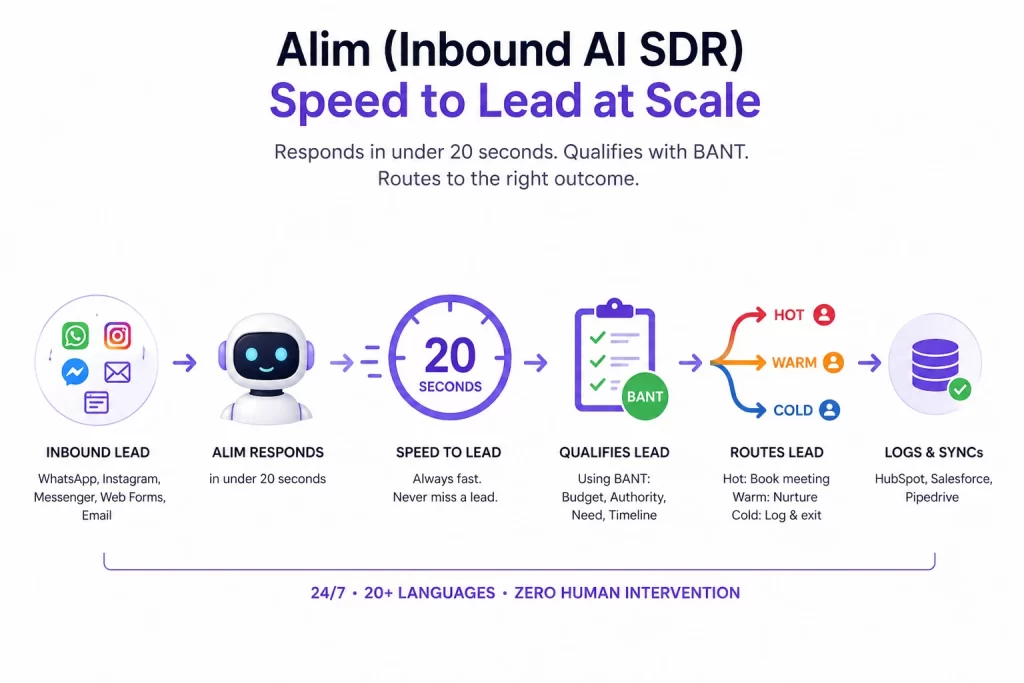
This process is what makes speed to lead one of the highest-impact drivers of AI sales rep ROI.
Alim responds to every incoming lead in under 20 seconds across WhatsApp, Instagram DMs, Facebook Messenger, web forms, and email. Because this is not an automated reply but a BANT-qualified conversation, leads are routed to the right outcome without any human intervention.
Alim’s qualification pipeline runs the same way on every lead:
- Detects incoming lead within seconds average response time under 20 seconds
- Engages in a context-aware conversation using natural language understanding, not script trees
- Qualifies using the BANT framework: Budget, Authority, Need, Timeline
- Classifies lead temperature Hot (books meeting), Warm (nurtures), Cold (logs and exits gracefully)
- For Hot leads: routes to human closer or books a calendar slot directly
- For Warm leads: continues follow-up sequence automatically
- Logs all outcomes and conversation data cleanly to HubSpot, Salesforce, or Pipedrive
The AI sales rep ROI driver for Alim is straightforward: every inbound lead that previously waited 42 hours for a response now gets a qualified conversation in under 20 seconds 24 hours a day, 7 days a week, in 20+ languages including Turkish, English, and Arabic.
Consider the math for a mid-market SaaS company generating 200 inbound leads per month. If current response time averages even 4 hours well below the industry average a significant portion of those leads have already moved on before first contact. Because Alim responds in under 20 seconds, that pool of “already gone” leads becomes a pool of “currently qualified” leads. The revenue impact is not incremental; it is structural.
Vera (Outbound AI SDR) — Pipeline Without Headcount
Here’s how an outbound AI SDR like Vera builds pipeline end-to-end without adding headcount.
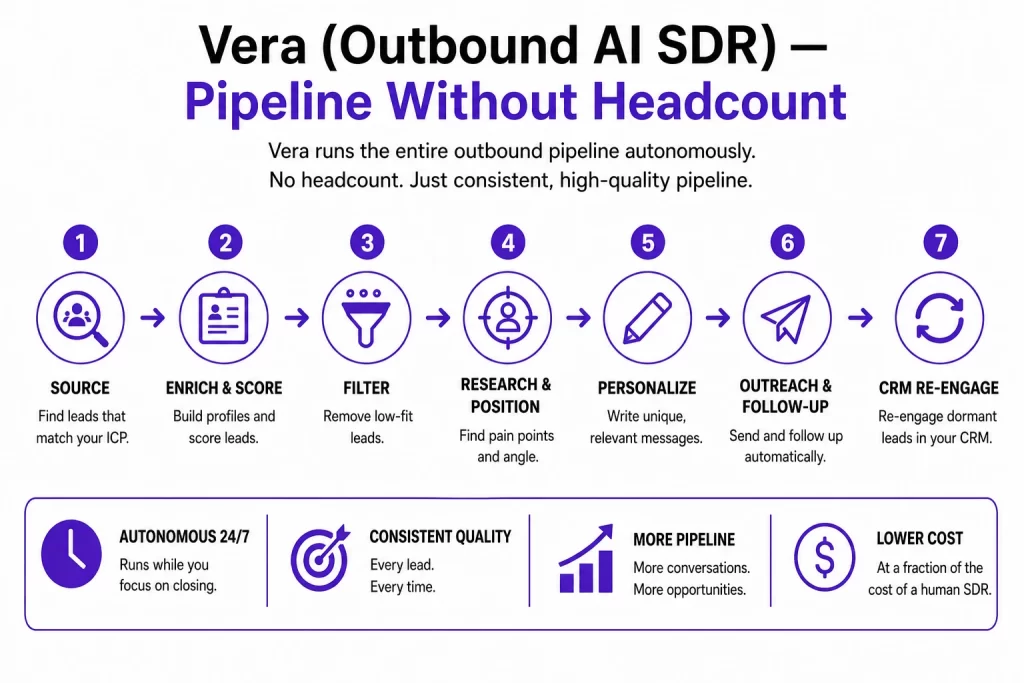
This is why outbound AI SDRs can generate consistent pipeline at scale with lower cost and higher ROI.
Vera runs the entire outbound pipeline autonomously. She does not assist a human doing outbound she does it herself, end to end, at a quality and consistency no single human SDR could sustain across the same volume.
Vera’s pipeline process runs in full sequence:
- Sourcing: Identifies leads based on ICP criteria industry, company size, role, buying signals
- Enrichment: Builds complete profiles with firmographic and technographic data
- Hard scoring: Rule-based filtering against your defined ICP parameters
- AI scoring: Soft scoring using behavioral and contextual signals
- Filtering: Removes bad-fit leads before any outreach happens no wasted touches
- Research: Deep-dives each prospect company news, LinkedIn activity, role context
- Positioning: Identifies the specific pain point to lead with for each prospect
- Copywriting: Writes a unique, personalized message for each prospect not a template with variable substitutions
- Outreach: Sends via LinkedIn and/or email based on channel strategy
- Follow-up: Follows up automatically with contextual messages, not generic sequences
- CRM re-engagement: Surfaces and re-engages dormant leads from your existing database
The AI sales rep ROI from Vera is cost-versus-output. If your team is not running structured outbound because nobody wants to do cold prospecting, because you cannot justify SDR headcount, or because your existing team burns out after two weeks of manual outreach Vera fills that function at a fraction of the cost of a human outbound SDR. Sales engagement platforms like Apollo or Outreach still require a human operator. Vera is the worker. You do not hire someone to run Vera, Vera is the hire.
The Closed-Loop System: Full-Funnel Coverage
The compounding advantage of deploying both Alim and Vera is that you are not just plugging one leak you are running a complete, autonomous first-touch sales function. Vera fills the top of the funnel with qualified outbound prospects. Meanwhile, Alim converts inbound leads as they arrive. As a result, your human closers only speak with people who are ready to buy.
No other competitor in the AI SDR space offers both. GrowthEffect is the only platform where a 15-person company can run the same full-funnel sales motion that a 50-person team runs with a dedicated SDR function at a fraction of the cost.
The Cost Comparison: AI Sales Rep ROI vs. Human SDR
| GrowthEffect AI SDR | Human SDR (Turkey) | Human SDR (US/EU) | |
|---|---|---|---|
| Inbound coverage | Yes (Alim) | Yes (during working hours only) | Yes (during working hours only) |
| Outbound coverage | Yes (Vera) | Yes (during working hours only) | Yes (during working hours only) |
| Monthly cost | See Pricing | $4,000–$6,000/mo fully loaded | $8,000–$12,000/mo fully loaded |
| Coverage hours | 24/7/365 | ~8h/day, weekdays | ~8h/day, weekdays |
| Ramp time | Days | 3.2 months avg (Bridge Group) | 3.2–5.7 months avg (Bridge Group) |
| Turnover risk | Zero | High (avg tenure: 14–16 months) | High (avg tenure: 14–16 months) |
| Output consistency | Identical every time, every hour | Variable mood, burnout, tenure all affect output | Variable mood, burnout, tenure all affect output |
| WhatsApp-native inbound | Yes (Alim) | Depends on rep | Rarely |
| CRM integration | HubSpot, Salesforce, Pipedrive — native | Requires manual data entry | Requires manual data entry |
| Languages supported | 20+ incl. Turkish, English, Arabic | Depends on rep hired | Usually English-only |
The comparison that matters most for companies evaluating AI sales rep ROI is not GrowthEffect versus any single competitor. It is GrowthEffect versus the status quo which for most 10–250 employee companies means expensive human SDRs, inconsistent follow-up, and a CRM full of leads nobody has touched in months.
What You Can Realistically Expect From AI Sales Rep ROI
Salesforce’s State of Sales report (based on 5,500 sales professionals across 27 countries) found that 83% of sales teams using AI saw revenue growth, compared to 66% of teams without AI a 17-percentage-point performance gap. Moreover, Gartner forecasts that by 2028, 60% of B2B seller work will be executed through generative AI technologies up from less than 5% in 2023. This is not a distant prediction; it is a shift already underway in how go-to-market teams are being structured.
The AI Sales Rep ROI Timeline in Practice
| Timeline | What Changes | What You Measure |
|---|---|---|
| Day 1–7 (Alim live) | Every inbound lead gets a response in under 20 seconds, 24/7 | Response time, contact rate, after-hours lead capture |
| Week 2–4 | Qualification data flows cleanly into CRM. Hot leads routed without delay. | Meeting booking rate, AE calendar utilization, qualification rate |
| Week 3–6 (Vera live) | Outbound sequences running on ICP-matched prospects. First replies arriving. | Outbound reply rate, positive response rate, meetings booked |
| Month 2–3 | Outbound pipeline building. Dormant CRM leads re-engaged. Full-funnel operating. | Pipeline generated from outbound, SQLs from re-engagement, cost per meeting |
| Month 3+ | Vera’s self-learning architecture improves message quality. Alim’s qualification data compounds. | Cost per qualified meeting vs. human SDR baseline, revenue from AI-touched pipeline |
What you should not expect is revenue doubling in 30 days. Because AI sales rep ROI comes from structural improvements stopping lead loss, starting outbound pipeline, reducing SDR cost the impact compounds over time rather than arriving all at once. Companies that see the fastest returns are those with existing lead volume and no current structured outbound. When Alim fixes the inbound leak and Vera starts the outbound engine simultaneously, the pipeline acceleration is typically visible within the first quarter.
Where AI Sales Rep ROI Breaks Down
The return on investment case is strong but it is not unconditional. There are specific failure modes worth naming before you commit.
No human closer ready to receive leads. Because Alim and Vera handle first-touch, your closing team needs to be ready to convert a higher volume of pre-qualified meetings. If closers are unavailable or not structured to act on those meetings, the AI creates the opportunity but the business does not capture it.
Poorly defined ICP. Vera’s sourcing and scoring quality depends entirely on how clearly you have defined your ideal customer profile. When the ICP criteria are vague, she generates volume without quality. Precise targeting criteria produce precise pipeline and the inverse is equally true.
Unrealistic volume expectations in the first 30 days. Vera’s outbound pipeline builds progressively. Because weeks 1–3 involve setup, initial outreach, and early replies, expecting a full quarter of pipeline in month one sets up disappointment. The AI sales rep ROI math works on a 90+ day horizon, not a 30-day sprint.
Messy CRM data before re-engagement begins. Both Alim and Vera feed clean data into your CRM going forward but if your existing database is years out of date, Vera’s re-engagement sequences will surface irrelevant leads. A quick ICP filter on dormant records before Vera starts prevents wasted outreach and protects sender reputation.
Who This Is NOT For
Honest positioning matters more than a universal pitch. GrowthEffect is not the right fit for every company, and being clear about that is part of why the rest of this analysis holds up.
Pre-revenue companies that have not yet found product-market fit or established a repeatable sales motion. Because AI sales reps amplify an existing system, they do not create one from scratch. If you do not yet know who your best customer is, Vera does not know who to target.
Companies generating fewer than 5 leads per month. The speed-to-lead ROI is a volume play. With only two or three inbound leads per month, Alim’s 24/7 availability does not produce a measurable lift there are not enough data points to see the improvement.
Buyers looking for a co-pilot for existing SDRs. Alim and Vera replace the SDR function rather than assist humans who are already doing prospecting and qualification. If your goal is to make existing human SDRs more efficient, that is a different product category sales enablement tools rather than AI SDRs.
Enterprise companies requiring 500+ seat deployments with complex compliance, data residency, or custom security architecture. GrowthEffect is built for the 10–250 employee company with an active sales function and a pipeline problem not for enterprise procurement cycles that take 12 months.
Companies with no lead generation motion at all. If you are not doing any outreach right now and have no process in place, the first investment is a go-to-market strategy not an AI SDR. Alim and Vera scale a pipeline motion; they do not invent one from zero.
FAQ
Can an AI sales rep replace a human SDR entirely?
For the first-touch function prospecting, qualifying, following up, and booking meetings yes. Alim handles inbound qualification end-to-end, while Vera runs outbound pipeline generation autonomously. Closing, relationship building, and complex negotiation remain human responsibilities. The model is AI for first-touch, humans for closing.
How long does it take to see AI sales rep ROI?
Alim’s speed-to-lead improvement starts on day one. Vera’s outbound pipeline typically produces qualified meetings at volume within 4–6 weeks, depending on ICP clarity. Compared to a human SDR requiring 3.2 months to ramp before meaningful output (Bridge Group), the time-to-value advantage is substantial even in the early weeks.
What if the AI says something wrong to a prospect?
Alim operates within a defined knowledge base with explicit guardrails, it does not hallucinate pricing, invent features, or make promises outside its configured scope. Hot leads are always handed off to a human closer. Every conversation is fully logged in the CRM for review at any time.
How does it integrate with our current CRM?
GrowthEffect integrates natively with HubSpot, Salesforce, and Pipedrive. Qualification data, conversation history, lead temperature, and meeting records pass cleanly to your CRM at handoff, no manual entry, no broken workflows.
Is AI sales rep ROI measurable, or mostly anecdotal?
The primary drivers are standard CRM metrics: inbound response time before vs. after, contact rate, meetings booked from outbound, cost per qualified meeting, and pipeline from dormant re-engagement. The cost reduction side is equally straightforward: fully loaded SDR cost minus GrowthEffect’s monthly cost, multiplied by roles not hired. See the Pricing page for the numbers to run your own model.
Ready to See How Alim and Vera Perform on Your Pipeline?
If your pipeline has inbound leads going cold or outbound that is not running consistently, GrowthEffect deploys the AI sales team that covers both without adding headcount, without a 3-month ramp, and without the recurring cost of SDR turnover.
- 👉 Book a Demo — See Alim and Vera in a live session using real conversations, not a scripted walkthrough
- 👉 Alim — Autonomous inbound AI SDR: responds to every lead in under 20 seconds across WhatsApp, Instagram DMs, Facebook, web forms, and email qualifies using BANT and books meetings 24/7/365
- 👉 Vera — Autonomous outbound AI SDR: sources leads, enriches profiles, researches each prospect, writes hyper-personalized LinkedIn and email messages, and follows up — entirely autonomously
- 👉 Pricing — Full cost breakdown so you can run your own AI sales rep ROI calculation
- 👉 FAQ — Detailed answers to the most common questions about how Alim and Vera work in practice
- 👉 Blog — More guides on AI sales, pipeline generation, speed to lead, and outbound strategy
Conclusion
AI sales rep ROI is not a theoretical concept. Because it comes from fixing three specific, measurable problems leads that do not get a response within the window that matters, outbound that does not happen consistently, and an SDR function that costs far more than its salary line suggests the financial case is grounded in operational reality.
Alim closes the inbound leak. Vera builds the outbound pipeline. Together, they run the first-touch sales function that your human closers should never have been doing in the first place. As Salesforce’s research confirms, teams using AI are simply outgrowing those that do not by 17 percentage points in revenue growth, on a sample of 5,500 sales professionals across 27 countries.
The return on investment from AI sales reps works because the comparison is not “AI versus a great SDR.” Instead, it is “AI versus the average performance you are actually getting at a cost that does not compound with every hire, ramp, and resignation.” When you run that comparison with real numbers, the decision becomes clear.
Want more like this?
Explore our blog for guides on AI agents, sales automation, and inbound strategy.
Leave a Reply