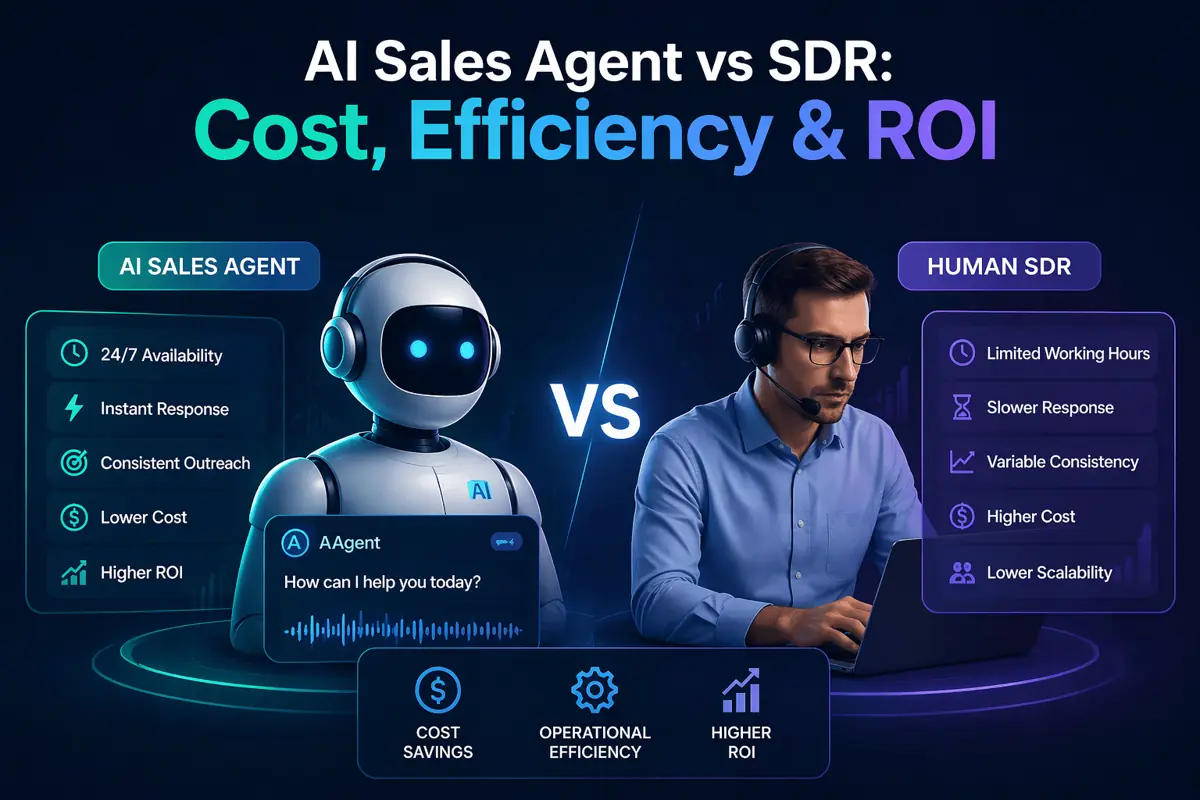
AI Sales Agent vs SDR: Cost, Efficiency and ROI Comparison
Introduction
The question facing most sales leaders today is not whether an AI sales agent vs SDR comparison favors one side. Instead, the question is how quickly a team can act on what the data already shows without disrupting active pipeline in the process.
This guide breaks down the real cost, efficiency, and ROI differences between an AI sales agent and a traditional human SDR. While the numbers come from Forrester, Gartner, and Harvard Business Review, the conclusions are grounded in what sales teams at 10 to 250-person companies actually experience.
Table of Contens
- What Is an AI Sales Agent and How Does It Differ from an SDR?
- Why Human SDRs Are Losing Ground to AI Sales Agents
- Head-to-Head Comparison: AI Sales Agent vs SDR
- ROI Comparison: AI Sales Agent vs SDR by the Numbers
- Vera: The AI Sales Agent That Replaces Your Outbound SDR
- Alim: The AI Sales Agent That Handles Every Inbound SDR Task
- AI Sales Agent vs SDR: Which One Does Your Pipeline Need?
- FAQ
- Ready to See How Vera and Alim Perform on Your Pipeline?
- Conclusion
What Is an AI Sales Agent and How Does It Differ from an SDR?
AI sales agents automate the top of your sales funnel, handling lead sourcing, engagement, and booking faster and more efficiently than human SDRs. See the differences and how they work together in the visual below
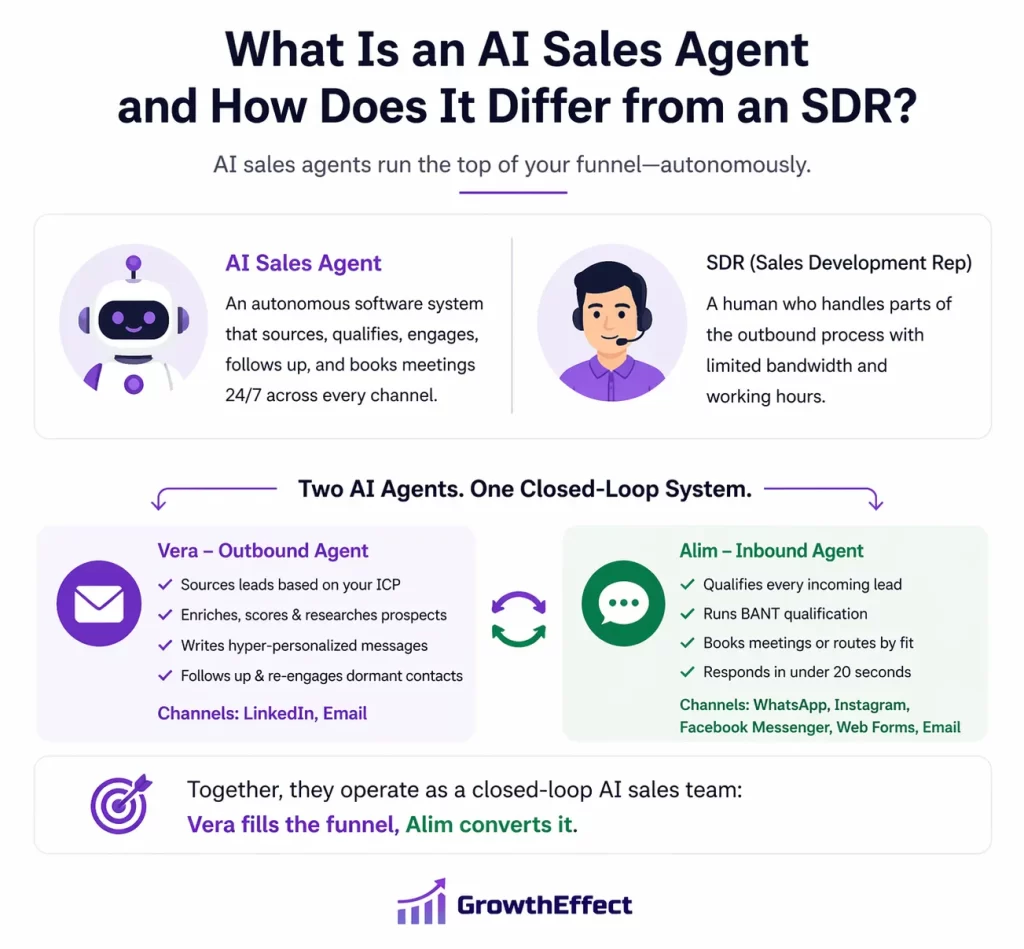
An AI sales agent is an autonomous software system that executes sales development tasks without human input. It sources prospects, qualifies inbound leads, runs outbound sequences, follows up, and books meetings directly into your sales team’s calendar.
This is not a chatbot. While chatbots follow rigid script trees and cannot qualify leads, adapt to context, or hand off to a calendar, an AI sales agent reasons across the full top-of-funnel workflow, adapts its messaging to each prospect, and operates 24 hours a day, 7 days a week, across every active channel.
At GrowthEffect, this takes two forms:
Vera handles outbound. She sources leads based on your ICP, enriches and scores them, researches each prospect, and writes hyper-personalized messages for LinkedIn and email. Vera then follows up autonomously and re-engages dormant CRM contacts.
Alim handles inbound. He qualifies every incoming lead across WhatsApp, Instagram, Facebook Messenger, web forms, and email, runs BANT qualification, and either books a meeting or routes the lead based on fit all in under 20 seconds.
Together, they operate as a closed-loop AI sales team: Vera fills the funnel, Alim converts it.
Why Human SDRs Are Losing Ground to AI Sales Agents
Human SDRs are expensive, inconsistent, and structurally limited by time.
According to Forrester, the fully loaded annual cost of a single SDR in the US ranges from $110,000 to $150,000 when salary, benefits, tooling, training, and management overhead are factored in. In Turkey, the equivalent figure runs $48,000 to $72,000 per year. Neither figure includes the cost of turnover average SDR tenure across the industry sits at approximately 14 months.
Beyond cost, human SDRs face structural constraints that no amount of coaching resolves:
- Work 8 hours a day, five days a week leads that arrive outside those hours wait.
- Handle one conversation at a time high inbound volume creates an immediate backlog.
- Deliver inconsistent quality depending on mood, tenure, and fatigue.
- Require 2 to 3 months to reach full productivity after hire.
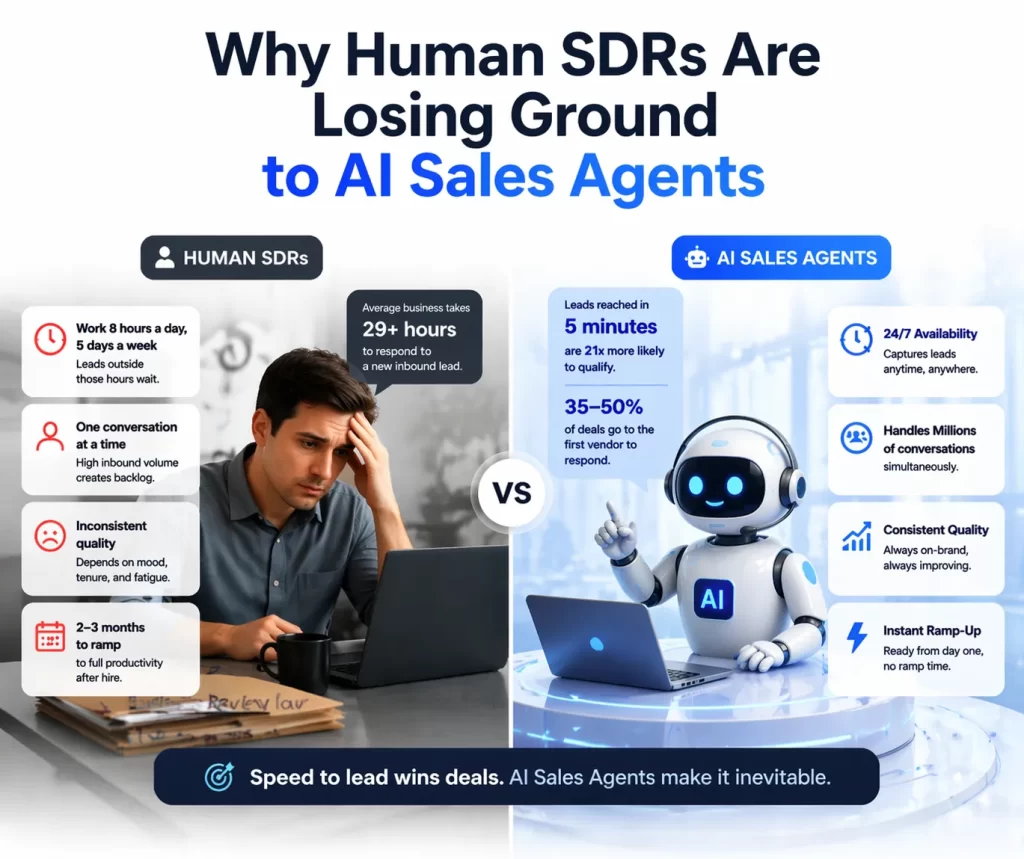
The speed-to-lead problem is particularly damaging. Research cited by Harvard Business Review found that leads reached within 5 minutes of inquiry are 21 times more likely to qualify than those reached 30 minutes later. Forrester’s research on B2B buyer behavior also shows that 35 to 50 percent of deals go to the vendor who responds first not the one with the best product or price. Yet the average business still takes 29 or more hours to respond to a new inbound lead.
That gap is where pipeline leaks. However, it is entirely preventable.
Head-to-Head Comparison: AI Sales Agent vs SDR
Before choosing a model, it helps to see the full picture. The table below compares key operational and financial dimensions across both models.
| Dimension | Human SDR | AI Sales Agent (Vera + Alim) |
|---|---|---|
| Monthly cost (Turkey) | $4,000 to $6,000 | See Pricing |
| Monthly cost (Global) | $8,000 to $12,000 | See Pricing |
| Operating hours | 8 hours/day, weekdays | 24/7/365 |
| Inbound response time | Minutes to hours | Under 20 seconds (Alim) |
| Simultaneous conversations | 1 | Unlimited |
| Ramp time to productivity | 2 to 3 months | Days |
| Turnover risk | High (avg. 14 months) | Zero |
| Outbound touchpoints per day | 50 to 100 | 200 to 500 (Vera) |
| Language support | 1 to 2 languages | 20+ including Turkish, English, Arabic |
| CRM integration | Manual entry | Automated (HubSpot, Salesforce, Pipedrive) |
| Follow-up consistency | 65 to 75% | 100% |
ROI Comparison: AI Sales Agent vs SDR by the Numbers
AI sales agents dramatically improve ROI compared to traditional human SDRs. See the numbers for yourself.
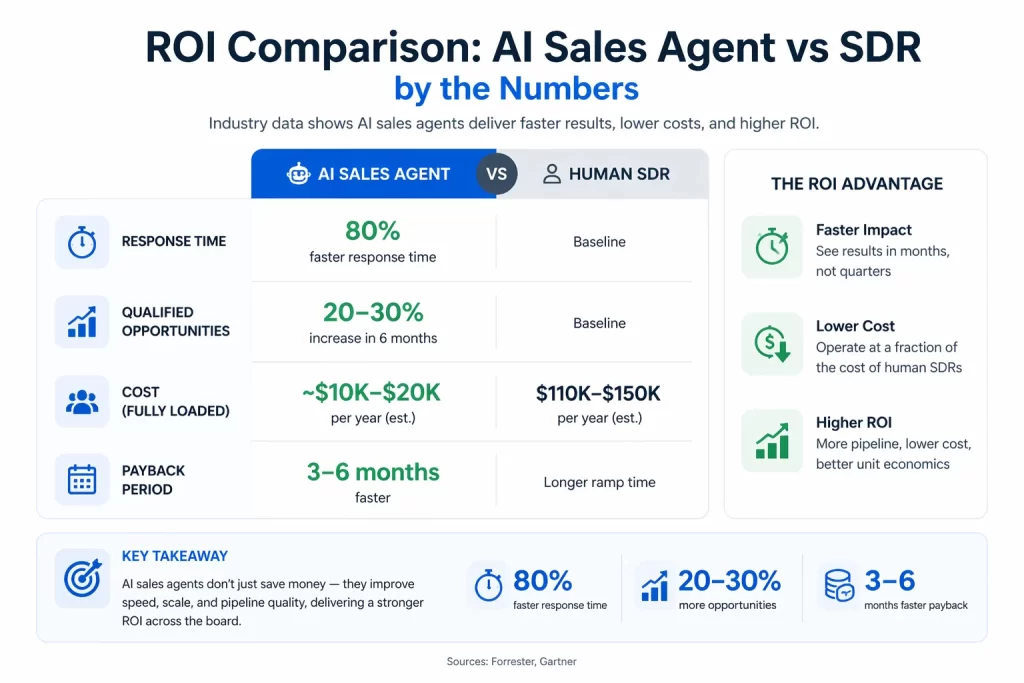
The ROI math on AI sales agents points consistently in one direction. Industry analysis from Forrester shows that AI-enabled lead routing reduces average response time by 80 percent, and companies investing in response time automation see 20 to 30 percent increases in qualified opportunities within 6 months.
Gartner projects that by 2028, AI agents will outnumber human sellers by tenfold. Their research also confirms that organizations effectively deploying AI report measurably better customer acquisition cost (CAC) ratios than those relying on manual processes.
On the cost side, the savings are not marginal. Fully loaded human SDR costs reach $110,000 to $150,000 annually in global markets. While AI sales agents operate at a fraction of that figure, they run continuous outbound and inbound coverage without overtime or turnover costs. As a result, the unit economics of pipeline generation change entirely.
The payback period for AI sales development is typically 3 to 6 months faster than the average ramp time of a new human SDR.
Vera: The AI Sales Agent That Replaces Your Outbound SDR
Vera is not a tool that assists an SDR. She is the SDR.
The distinction matters because most outbound platforms (Apollo, Outreach, Salesloft) still require a human to operate them. You buy the software and still hire someone to run it. By contrast, Vera is the worker she executes the complete outbound motion autonomously:
- Sourcing based on your ICP (industry, company size, role, buying signals)
- Enrichment with firmographic and technographic data
- Hard scoring using rule-based filters to remove bad-fit leads
- AI-powered lead scoring to prioritize accounts showing intent signals
- Research on each prospect including company context, recent news, and LinkedIn activity
- Positioning to identify the specific pain point most relevant to each prospect
- Copywriting that produces unique, personalized messages not templates
- Outreach via LinkedIn and email based on channel strategy
- Follow-up with contextual messages based on prior engagement
- CRM re-engagement on dormant contacts already in your database
Human outbound SDRs typically send 50 to 100 touchpoints per day. Vera, however, operates at 200 to 500 per day with per-contact research and personalization intact. The quality of research is not diluted at scale because Vera is not constrained by time.
For sales teams that currently rely on a small or overextended SDR team to generate outbound pipeline, Vera removes both the headcount dependency and the performance ceiling. No burnout, no off days, no notice period. As a result, pipeline generation becomes a fixed, predictable operation rather than a variable tied to headcount.
Learn more about Vera, the outbound AI sales agent.
Alim: The AI Sales Agent That Handles Every Inbound SDR Task
Inbound is where the speed-to-lead problem hits hardest and where Alim is most decisive.
When a lead submits a form, sends a DM, or initiates a WhatsApp conversation, Alim responds within 20 seconds regardless of the day or hour. There is no next-business-day delay, no waiting for someone to come online, no lead going cold because the team was in a meeting.
How an AI Sales Agent Moves Faster Than Any Human SDR on Inbound
After the first response, Alim qualifies the lead using the BANT framework (Budget, Authority, Need, Timeline) and classifies it:
- Hot leads get routed immediately to the sales team or booked directly onto the calendar.
- Warm leads enter an automatic nurture sequence with follow-up managed by Alim.
- Cold leads are tagged, logged, and exited cleanly.
Once qualification is complete, every interaction is logged to your CRM with structured data. The human closer then receives a pre-qualified lead with full context not a cold name and a phone number.
This is not a chatbot workflow. While a chatbot fails when the script runs out, Alim has natural language understanding and context awareness, meaning he adapts to what the prospect actually writes. He also supports over 20 languages, making him effective across Turkish, English, Arabic, and other markets simultaneously.
For companies generating high inbound volume but losing deals to slow or inconsistent follow-up, Alim is the structural fix.
Learn more about Alim, the inbound AI sales agent.
AI Sales Agent vs SDR: Which One Does Your Pipeline Need?
The right deployment depends on where your pipeline is breaking down.
Start with Vera if: your team relies on manual outbound, your SDRs are burned out or underperforming, your pipeline is thin, or you want to open new markets without adding headcount.
Alim is the right fit if: inbound leads are going unanswered for hours, your team is inconsistent in follow-up, you are losing deals to competitors who respond faster, or you are generating leads outside business hours that go cold overnight.
Deploy both if: you want a complete, closed-loop sales development function. When both are running, Vera generates pipeline at the top while Alim converts it when leads respond. Human closers only enter once a lead is qualified and ready. One platform, full coverage.
GrowthEffect is the only provider that offers both outbound and inbound AI sales agents in a single integrated system. For a full breakdown of plans and costs, visit the Pricing page.
FAQ
Is an AI sales agent the same as a chatbot?
No. A chatbot follows a decision tree. If the user says something unexpected, the bot fails. An AI sales agent like Alim, however, has natural language understanding, adapts to the conversation in real time, qualifies leads using the BANT framework, and books meetings directly to a calendar. Chatbots do not qualify. Chatbots do not book. Alim does both.
How quickly can an AI sales agent replace an SDR’s workload?
Both agents are typically live within days, not months. There is no 2 to 3 month ramp period as with a human SDR. Instead, the ICP definition, knowledge base, and CRM integration are set up during onboarding and refined as the agent learns from response patterns.
Can an AI sales agent write personalized outbound messages at scale?
Yes. Vera researches each prospect individually before writing. She does not use templates applied to a list. Instead, she identifies company context, recent news, LinkedIn activity, and the most relevant positioning angle for each target. Messages are unique to the prospect that research at 200 to 500 contacts per day is what makes Vera structurally different from a human SDR running a sequence tool.
What happens when Alim qualifies a hot lead?
Hot leads are either booked directly onto the sales team’s calendar or routed to the designated human closer. After qualification, full context is passed via CRM integration. The human closer then receives a pre-qualified lead who is ready for a conversation — not a cold contact who has not yet been engaged.
Does GrowthEffect integrate with our existing CRM?
Yes. Both Alim and Vera integrate natively with HubSpot, Salesforce, and Pipedrive. Every interaction is logged with structured data, ensuring clean handoffs and no broken workflows. For questions about specific integrations, visit the FAQ page.
Ready to See How Vera and Alim Perform on Your Pipeline?
The right starting point depends on your immediate constraint. When outbound pipeline is insufficient or dependent on a small, overextended SDR team, start with Vera. When inbound leads are going unanswered or taking hours to qualify, start with Alim. If both problems exist, deploy both.
One platform, full outbound and inbound coverage.
- 👉 Vera, Outbound AI Sales Rep — Autonomous prospecting, signal-based personalization, multi-channel sequencing, self-learning architecture
- 👉 Alim, Inbound AI Sales Rep — 24/7 qualification across WhatsApp, Instagram, email, and web forms
- 👉 Pricing — Full cost breakdown and plan details
- 👉 FAQ — Common questions on setup, ICP definition, and channel coverage
- 👉 Full AI Sales Rep Guide — What it is, how it works, and ROI breakdown
- 👉 Book a Demo — See Vera and Alim in action on your pipeline
Conclusion
The AI sales agent vs SDR comparison is no longer theoretical. The cost gap is documented, the speed-to-lead data is clear, and the structural limitations of human-only SDR teams are well established.
But beyond the numbers, the more useful frame is this: your best salespeople should be closing, not chasing. When Vera and Alim handle the top-of-funnel work sourcing, qualifying, following up, booking your human team shows up to conversations that are already worth having.
If your pipeline has a leak, the fix is not hiring faster. It is deploying smarter.
Want more like this?
Explore our blog for guides on AI agents, sales automation, and inbound strategy.
Leave a Reply