
The short answer: companies did not replace every SDR with AI. They replaced the repetitive, measurable, first-touch work inside the SDR role: prospect research, list building, enrichment, lead scoring, first drafts, follow-up, CRM updates, routing, and simple reply handling. Human salespeople still matter for judgment, trust, discovery, negotiation, strategic accounts, and closing.
So if you searched “replace sdr with ai,” the better question is not whether AI can remove the SDR role completely. The better question is which SDR tasks should move to an AI sales worker, which tasks should stay human, and which tasks need AI preparation plus human approval.
Key Takeaways
– AI replaced SDR tasks before it replaced SDR jobs.
– The highest-fit AI work is repetitive, high-volume, data-driven, and easy to measure.
– The lowest-fit AI work is emotional, ambiguous, risky, political, or commercially sensitive.
– AI can create more pipeline coverage, but only if time savings are reinvested into better sales work.
– For GrowthEffect, Alim handles inbound first-touch work, Vera handles outbound pipeline creation, and humans own closing.
– The winning model is not AI-only sales. It is a task-level operating model for human plus AI sales.

What Actually Happened When Companies Tried to Replace SDRs with AI
Replacing SDRs with AI started as a headcount story. In practice, it became a workflow redesign story.
Sales leaders looked at the SDR role and saw a familiar cost problem. SDRs spend a large part of the week on work that is necessary but not deeply human: finding accounts, researching websites, validating contacts, writing first drafts, sending follow-ups, updating CRM fields, and sorting replies. That work is important, but it is also fragmented, repetitive, and easy to drop when volume rises.
AI sales automation attacked that work first.
The market data supports the shift. Salesforce’s 2026 State of Sales announcement says 87% of sales organizations already use some form of AI for tasks such as prospecting, forecasting, lead scoring, or drafting emails. The same report says sellers expect agents, once fully implemented, to cut prospect research time by 34% and email drafting by 36%. McKinsey’s November 2025 State of AI report adds a second signal: 23% of organizations say they are already scaling an agentic AI system somewhere in the enterprise, while another 39% are experimenting.
That last point is the operator lesson. AI saves time. It does not automatically create pipeline.
If the saved time goes into better account strategy, cleaner handoff, faster qualification, higher-quality conversations, and tighter follow-up, AI improves the sales system. If the saved time simply becomes lower headcount with the same broken process, the company may reduce cost but still miss revenue.
The SDR Role Did Not Disappear. It Was Split Into Tasks
The old SDR role bundled too many different jobs into one seat. A junior rep might be asked to be a data researcher, copywriter, qualification rep, CRM admin, follow-up machine, objection handler, meeting setter, market feedback loop, and brand-safe communicator at the same time.
AI made that bundle visible. Once sales leaders looked task by task, the split became clearer.
| SDR job | Should AI own it? | Should a human own it? | Why |
|---|---|---|---|
| ICP-based account sourcing | Yes, with rules | Human sets strategy | AI can process volume; humans define the market |
| Contact enrichment | Yes | Human reviews exceptions | Structured data work is a good automation fit |
| Prospect research | Yes for first pass | Human reviews strategic accounts | AI can summarize; humans judge importance |
| Lead scoring | Yes, if transparent | Human audits thresholds | AI gives consistency; humans prevent bad incentives |
| First email draft | Yes | Human edits high-value accounts | AI drafts faster; humans protect voice and nuance |
| LinkedIn or cold email sending | Sometimes | Human sets guardrails | Risk depends on volume, channel rules, and brand |
| Reply classification | Yes | Human handles intent and risk | AI can triage; humans respond when stakes rise |
| Inbound qualification | Yes for structured first touch | Human handles complex cases | AI can capture facts and route quickly |
| Discovery call | No, not as sole owner | Yes | Trust, politics, and ambiguity need humans |
| Negotiation and procurement | No | Yes | Commercial judgment and legal risk need ownership |
| Closing | No | Yes | Closing is not a repetitive admin workflow |
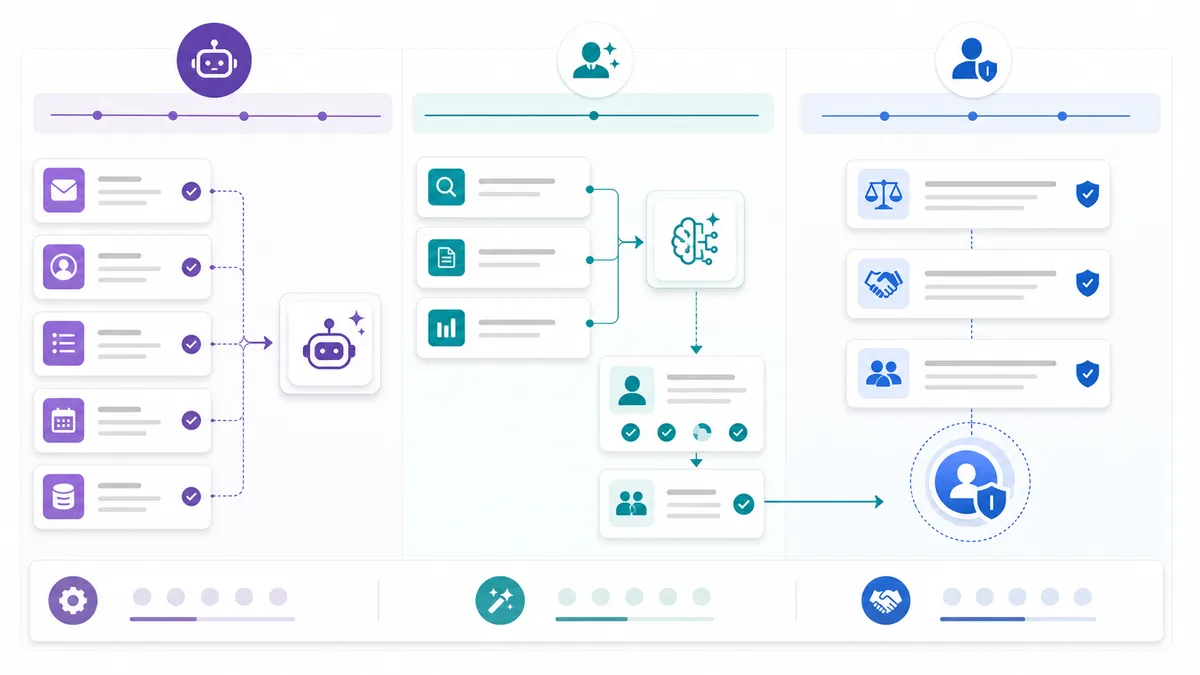
This is why “replace SDR with AI” is usually the wrong operating question. The right question is: which work has a clear input, a clear policy, a measurable output, and a known escalation path?
If those four conditions exist, AI can probably own the work. If they do not, AI should prepare the human, not replace the human.
The Task Automation Framework: Automate, Assist, or Keep Human
Use this framework before cutting an SDR role, hiring another rep, or buying another AI SDR platform.
Every SDR task should go into one of three buckets: automate, assist, or keep human.
1. Automate tasks that are structured and measurable
Automate the task when the answer is mostly process execution.
Good examples:
- build a lead list from ICP rules
- enrich accounts and contacts
- score leads against a visible scoring model
- summarize company pages and recent signals
- draft first-touch email variants
- send approved follow-up steps
- log activities in the CRM
- classify replies into known categories
- route leads based on rules
- suppress opt-outs and bad-fit records
These jobs are not easy, but they are structured. They have repeatable inputs and outputs. They also improve when the data layer improves.
HubSpot’s AI sales prospecting guide describes this pattern clearly: AI prospecting can identify leads, enrich records, personalize outreach, score prospects, and hand qualified prospects into sequences or reps. The reason this works is not magic. It works because prospecting has enough repeated structure for software to do the heavy lifting.
2. Assist tasks where AI can prepare but not decide
Assist the task when AI can reduce prep time but a human still owns judgment.
Good examples:
- account strategy for high-value targets
- executive outreach angles
- objection handling notes
- call preparation
- buying committee mapping
- proposal context
- renewal or expansion research
- handoff summaries for qualified leads
- forecast risk notes
AI can prepare a strong first pass. It can summarize the account, extract signals, suggest questions, and organize CRM history. But the human decides what matters.
This is where many teams get the biggest practical gain. They do not remove the seller from the important moment. They remove the blank page before the important moment.
3. Keep human tasks that carry trust, risk, or commercial judgment
Keep the task human when the wrong answer can damage trust, legal position, margin, or strategic account quality.
Human-owned work includes:
- complex discovery
- executive conversations
- multi-stakeholder alignment
- negotiation
- procurement trade-offs
- legal and security commitments
- custom pricing or discount decisions
- strategic account messaging
- sensitive complaint handling
- final disqualification of high-value accounts
The implication is direct: buyers want fewer low-value seller interruptions, not zero human expertise. That is why AI-first SDR design should remove manual prep and low-signal follow-up while keeping humans focused on contextual judgment.
What AI Replaced First in SDR Work
AI replaced the operational drag around sales development before it replaced the sales development function.
Here is the practical replacement map.
| Workstream | What AI can replace | What should stay human |
|---|---|---|
| Outbound list building | Manual database searching, basic account filtering, duplicate cleanup | ICP strategy, market selection, account tiering |
| Research | Website summaries, signal extraction, industry notes, company snapshots | Judging whether the signal is commercially meaningful |
| Personalization | First drafts based on role, company, trigger, pain, and offer | Founder voice, strategic nuance, sensitive accounts |
| Follow-up | Timing, reminders, sequence steps, “not now” resurfacing | Judgment on when to break sequence or personalize deeply |
| Reply handling | Positive, neutral, referral, objection, out-of-office, opt-out classification | Commercial response, negotiation, relationship recovery |
| CRM hygiene | Field updates, notes, status movement suggestions, activity logging | Forecast impact, opportunity ownership, disqualification policy |
| Inbound response | First reply, qualification questions, routing, meeting booking | Complex buyer context, high-value evaluation, close path |
This is why AI SDR programs fail when leaders treat them as a cheaper human instead of a different operating layer. AI does not need a quota the same way a human SDR does. It needs input quality, allowed actions, guardrails, escalation rules, and a measurement loop.
Where GrowthEffect Fits: Alim Inbound, Vera Outbound, Humans Close
GrowthEffect’s model is built around this task split. It is not one generic chatbot pretending to run the whole funnel.
Alim is the AI inbound sales representative. Alim handles inbound first-touch work: lead response, qualification, routing, CRM sync, and meeting booking. Alim is useful when leads arrive through channels like website forms, chat, social DMs, WhatsApp, or email and the team needs fast, consistent qualification before a human takes over.
Vera is the outbound AI sales representative. Vera handles outbound work: ICP-based sourcing, enrichment, account research, scoring, personalized outreach, follow-up, reply classification, and pipeline generation. Vera is useful when the company needs more qualified outbound conversations without forcing AEs or founders to spend hours building lists and writing first drafts.
Humans still close.
That separation matters. If inbound and outbound are mixed into one vague AI bot, the workflow becomes hard to manage. If Alim owns inbound, Vera owns outbound, and humans own judgment-heavy conversion, the operating model becomes measurable.
Related GrowthEffect workflow
If this decision is really a hiring-versus-workflow question, start with the GrowthEffect pricing page to compare the cost of repetitive SDR work against a digital sales employee.
If outbound pipeline creation is the bottleneck, Vera is the GrowthEffect AI sales representative built for sourcing, enrichment, research, scoring, personalized outreach, follow-up, and CRM handoff.
If inbound leads are waiting too long or reaching reps without enough context, Alim is built for instant response, qualification, routing, meeting booking, and CRM sync.
| GrowthEffect layer | Primary job | Human handoff trigger |
|---|---|---|
| Alim | Capture and qualify inbound demand | Hot lead, complex question, sensitive issue, meeting-ready buyer |
| Vera | Create outbound pipeline from ICP to reply | Positive reply, strategic account, objection, high-value opportunity |
| Human sales team | Discovery, trust, negotiation, closing | Every qualified or commercially sensitive opportunity |
| RevOps or founder | Rules, scoring, guardrails, feedback loop | When conversion, quality, or brand risk changes |
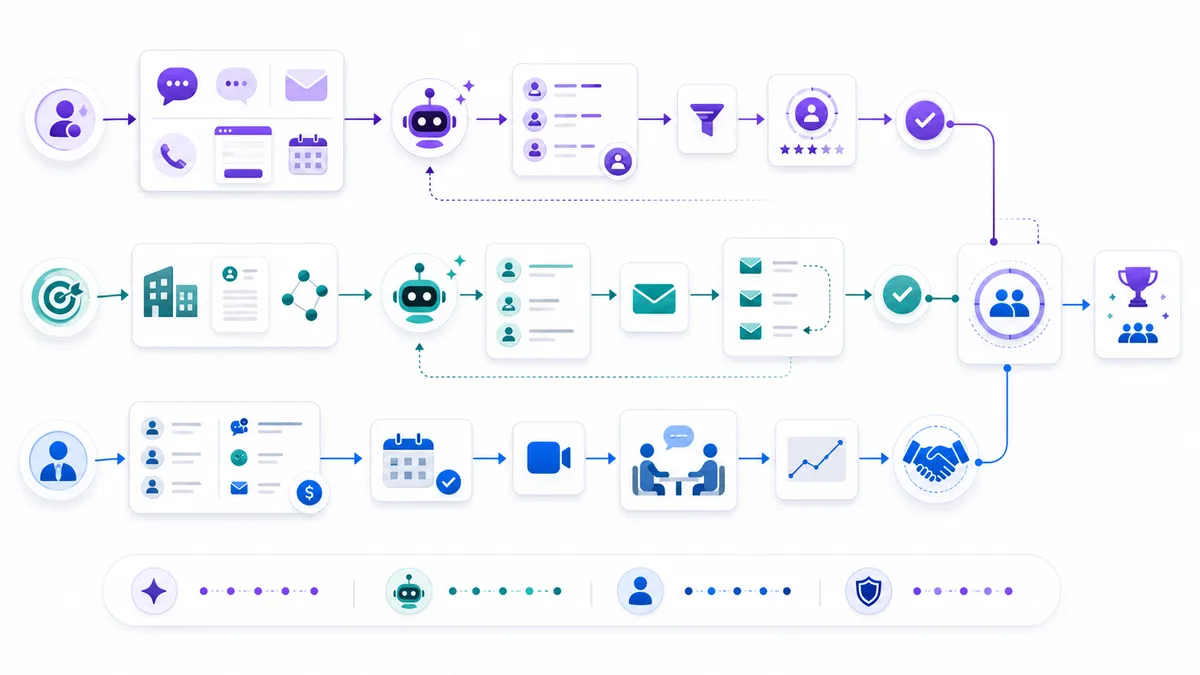
This is the core answer to the replacement question: AI replaces the manual first-touch workload. It should not remove human accountability from the sales system.
How to Measure Whether AI Actually Replaced Useful SDR Work
Do not measure AI only by emails sent or leads processed. Those are activity metrics. They can make a bad system louder.
Measure whether AI created usable selling capacity.
That gives sales leaders a clean measurement principle: AI impact is not time saved by itself. AI impact is time saved and reinvested into better revenue work, cleaner handoffs, and faster qualified conversations.
Track five categories.
| Metric category | What to measure | Why it matters |
|---|---|---|
| Coverage | Accounts researched, leads qualified, follow-ups completed, replies classified | Shows whether AI removed manual backlog |
| Quality | ICP fit, personalization relevance, lead score accuracy, handoff completeness | Prevents volume from becoming noise |
| Speed | Time to first inbound response, time to research, time to first draft, time to route | Shows where AI improves buyer experience |
| Conversion | Reply rate, positive reply rate, lead-to-opportunity rate, meeting show rate | Connects automation to pipeline quality |
| Governance | Opt-outs handled, risky replies escalated, CRM fields complete, human approvals met | Protects brand, data, and process trust |
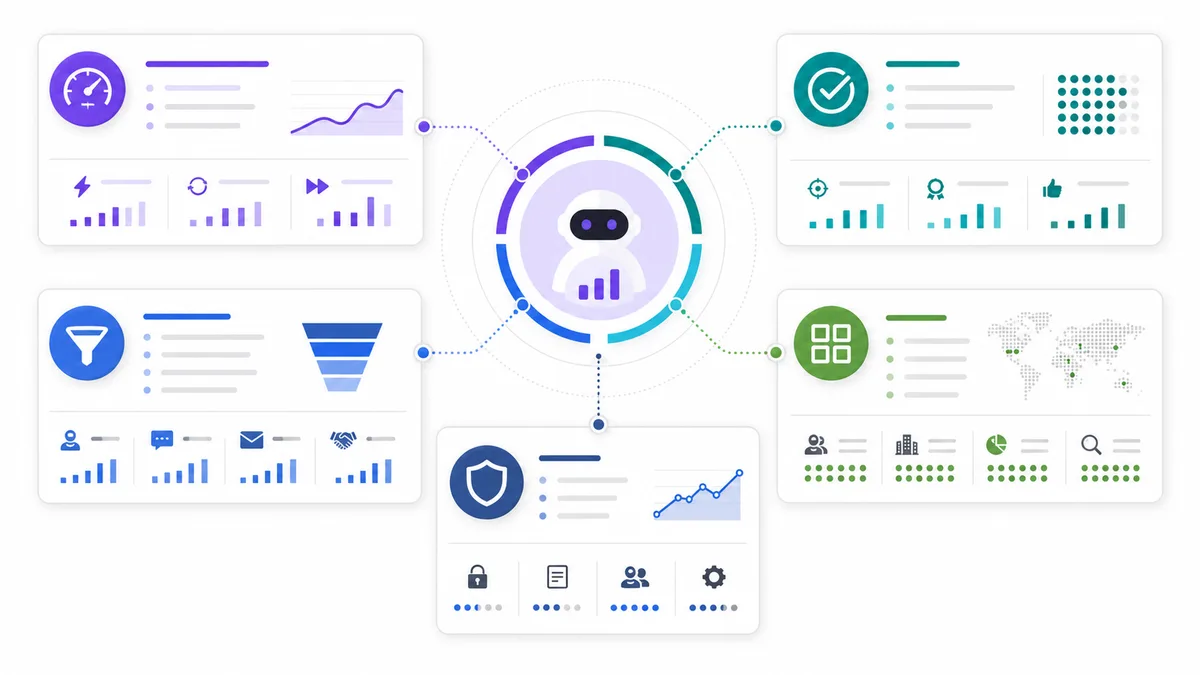
The best teams also track a negative metric: bad automation avoided.
Examples:
- leads suppressed because they were poor fit
- accounts paused because personalization confidence was low
- replies escalated instead of automated
- contacts removed because channel risk was high
- records rejected because CRM data was incomplete
This is where AI becomes a sales operating system instead of a message cannon.
When Replacing an SDR with AI Is a Bad Idea
Replacing an SDR with AI is a bad idea when the company does not have the process maturity to direct the AI.
Bad-fit cases include:
- no clear ICP
- no clean CRM ownership
- no agreed qualification criteria
- no source of truth for product messaging
- no handoff rules between SDR, AE, founder, and RevOps
- no suppression policy for opt-outs or bad-fit accounts
- no review process for high-risk outreach
- no measurement beyond send volume
- no human owner for interested replies
This is why some teams buy AI and still do not get pipeline. They automated the surface area but not the system around it.
Salesforce’s 2026 research makes the same point from a data angle: 74% of sales professionals are focusing on data cleansing to maximize AI returns, and Salesforce notes that stand-alone agents without comprehensive customer context tend to fail. McKinsey’s B2B sales analysis also warns that many leaders are still prioritizing where gen AI creates measurable commercial value instead of adding more isolated tooling.
The operator conclusion is simple. AI is not a shortcut around sales fundamentals. It exposes whether those fundamentals exist.
A Practical Rollout Plan for Human Plus AI SDR Work
Do not start by asking, “How many SDRs can we replace?”
Start by asking, “Which sales development workload is slowing revenue down?”
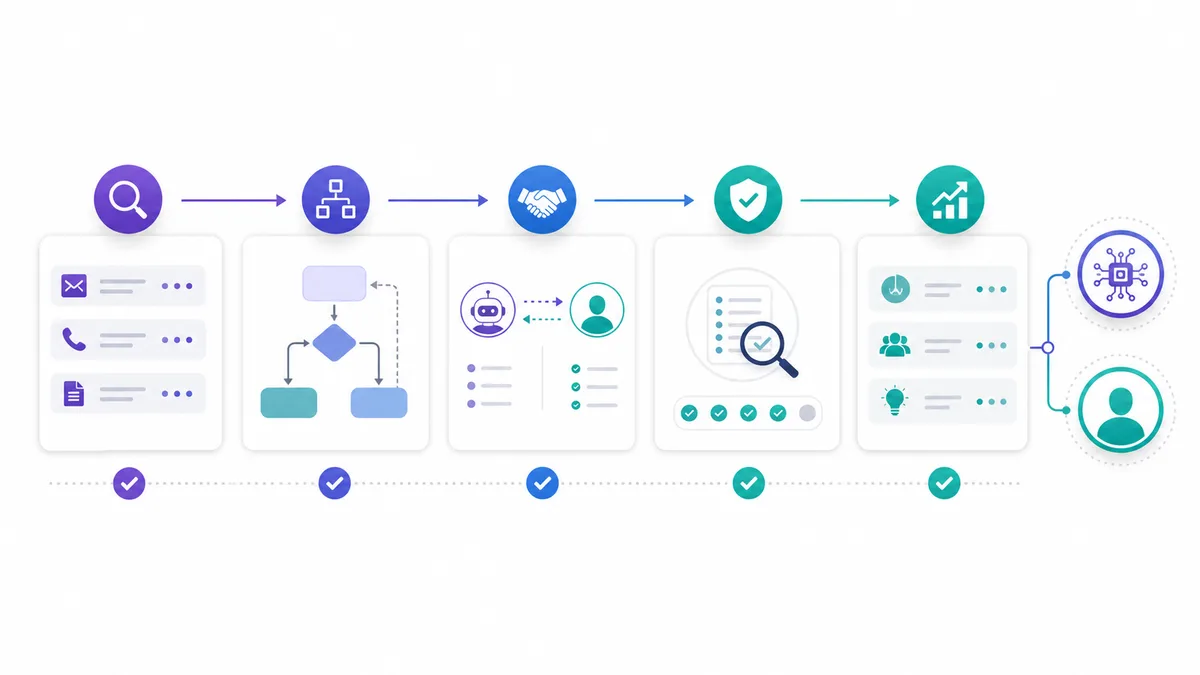
Step 1: Inventory the SDR workload
List the actual weekly work:
- prospect sourcing
- enrichment
- research
- scoring
- first-touch messaging
- follow-up
- reply classification
- inbound response
- qualification
- meeting booking
- CRM updates
- handoff summaries
- reporting
Then score each task from 1 to 5 across repeatability, volume, risk, data quality, and business value.
Step 2: Pick one narrow workflow
Choose one workflow where success is measurable.
Good starting points:
- inbound lead response and qualification
- outbound account research and first draft creation
- CRM cleanup and lead scoring
- reply classification and human handoff
- “not now” nurture resurfacing
Avoid starting with a fully autonomous, multi-channel, unsupervised outbound machine. That creates risk before trust.
Step 3: Define the human handoff rule before launch
For every AI-owned workflow, define when a human takes over.
Handoff triggers can include:
- positive buying intent
- pricing or procurement question
- legal or security question
- complaint or frustration
- high-value target account
- low confidence score
- uncertain data
- executive persona
- request to speak with a human
The handoff rule is what makes the system safe.
Step 4: Measure quality before scale
Before increasing volume, audit outputs.
Review:
- Are target accounts actually ICP-fit?
- Are messages specific without sounding fake?
- Are CRM updates complete and useful?
- Are opt-outs handled correctly?
- Are positive replies reaching humans quickly?
- Are handoff summaries good enough for an AE to act on?
- Are humans using the time savings for higher-value sales work?
If quality is weak, do not add volume. Fix the workflow.
Step 5: Reinvest capacity into human selling
The final step is the one many teams miss. Decide where the saved SDR time goes.
Better uses of recovered time include:
- calling qualified replies faster
- improving account strategy
- running deeper discovery
- coaching reps from real conversation data
- refining ICP and messaging
- cleaning CRM segmentation
- building better qualification rules
- giving founders or AEs more prepared conversations
That is how AI changes the SDR model without turning the sales process into a low-trust automation stream.
Final Answer: Should You Replace SDRs with AI?
You should replace parts of the SDR workload with AI, not blindly replace every SDR with AI.
AI should own the work that is repetitive, high-volume, structured, and measurable. Humans should own the work that requires trust, judgment, negotiation, and strategic context. The company should measure the result by pipeline quality, conversion, response speed, data accuracy, and reinvested human capacity, not by how many automated touches were sent.
For GrowthEffect customers, the operating model is straightforward: use Alim for inbound lead qualification, use Vera for outbound pipeline generation, and keep human salespeople focused on qualified conversations, complex discovery, and closing.
If this article is part of a headcount or ROI decision, compare the workflow cost on the GrowthEffect pricing page. If the real issue is still unclear, start with the GrowthEffect revenue leak scan or book a GrowthEffect demo. The real question is not whether AI can send more messages. It is where your current pipeline process is losing qualified conversations.
FAQ
Can AI fully replace an SDR?
AI can replace many repetitive SDR tasks, but it should not fully replace human sales judgment. AI is strongest at sourcing, enrichment, research, scoring, first drafts, follow-up, inbound first response, CRM updates, and reply routing. Humans should still own discovery, negotiation, strategic accounts, sensitive conversations, and closing.
What SDR tasks should be automated first?
Start with tasks that are structured and measurable: lead enrichment, account research, scoring, CRM updates, first-draft outreach, follow-up reminders, reply classification, inbound qualification, and routing. Avoid automating high-risk messages or strategic accounts until you have quality controls.
Is replacing SDRs with AI cheaper than hiring SDRs?
It can reduce the cost of repetitive first-touch work, but lower cost is not the same as higher revenue. The business case depends on whether AI increases qualified conversations, improves response speed, raises lead-to-opportunity conversion, and lets human sellers spend more time on high-value work.
What is the difference between an AI SDR and a sales automation tool?
A sales automation tool usually helps humans execute predefined steps. An AI SDR or AI sales worker can handle larger parts of a workflow, such as researching accounts, scoring leads, drafting messages, classifying replies, and preparing handoffs. The more autonomy it has, the more important guardrails, CRM context, and human escalation become.
How should a sales leader measure AI SDR performance?
Measure coverage, quality, speed, conversion, and governance. Useful metrics include time to first response, research time saved, positive reply rate, lead-to-opportunity rate, handoff completeness, CRM data accuracy, opt-out handling, and how much saved time is reinvested into high-value sales activities.
Internal Links
- GrowthEffect AI sales team
- Alim AI inbound sales representative
- Vera outbound AI sales representative
- AI sales automation tools
- AI sales workflows
- Revenue leak scan
- Book a GrowthEffect demo
Metadata and Social Fields
{
  "canonical": "https://www.growtheffect.co/blog/replace-sdr-with-ai",
  "yoast_primary_category": "AI Sales Automation",
  "categories": ["AI Sales Automation", "English"],
  "focus_keyphrase": "replace sdr with ai",
  "seo_title": "Replace SDR with AI: What Actually Happened",
  "meta_description": "Should you replace SDRs with AI? Learn what AI replaces, what humans still own, and a practical task-by-task sales automation framework.",
  "opengraph_title": "Replace SDR with AI: What Actually Happened",
  "opengraph_description": "A practical operator-level guide to what AI really replaces in SDR work, what humans still own, and how to measure impact.",
  "opengraph_image": "replace-sdr-with-ai-hero.webp",
  "twitter_title": "Replace SDR with AI: What Actually Happened",
  "twitter_description": "What actually happened when companies tried replacing SDRs with AI: task automation, human judgment, and a better operating model.",
  "twitter_image": "replace-sdr-with-ai-hero.webp"
}
JSON-LD BlogPosting
{
  "@context": "https://schema.org",
  "@type": "BlogPosting",
  "headline": "Replacing SDRs with AI: What Actually Happened",
  "description": "Should you replace SDRs with AI? Learn what AI replaces, what humans still own, and a practical task-by-task sales automation framework.",
  "image": [
    "https://www.growtheffect.co/blog/replace-sdr-with-ai/replace-sdr-with-ai-hero.webp",
    "https://www.growtheffect.co/blog/replace-sdr-with-ai/replace-sdr-with-ai-task-split.webp",
    "https://www.growtheffect.co/blog/replace-sdr-with-ai/replace-sdr-with-ai-measurement-framework.webp"
  ],
  "author": {
    "@type": "Person",
    "name": "Can Buyuk"
  },
  "publisher": {
    "@type": "Organization",
    "name": "GrowthEffect AI",
    "url": "https://www.growtheffect.co/"
  },
  "datePublished": "2026-05-20",
  "dateModified": "2026-05-20",
  "url": "https://www.growtheffect.co/blog/replace-sdr-with-ai",
  "mainEntityOfPage": {
    "@type": "WebPage",
    "@id": "https://www.growtheffect.co/blog/replace-sdr-with-ai"
  },
  "inLanguage": "en"
}
Leave a Reply