How AI Sales Reps Work (Step-by-Step + Real Flow Examples)
To understand how an AI sales rep actually operates in practice, here’s a step-by-step breakdown of the full workflow:
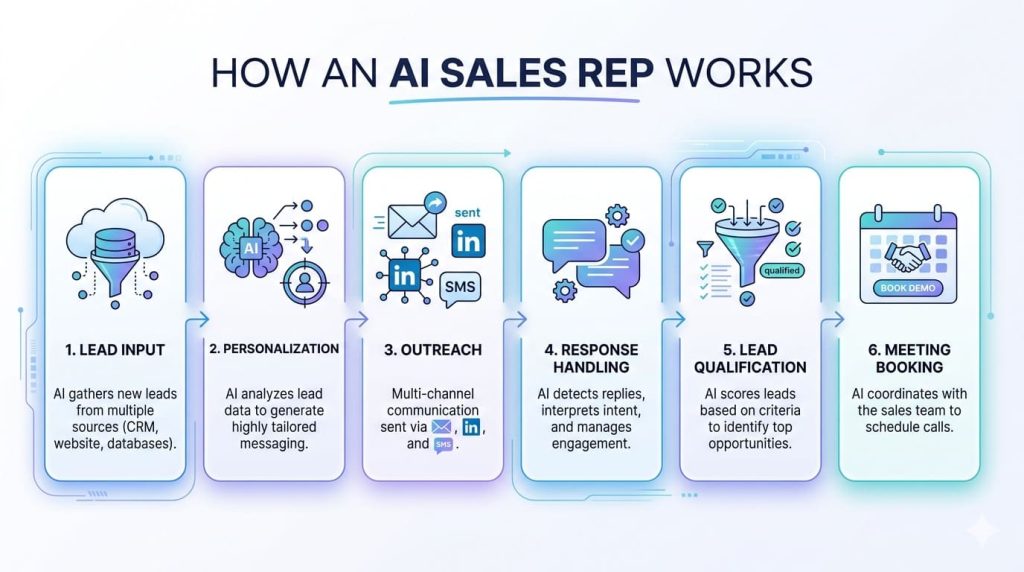
AI sales reps are often described in abstract terms automation, personalisation, AI-driven outreach. However, understanding how AI sales reps work in practice is what separates teams that build real pipeline from those that spend months chasing marginal results. Based on our analysis of 50+ live outbound campaigns, this guide breaks down the full workflow from lead research to booked meeting with no abstraction.
Key Takeaways
- AI sales reps follow a seven-stage decision-making workflow not a fixed sequence
- Furthermore, performance degrades at every downstream stage when data or signals are weak
- The most common failure mode: high volume with low relevance however, this is fixed by signal-based personalisation
- Additionally, research, drafting, sequencing, and qualification running in separate tools creates unnecessary fragmentation
- Therefore, test on 200–500 leads before scaling any AI SDR workflow
In this guide:
- The exact seven-step workflow of an AI sales rep
- What happens behind the scenes at each stage
- A real outbound flow example email + LinkedIn + qualification
- Where AI performs well and where it breaks down
- How to build your own AI SDR workflow from scratch
Still exploring the basics? Start with our full AI sales rep guide. Otherwise, let’s go deeper.
What Does an AI Sales Rep Actually Do?
An AI sales rep automates the repetitive, high-volume tasks of outbound sales while adapting dynamically to prospect behaviour at every step.
At a high level, the system identifies and processes leads, enriches them with live signals, personalises outreach, executes multi-channel sequences, interprets responses, qualifies leads, and books meetings without requiring human input for each interaction. In other words, it handles the entire top-of-funnel autonomously.
The critical distinction: this is not a fixed sequence. Rather, it’s a decision-making workflow. Every action the AI takes is conditioned on the current state of each prospect interaction making it fundamentally different from traditional sales automation tools that run to completion regardless of what the prospect does.
In the most advanced implementations, the AI handles the entire workflow end-to-end: lead research, prospect identification, message drafting, sequencing, reply handling, qualification, and booking all within a single system. This is what separates autonomous digital sales employees like GrowthEffect’s Alim and Vera from point-solution outreach tools that still require a human to operate them.
It’s also worth addressing a common misconception upfront: an AI sales rep is not a chatbot. Chatbots follow script trees, say “I didn’t understand that,” and can’t qualify leads or book meetings. An AI sales rep engages in natural, context-aware conversation, runs structured BANT qualification (Budget, Authority, Need, Timeline), and routes qualified leads to your calendar or your team automatically. If you’ve tried a chatbot before and it failed, the experience with a properly built AI sales rep is categorically different.
AI Sales Rep Workflow Full Overview
The complete workflow runs across seven stages. Each feeds directly into the next consequently, weakness at any single stage reduces performance across the entire system.
AI Sales Rep Workflow At a Glance
To visualise how the full system operates end-to-end, here’s a simplified breakdown of the AI sales rep workflow:
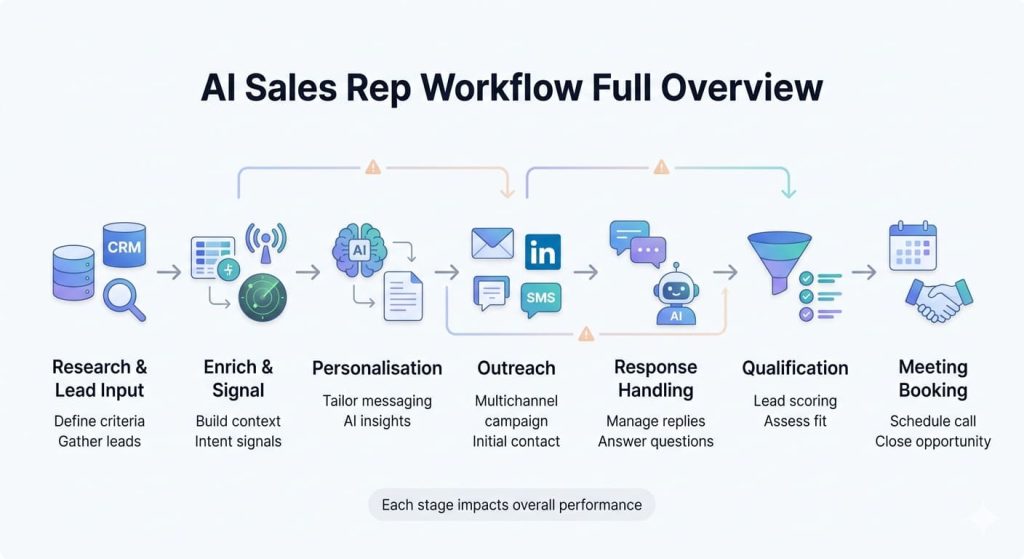
Research & Lead Input → Enrich & Signal → Personalise → Outreach → Response Handling → Qualify → Book Meeting
Below is a detailed breakdown of what happens at each stage including the failure modes most teams don’t anticipate until they’re already mid-campaign.
How AI Sales Reps Work: Step 1 — Lead Research & Input
Every AI sales rep workflow begins with leads and the quality of that input directly determines the ceiling on everything that follows.
In basic setups, leads come from CRM systems (HubSpot, Salesforce, Pipedrive), inbound forms, or manually uploaded lists. In more advanced workflows, however, the AI handles lead research and prospecting entirely identifying target companies that match your ICP, finding the right contacts, and enriching them with signals before any outreach begins.
This distinction matters more than most teams realise. When research and outreach run inside the same system, the AI can act on signals in real time referencing what’s happening at a company right now, not data that was exported weeks ago. When research happens in a separate tool, by contrast, that freshness is lost at every handoff.
The most common mistake at this stage: uploading generic, unfiltered lead lists without ICP criteria applied first. As a result, the AI executes sequences against every contact on the list qualified or not and you get noise instead of pipeline.
⚠ Common Mistake
Uploading generic, unfiltered lead lists without ICP criteria applied first. The AI will execute sequences against every contact on the list qualified or not.
How AI Sales Reps Work: Step 2 — Data Enrichment & Signal Layer
Before any message is sent, the AI builds context around each prospect. This is where most of the system’s intelligence originates and where most generic outreach tools fall short.
The enrichment layer pulls together company-level data (industry, headcount, funding stage, tech stack), individual-level data (role, seniority, tenure), and live behavioural signals: active job postings, recent funding announcements, tech stack changes, website activity, and intent data where available.
Personalisation is only as strong as the signals behind it. Understanding how AI sales reps work at this stage reveals why most generic outreach underperforms: an AI system with no enrichment layer sends slightly more polished generic outreach. A system with a strong, live signal layer, on the other hand, sends messages that feel like they were written by someone who spent 20 minutes researching the prospect at scale, for every contact in the sequence.
This is also the stage where platforms diverge most significantly. Systems that handle enrichment internally continuously refreshing signals rather than relying on static exports consistently outperform those that depend on manually prepared data. Vera, GrowthEffect’s outbound AI agent, handles this enrichment layer natively tracking target accounts for buying signals without requiring a separate data tool.
How AI Sales Reps Work: Step 3 — Personalisation Engine
This is where AI sales reps separate most clearly from traditional outbound automation tools.
Rather than inserting a first name or company name into a fixed template, the personalisation engine generates message variations per lead referencing the specific signals captured in Step 2. Specifically, tone, angle, and opening line adapt based on persona, seniority, and the most relevant trigger for that specific contact at that specific moment.
The difference in practice:
| Approach | Example Opening Line |
|---|---|
| Template-based automation | “Saw you’re in HR — wanted to connect.” |
| Signal-based AI personalisation | “Noticed you’re hiring 5+ SDRs this quarter — teams at that stage usually hit outbound bottlenecks fast…” |
The second message works because it references something real it signals research and opens with a problem the prospect is likely experiencing right now. That’s why signal-based personalisation consistently outperforms template-based approaches on reply rate.
In practice, cold email reply rates for generic outreach sit around 1–2%. Well-configured signal-based campaigns in our analysis consistently reached 3–4% roughly 2x the baseline with the delta attributable to personalisation depth, not send volume.
How AI Sales Reps Work: Step 4 — Multi-Channel Outreach
The AI launches sequences across the most relevant channels, adapting timing and next steps based on prospect behaviour not a fixed calendar.
A typical multi-channel sequence structure:
| Day | Action | Condition |
|---|---|---|
| Day 1 | Email (signal-personalised) | Always |
| Day 3 | LinkedIn connection request | Email opened but no reply |
| Day 5 | Follow-up email (varied angle) | No reply to Day 1 |
| Day 7 | LinkedIn message | Connection accepted |
| Day 10 | Final email (breakup) | No engagement throughout |
The key difference from traditional sales automation: the sequence is not linear. Every step is conditional on the previous interaction. A prospect who opens the Day 1 email three times but doesn’t reply gets a different follow-up than one who never opened it. This behavioural responsiveness is therefore what makes AI sales reps meaningfully different from drip tools.
Purpose-built outbound AI agents like Vera handle this logic natively adapting channel, timing, and message angle based on live engagement signals without requiring manual sequence rules to be configured for each scenario.
How AI Sales Reps Work: Step 5 — Response Detection & Handling
When a prospect replies, the AI classifies the message, detects intent, and decides the appropriate next action without a human reviewing every response.
Response classification categories typically include: positive interest, request for more information, soft objection, hard objection, timing-based deferral, and not relevant / disqualified. For each category, the AI determines whether to continue the conversation, ask a follow-up question, route to a human rep, or remove from the sequence.
A real example of how this plays out:
Prospect reply: “Not a priority right now.”
AI response: “Makes sense is this something you’re planning to revisit this quarter or later in the year? Happy to follow up at the right time.”
This response doesn’t push. Instead, it opens a future re-engagement path. A skilled SDR would make the same call the AI, however, makes it consistently, at scale, for every reply in the sequence. No leads fall through because someone forgot to follow up.
How AI Sales Reps Work: Step 6 — Lead Qualification
Rather than routing every reply to your sales team, the AI filters leads against your ICP. This is where the largest time savings in the entire workflow occur.
Qualification is scored against ICP match (industry, company size, role), budget signals, stated timeline, and intent level inferred from the conversation. Leads are subsequently categorised as qualified (route to human), nurture (re-engage later), or disqualified (remove from sequence).
Without this step, an AI sales rep creates noise at scale your inbox fills with replies requiring manual triage. With it, however, the AI functions as a filter that only passes genuinely warm, ICP-matched leads to your team. Consequently, your closers spend time on meetings that actually convert, not on triage.
This same qualification logic applies to inbound leads. Alim, GrowthEffect’s inbound AI agent, scores every form submission, WhatsApp message, Instagram DM, and email enquiry against your ICP criteria then routes qualified contacts to booking in under 20 seconds, not hours. The same standards that qualify your outbound replies govern your inbound pipeline, ensuring consistency across both channels.
How AI Sales Reps Work: Step 7 — Automated Meeting Booking
Once a lead is qualified and ready to talk, the AI handles the full scheduling flow without human involvement.
The system shares availability, confirms the meeting, and sends reminders all within the same conversation thread. The prospect goes from “yes, I’m interested” to a confirmed calendar invite without any manual back-and-forth.
Removing scheduling friction consistently improves show rates compared to manual booking flows. Furthermore, faster time-to-meeting reduces the window in which a warm lead goes cold and moves on to a competitor.
Real AI Sales Rep Flow Example
Here’s how all seven steps connect in a real outbound campaign run entirely within a single AI sales platform, with no separate tools required for research, enrichment, or sequencing.
Campaign Setup
- Target: HR Directors at mid-market SaaS companies (Series A–C)
- Channels: Email + LinkedIn
- Goal: Book product demo meetings
- Trigger signal: Active SDR hiring (detected from live job postings)
- Platform: GrowthEffect — Vera handles research, drafting, sequencing, and outbound; Alim covers inbound qualification and booking
Step-by-Step Flow
1. Lead identified
Company matches ICP: Series B SaaS, 50–200 employees. HR Director identified and enriched directly within the platform no external data export required.
2. Signal captured
Live enrichment detects: 3 active SDR job postings in the past 30 days. Growth stage: post-Series B. Tech stack includes an established outreach tool.
3. Message drafted and sent
Vera generates an opening that references the specific hiring signal drafted inside the same system, no external copywriting tool needed:
“Saw you’re hiring SDRs teams at your stage usually hit outbound scaling issues before the new hires are fully ramped. Worth a quick conversation?”
4. Prospect opens email but doesn’t reply
Email opened twice in 48 hours. A LinkedIn connection request fires automatically on Day 3 with a different angle same signal, new entry point.
5. Prospect replies
Day 5 reply: “We already have a team handling this.”
6. AI handles the objection
Intent classified as soft objection not disqualified. Response sent:
“Makes sense most teams we see don’t replace SDRs, they use AI to increase output per rep. Is improving outbound volume something you’re currently looking at, or is capacity not the constraint right now?”
7. Qualification triggered
Prospect responds: “Actually, output per rep is something we’ve been discussing.” classified as qualified, routed to human for handoff with full conversation context.
8. Meeting booked
Vera shares calendar link in the same thread. 30-minute demo confirmed. Total human time involved in this sequence: reviewing the booked meeting notification.
Where AI Sales Reps Break Down
Understanding failure modes is as important as understanding the workflow itself. In our analysis of 50+ campaigns, these are the points where how AI sales reps work breaks down most predictably:
Before diving into the details, here’s a visual breakdown of the most common failure points across AI sales rep workflows.
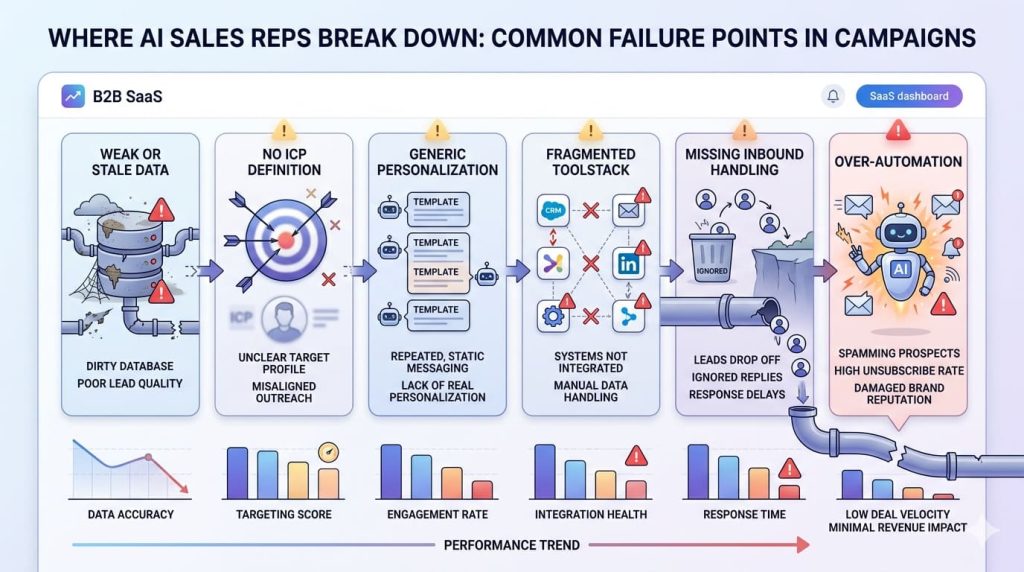
The fragmented toolstack failure is the one most teams underestimate. When research happens in one tool, enrichment in another, sequencing in a third, and reply handling manually every integration is a potential data loss point and a source of operational overhead. Systems that consolidate the full workflow reduce this risk significantly.
The inbound gap is equally underestimated. Many teams deploy an outbound AI rep and see pipeline grow but continue responding to inbound leads manually after 4–6 hours. As a result, the most valuable leads (people who already want to talk) are still being lost to slow follow-up and competitors who respond faster.
AI Sales Rep vs Traditional Sales Automation
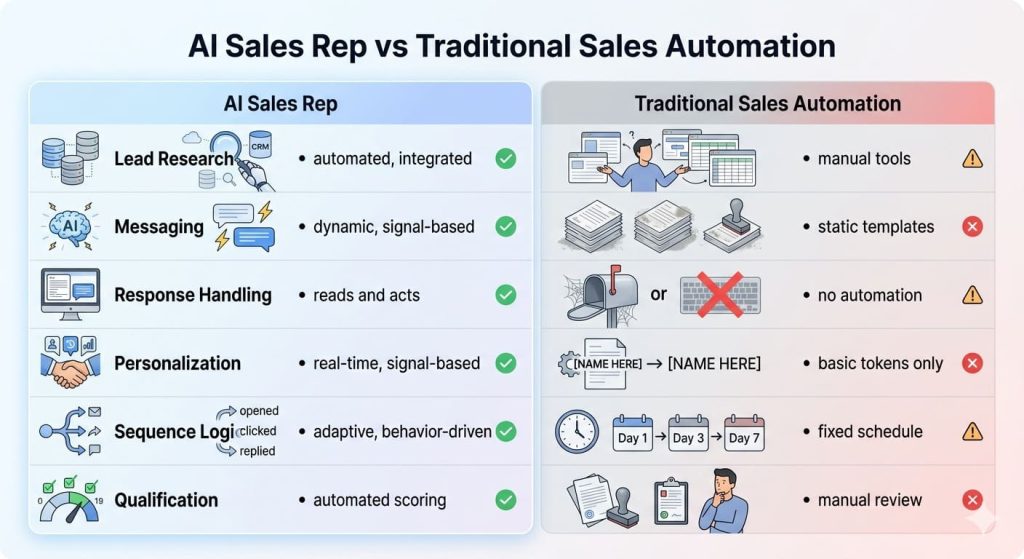
The core difference: traditional automation executes a fixed plan. An AI sales rep, by contrast, makes decisions.
To quickly understand the difference, here’s a visual comparison between AI sales reps and traditional sales automation:
How to Build Your Own AI Sales Rep Workflow
If you’re setting up an AI SDR workflow from scratch, knowing how AI sales reps work at each stage directly informs how you should configure your setup. This is the structure that consistently produces the best early results:
1. Define Your ICP Precisely
Industry, company size range, revenue stage, specific roles, and the trigger conditions that indicate a prospect is likely in-market. Vague ICP criteria produce vague results at every downstream stage specifically, they cause the AI to pursue unqualified leads that waste your closers’ time and erode trust in the system.
2. Choose Whether to Consolidate or Stack
You have two options: build a stack of specialist tools (data enrichment, sequencing, inbox management, booking) or deploy a platform that handles all of this within one system. Consolidation reduces the ops overhead of maintaining integrations and preserves signal freshness across the workflow. Platforms like GrowthEffect — with dedicated outbound (Vera) and inbound (Alim) agents — are built on this consolidated model.
3. Cover Both Outbound and Inbound
Most teams set up outbound first and that’s fine. However, don’t neglect inbound. If your outbound is generating awareness and interest, but your inbound leads are sitting for 4+ hours before getting a response, you’re creating demand and then losing it. Alim responds to every inbound enquiry in under 20 seconds across WhatsApp, Instagram DMs, Facebook Messenger, web forms, and email simultaneously, 24/7.
4. Identify Your Two or Three Key Signals
What events most reliably indicate a prospect is in-market for your product? Common examples: active hiring for roles adjacent to your solution, recent funding, tech stack changes, or website visits. These signals become the basis for personalised message generation and are therefore the single biggest lever on reply rate.
5. Set Explicit Qualification Criteria
Define what constitutes a qualified lead before the campaign runs. The clearer your ICP criteria, the cleaner the handoff to your sales team and the less time they spend on borderline leads. The BANT framework (Budget, Authority, Need, Timeline) is a solid starting structure for most B2B teams.
6. Test Before Scaling
Run the first iteration on 200–500 contacts. Measure reply rate, positive response rate, and meeting quality before increasing volume. Scaling a workflow that hasn’t been validated amplifies every flaw in the setup consequently, errors that are small at 500 contacts become expensive at 5,000.
7. Iterate on Signals First, Copy Second
When performance is below expectations, the instinct is to rewrite the email copy. In most cases, however, the constraint is the signal layer either the signals aren’t predictive enough, or the personalisation isn’t referencing them tightly enough. Fix the signal before rewriting the message.
FAQ: How AI Sales Reps Work in Practice
Do I need separate tools for research, enrichment, and sequencing?
With point-solution platforms, yes a typical stack involves separate tools for prospecting data, enrichment, email sending, LinkedIn outreach, and inbox management. With full-cycle platforms like GrowthEffect, research, message drafting, and multi-channel sequencing all run inside the same system. As a result, you reduce the ops overhead of managing integrations and preserve signal freshness at every stage of the workflow.
Is an AI sales rep the same as a chatbot?
No and this distinction matters. Chatbots follow script trees, say “I didn’t understand that,” can’t qualify leads, and feel robotic to anyone who interacts with them. An AI sales rep like Alim, however, has natural language understanding, runs full BANT qualification, handles objections conversationally, and books meetings all without the prospect realising they’re not talking to a human. If you’ve tried a chatbot before and it failed, the experience with a properly built AI sales rep is therefore categorically different.
How long does it take to see results from an AI sales rep?
Most teams see meaningful data within 2–4 weeks of a properly configured campaign. The first two weeks typically surface deliverability and ICP fit issues. Weeks three and four, on the other hand, provide enough reply and meeting data to decide whether to scale or iterate.
What reply rates should I realistically expect?
Generic cold email averages 1–2% positive reply rate. Well-configured campaigns with strong signal-based personalisation consistently reach 3–4% in our analysis roughly 2x the baseline. The variable that drives the difference is almost always personalisation depth, not send volume. For more context, see our FAQ.
Can an AI sales rep handle objections?
Basic objections timing, capacity, “already using something else” yes. Complex, multi-stakeholder objections requiring deep product knowledge or relationship context: no. The practical design is to use AI to carry conversations to the qualification point, then hand off to a human for anything requiring deeper judgment.
What happens to inbound leads while outbound is running?
In most platforms, nothing inbound is left to manual follow-up. That’s a significant revenue leak. With a closed-loop system, Alim handles every inbound lead across WhatsApp, Instagram DMs, Facebook Messenger, web forms, and email simultaneously responding in under 20 seconds, qualifying against BANT criteria, and booking meetings or routing to your team. Outbound generates the pipeline; inbound converts it.
Final Thoughts
How AI sales reps work is best understood not as a single tool but as a decision-making workflow system. Understanding each stage in isolation matters less than understanding how they connect: data quality constrains the signal layer, signal quality constrains personalisation, personalisation determines reply rate, and reply rate determines how much qualified pipeline the system generates.
Teams that consolidate the full workflow research, drafting, sequencing, qualification, and booking inside a single system reduce the failure points at each handoff and consequently get better performance at each stage. Teams that fragment across multiple tools, on the other hand, introduce ops overhead and data degradation between every step.
Above all, remember this: the most sophisticated outbound setup in the world still leaks revenue if inbound leads aren’t responded to in seconds. The complete AI sales rep workflow covers both directions Vera fills the funnel, Alim converts it, and your human closers focus on what only humans can do.
Next Steps
If you want to go deeper or evaluate a platform that runs the full workflow end-to-end:
- 👉 Full AI sales rep guide — what it is, ROI breakdown, and use cases
- 👉 Vera Outbound AI Agent — autonomous prospecting, enrichment, and outreach
- 👉 Alim Inbound AI Agent — 24/7 lead qualification and booking across all channels
- 👉 Pricing — current plans and what’s included
- 👉 FAQ — common questions on setup, signals, and ICP definition
Leave a Reply