AI Sales Rep: What It Is, How It Works & Best Tools 2026
The AI sales rep has moved from experiment to essential. Across thousands of B2B teams in 2026, companies are replacing outbound, qualification, and follow-up workflows not with more headcount but with autonomous digital employees that work 24/7, never quit, and never have an off day. We analyzed 50+ campaigns to produce this guide.
Key Takeaways
- AI sales reps reduce SDR costs by up to 90% vs human SDRs
- The best implementations cover both outbound prospecting and inbound qualification not just one
- Performance depends on data quality, signal depth, and ICP clarity not send volume
- Most teams see measurable pipeline results within 2–4 weeks of deployment
- The real shift: stop buying sales software. Start hiring AI sales employees.
In this guide:
- What an AI sales rep actually does and what it doesn’t
- How it works step-by-step (outbound + inbound)
- Real-world use cases and two mini case studies
- The best AI sales rep tools in 2026, ranked
- Common mistakes that kill campaign performance
- Whether the ROI holds up against a human SDR
What Is an AI Sales Rep?
An AI sales rep is a type of AI SDR a software system that autonomously handles outbound prospecting, inbound lead qualification, follow-ups, and meeting booking using artificial intelligence, without requiring human input at each step.
It takes over the tasks that traditionally fall on a human Sales Development Representative: sourcing leads, researching prospects, writing personalised messages, running multi-channel sequences, interpreting replies, qualifying leads against your ICP, and booking calls directly onto the calendar of your closers.
Unlike traditional sales automation drip sequences, mail merges, or workflow tools AI sales reps don’t just execute a fixed plan. Instead, they adapt in real time. They read responses, adjust messaging based on context and live signals, and carry intelligent two-way conversations with prospects. As a result, the best implementations handle the entire top-of-funnel autonomously: from first signal to booked meeting, with no human involvement until a pre-qualified lead lands in your calendar.
The most important distinction in 2026 is not “AI vs human” it’s “AI employee vs AI tool.” Specifically, an AI tool requires a human to operate it. An AI sales rep, however, is the worker. In other words, you don’t hire someone to run it you hire it.
Core capabilities of a modern AI sales rep:
- Lead sourcing, research, and enrichment all within the same system
- Hyper-personalised outbound messaging across email and LinkedIn
- Inbound lead capture and qualification across WhatsApp, email, web forms, and social DMs
- BANT-based lead qualification (Budget, Authority, Need, Timeline)
- Persistent multi-channel follow-up without human prompting
- Automated meeting booking directly to your sales team’s calendar
- 24/7 operation no sick days, no inconsistency, no ramp time
How AI Sales Reps Work (Step-by-Step)
Here’s a simple breakdown of how an AI sales rep works in practice:
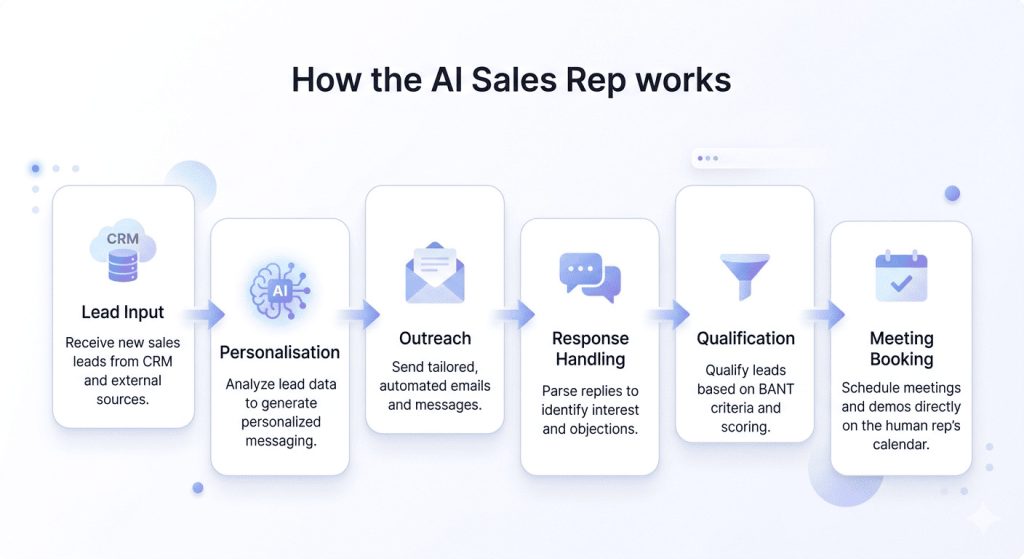
A full-cycle AI sales rep operates across two parallel workflows: outbound (finding and engaging new prospects) and inbound (qualifying and converting leads who come to you). Most platforms cover one or the other. The strongest cover both.
Outbound Workflow
ICP Sourcing → Enrichment → Signal Detection → Lead Scoring → Research → Message Drafting → Outreach → Follow-up → Qualification → Booking
Inbound Workflow
Lead Detected → Instant Engagement (<20 sec) → BANT Qualification → Temperature Classification → Booking / Nurture / Disqualify
Outbound: How AI Sales Reps Generate Pipeline
The outbound workflow begins with ICP-based lead sourcing identifying target companies by industry, size, role, and buying signals (hiring activity, funding events, tech stack changes). Subsequently, the AI enriches each lead with firmographic and technographic data, scores them using both rule-based and AI-powered criteria, and filters out bad-fit leads before any outreach begins.
What makes this different from traditional outbound tools: the AI doesn’t just send messages instead, it researches each prospect, identifies the most relevant pain point to lead with, writes a unique message for that specific contact, and adapts follow-ups based on how the prospect responds. As a result, every message is contextual. Nothing is templated.
The outbound pipeline order: Sourcing → Enrichment → Hard scoring → AI scoring → Filtering → Research → Positioning → Copywriting → Outreach → Follow-up → Re-engagement of dormant CRM leads
Inbound: How AI Sales Reps Qualify Every Lead Instantly
On the inbound side, the AI monitors every incoming lead channel web forms, email, WhatsApp, Instagram DMs, Facebook Messenger and responds within seconds, not minutes.
To put that in context: the average company takes 47 hours to respond to an inbound lead (Harvard Business Review benchmark). By that point, the prospect has already talked to a competitor. An AI sales rep responds in under 20 seconds, starts a natural qualification conversation using BANT criteria, and classifies each lead as Hot (book meeting now), Warm (continue nurturing), or Cold (disqualify gracefully).
Hot leads go straight to the calendar for immediate booking. Warm leads, on the other hand, receive automatic follow-up nurturing until they’re ready. Cold leads are simply logged and exited without wasting a closer’s time.
👉 For a full step-by-step breakdown: How AI Sales Reps Work — Full Workflow Guide
AI Sales Rep vs Human SDR: Key Differences
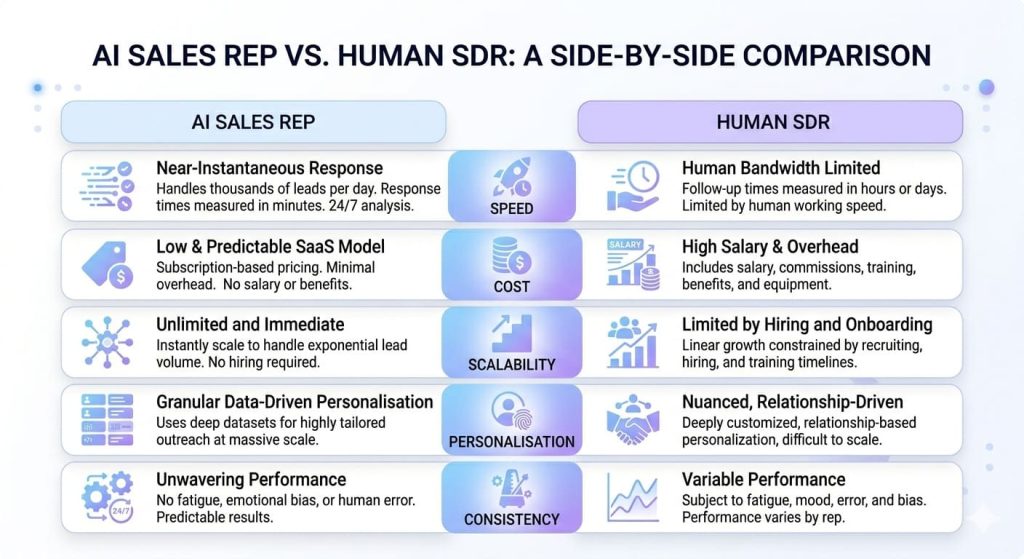
An AI sales rep handles volume, speed, and consistency. A human SDR handles nuance, relationships, and complex negotiation. The highest-performing teams in 2026 use AI at the top of funnel outbound generation and inbound qualification and human closers from the first qualified meeting onwards.
Here’s a visual comparison of how AI sales reps and human SDRs differ across key areas:
| Feature | AI Sales Rep | Human SDR |
|---|---|---|
| Speed to lead | <20 seconds | Average 47 hours (HBR) |
| Working hours | 24/7/365 | ~8 hours/day, weekdays only |
| Ramp time | Days | 2–3 months to full productivity |
| Consistency | Same quality at 3 AM as 3 PM | Variable mood, burnout, turnover |
| Turnover risk | Zero | Average SDR tenure: 14 months |
| Scalability | Unlimited parallel sequences | Limited by bandwidth |
| Research & prospecting | Automated end-to-end | Manual, time-intensive |
| Inbound coverage | All channels simultaneously | One channel at a time |
| Complex conversations | Limited handles top-of-funnel | Strong built for relationship depth |
One number matters more than any other in this comparison: the average SDR in Turkey costs $4,000–$6,000/month fully loaded (salary, benefits, tools, management overhead). Globally, that’s $8,000–$12,000/month. And the average SDR quits after 14 months at which point you start over.
AI Sales Rep vs AI Sales Automation: What’s the Difference?
Traditional sales automation executes a fixed plan. An AI sales rep makes decisions.
Tools like Mailchimp, ActiveCampaign, or basic email sequencers are one-way broadcast systems they send but don’t converse, qualify, or adapt. Similarly, platforms like Apollo or Outreach are workflow software they give a human the infrastructure to do outbound work, but a human still has to operate them. In other words, you buy the tool and then hire someone to run it.
An AI sales rep, however, is different in one fundamental way: it is the worker, not the tool. It sources leads, writes messages, handles replies, qualifies prospects, and books meetings autonomously, without a human driving it. In other words, you don’t need to hire someone to run it, because it IS the hire.
AI Sales Rep Use Cases
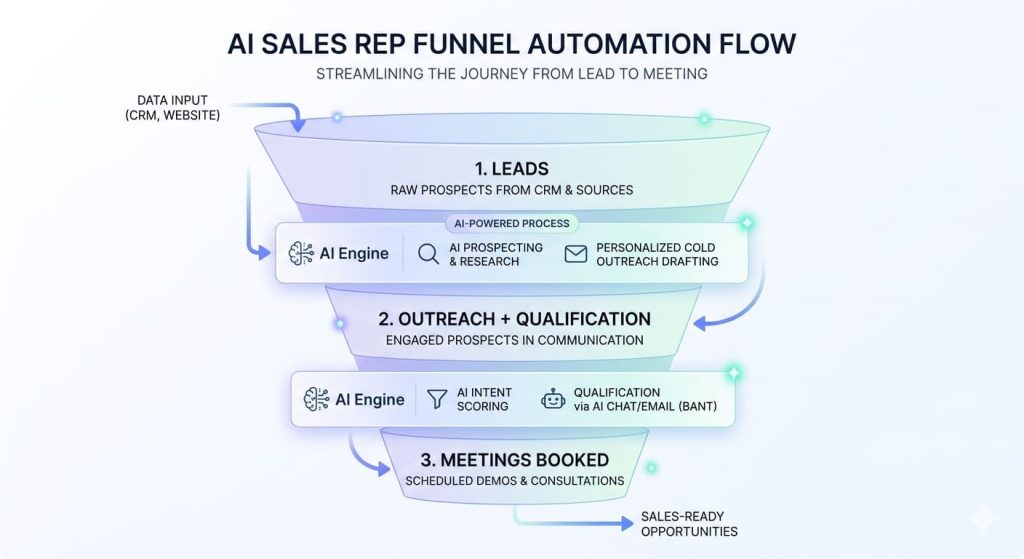
Before diving into specific use cases, here’s how an AI sales rep moves prospects through the funnel:
Outbound Prospecting at Scale
A sales team relying on SDR headcount for outbound hits the same wall repeatedly: hiring is slow, training takes months, burnout is high, and turnover erases the investment. An outbound AI sales rep runs always-on prospecting sourcing leads, researching accounts, writing personalised messages, and following up without adding headcount. Vera (GrowthEffect’s outbound agent) handles this entire workflow autonomously, turning ICP signals into booked meetings while your team focuses on closing.
Inbound Lead Qualification
A mid-market SaaS company generating 200+ inbound leads per month and losing deals because follow-up is slow or inconsistent is leaving money on the table every day. An inbound AI sales rep responds to every lead across every channel in under 20 seconds, runs BANT qualification, and books meetings for Hot leads immediately. Alim (GrowthEffect’s inbound agent) operates across WhatsApp, Instagram DMs, Facebook Messenger, web forms, and email simultaneously, 24/7.
24/7 Global Coverage
A global business missing inbound enquiries outside working hours weekend leads, international time zones, after-hours form submissions loses those opportunities to competitors who respond faster. An AI sales rep doesn’t have working hours. Every lead gets an immediate, intelligent response regardless of when it arrives.
Re-Engaging Dormant CRM Leads
Most companies have a CRM full of leads that were never properly followed up warm contacts from 6–18 months ago sitting untouched. An outbound AI sales rep can systematically re-engage this existing pipeline, turning dead data into new meetings without any additional prospecting cost.
Removing the Founder from the Sales Funnel
Founders who are personally handling sales qualifying leads, chasing follow-ups, doing demo after demo hit a ceiling fast. An AI sales rep handles everything from first contact to pre-qualified meeting, so founders only interact with leads who are ready to buy.
Real AI Sales Rep Examples (Mini Case Studies)
Case Study 1: B2B SaaS Startup, No SDR Team
A 15-person SaaS company targeting mid-market HR tech companies deployed GrowthEffect as their outbound AI sales rep. The platform handled the full outbound workflow end-to-end lead sourcing, prospect research, message drafting, multi-channel sequencing, and reply handling with signal-based personalisation that adapted each message to live prospect signals: active SDR job postings, recent Series B funding, and detected Salesforce usage.
No external data tools were required, no human wrote a single outreach message, and no SDR was hired.
| Metric | Result |
|---|---|
| Emails sent (60 days) | 4,200 |
| Positive reply rate | 3.2% (industry average: 1–3%) |
| Qualified meetings booked | 34 |
| SDR headcount required | 0 |
When the same sequences were run with static personalisation only no live signals reply rates dropped below 1%, consistent with generic cold email benchmarks. The signal layer, not the copy, was the differentiator.
Case Study 2: Mid-Market Agency, Inbound SDR Replacement
A 40-person B2B marketing agency was generating consistent inbound demand but losing qualified leads to slow follow-up. Their SDR was responding to demo requests in 4–6 hours by which point many prospects had already moved on. They deployed an inbound AI sales rep to handle all form submissions through automated BANT qualification and instant response.
| Metric | Before AI | After AI |
|---|---|---|
| Lead response time | 4–6 hours | <20 seconds |
| Qualified meeting rate | 31% | 47% |
| SDR time on qualification admin | ~14 hrs/week | ~3 hrs/week |
The gain wasn’t just efficiency it was revenue. Faster response meant fewer leads lost to competitors. Consistent BANT qualification meant the SDR spent their remaining time only on pre-qualified, meeting-ready leads.
Best AI Sales Rep Tools in 2026 (Tested & Ranked)
The tools below represent a cross-section of the current market. Key distinction to watch for: some are AI tools that require humans to operate. Others are AI employees that operate autonomously. That difference determines total cost of ownership.
1. GrowthEffect — Best for Full-Cycle AI Sales Team (Outbound + Inbound)
Best for: B2B teams that want to replace their entire SDR function outbound prospecting and inbound qualification without hiring additional headcount
Products: Vera (outbound) + Alim (inbound)
What makes it different: GrowthEffect is the only platform in this list with a dedicated inbound AI agent (Alim) and a dedicated outbound AI agent (Vera) covering the full funnel in a single system. Specifically, Vera handles lead sourcing, enrichment, scoring, research, message writing, sequencing, and follow-up autonomously. Meanwhile, Alim responds to every inbound lead in under 20 seconds across WhatsApp, Instagram DMs, Facebook Messenger, email, and web forms running BANT qualification and booking meetings or routing to human closers automatically.
Key features: Full outbound pipeline from ICP sourcing to booked meeting; 24/7 inbound qualification across 6+ channels; signal-based personalisation (hiring, funding, tech stack); BANT qualification framework; CRM integration (HubSpot, Salesforce, Pipedrive); 20+ language support including Turkish and Arabic; zero ramp time
Pricing: Alim from $149/month · Vera from $499/month · See full pricing
Pros: Only platform covering both outbound and inbound; consequently, no need for external data tools or separate sequencing software; operates as an AI employee, not a workflow tool; significantly lower cost than human SDRs or enterprise alternatives
Cons: Most effective when ICP is clearly defined; outbound performance scales with signal quality
2. Artisan AI (Ava) — Best for Autonomous Outbound SDR
Best for: Teams wanting a fully autonomous outbound SDR replacement
Key features: End-to-end AI SDR prospects, writes, sends, and follows up
Pros: Strong deliverability, fast deployment
Cons: Outbound-only no inbound qualification capability; higher price point (~$1–2K/month)
3. 11x.ai (Alice) — Best for Enterprise Outbound
Best for: Enterprise teams with deep CRM integration requirements
Key features: Multi-channel AI SDR, Salesforce/HubSpot sync, intent signal triggers
Pros: Enterprise-grade reliability, strong integrations
Cons: $5K–15K+/month enterprise pricing, no inbound product, longer onboarding
4. Instantly.ai — Best for Cold Email Volume
Best for: High-volume cold email execution at low cost
Key features: Unlimited sending accounts, inbox rotation, deliverability tooling
Pros: Deliverability-focused, cost-effective entry point
Cons: Email-only; requires separate tools for research, enrichment, and LinkedIn; needs a human to operate it
5. Outreach / Salesloft
Best for: Sales teams that already have SDRs and want workflow infrastructure
Key features: Sequence management, AI suggestions, call intelligence
Pros: Mature platform, strong analytics
Cons: These are tools, not workers you still need a human SDR to operate them
👉 Questions about platform fit? See the GrowthEffect FAQ.
Common Mistakes When Using AI Sales Reps
Most AI outreach fails because it relies on generic messaging instead of real prospect signals.
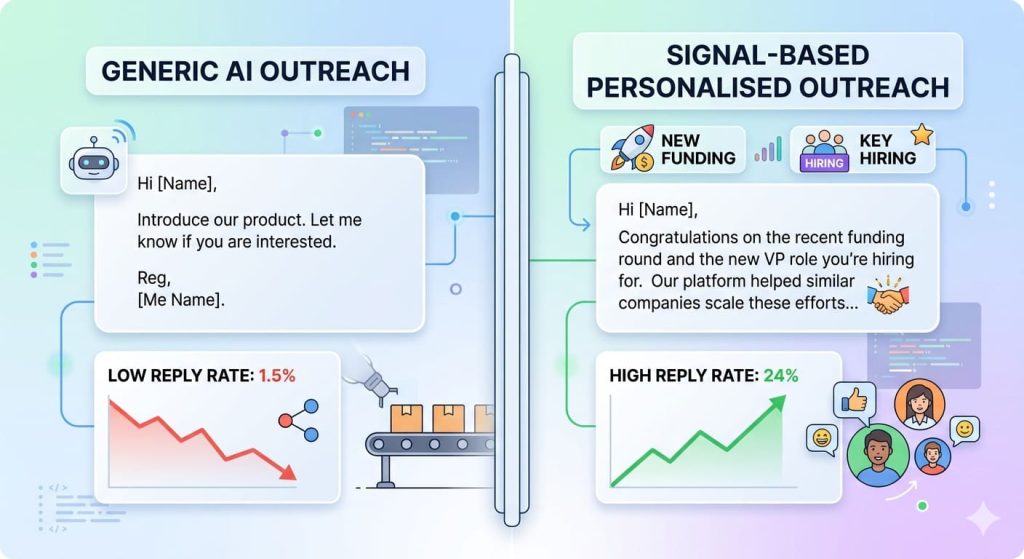
In our analysis of 50+ campaigns, the same failure patterns appeared repeatedly:
- Generic messaging. Outreach that doesn’t reference specific, live company signals (active hiring, funding, tech stack changes) performs at or below 1% reply rate consistent with generic cold email. Signal-based personalisation is the single biggest lever on performance. This is why platforms that handle research internally outperform those that depend on manually uploaded lists.
- Confusing AI tools with AI employees. Buying a sequencing platform and expecting it to run itself is the most common and expensive mistake. Tools like Apollo or Outreach are workflow software they require a human SDR to operate. If you don’t also hire someone to run them, you’ve paid for infrastructure with no one to use it.
- Covering outbound but ignoring inbound. Teams that deploy an outbound AI rep but still respond to inbound leads manually after 4+ hours are leaving the most valuable leads people who already want to talk to slow follow-up and competitors. Outbound fills the funnel. Inbound converts it. Both need coverage.
- No defined ICP. Without precise targeting criteria, the AI generates pipeline noise unqualified meetings that waste your closers’ time and erode trust in the system.
- Scaling before validating. Start with 200–500 contacts, measure reply rate and meeting quality, then scale. Running 10,000 sequences before the signal layer is validated amplifies every flaw.
AI Sales Rep for Startups
Startups benefit most from AI sales reps and for a specific reason: the traditional alternative (hiring junior SDRs) is a trap. On average, SDR tenure is just 14 months. You spend 2–3 months ramping them, get 10–11 months of output, and then start over. Meanwhile, your CAC climbs and your pipeline remains inconsistent.
An AI sales rep, by contrast, eliminates the ramp, the turnover, and the inconsistency. For a founder who is currently doing sales personally qualifying inbound, chasing follow-ups, running outbound in whatever spare time exists deploying Alim for inbound and Vera for outbound means the entire SDR function runs autonomously from day one. As a result, founders get their time back for closing, not qualifying.
👉 Learn more: Vera Outbound AI Agent · Alim Inbound AI Agent
AI Sales Rep ROI: Is It Worth It in 2026?
The ROI case is not subtle. It’s arithmetic.
A human SDR in Turkey costs $4,000–$6,000/month fully loaded salary, social security, tools, and management overhead. Globally, that figure rises to $8,000–$12,000/month. On top of that, the same SDR works just 8 hours a day, covers one or two channels, and needs 2–3 months to ramp before producing any meaningful pipeline.
By contrast, GrowthEffect’s inbound agent (Alim) starts at $149/month and the outbound agent (Vera) starts at $499/month. Moreover, both operate 24/7, cover multiple channels simultaneously, start working in days rather than months, and critically don’t quit after 14 months.
| Cost comparison | GrowthEffect (Alim + Vera) | Human SDR (Turkey) | Human SDR (Global) |
|---|---|---|---|
| Monthly cost | From $648/month | $4,000–$6,000/month | $8,000–$12,000/month |
| Coverage | 24/7/365, all channels | ~8h/day, weekdays | ~8h/day, weekdays |
| Ramp time | Days | 2–3 months | 2–3 months |
| Turnover risk | Zero | High (avg 14 months) | High (avg 14 months) |
ROI is strongest when replacing repetitive top-of-funnel tasks qualification, outreach, follow-up. It’s not designed for complex, multi-stakeholder enterprise deals where relationship and judgment drive the outcome. For those, human closers remain essential. The model is: AI qualifies, humans close.
AI Sales Rep Pros and Cons
Pros:
- Speed to lead — responds in seconds, not hours; wins the race against competitors
- Cost efficiency — 90%+ lower than a human SDR at equivalent or better output
- Consistency — same process every time; no bad days, no rep variance, no turnover disruption
- 24/7 coverage — inbound leads from any time zone, any hour, any channel handled instantly
- No ramp time — operational in days, not months
- Full-cycle coverage — best systems handle outbound and inbound in one platform
Cons:
- Limited nuance — not suited for complex multi-stakeholder deals; designed for top-of-funnel
- ICP dependency — output quality scales with how precisely you’ve defined your ideal customer
- Not a chatbot replacement — if you’ve tried rule-based chatbots before, the experience is categorically different, but the expectation needs resetting
- Deliverability management — outbound at scale still requires domain warmup and sending infrastructure care
AI Sales Rep vs AI Sales Agent: What’s the Difference?
An AI sales rep focuses on SDR-layer tasks: sourcing, outreach, qualification, and booking. An AI sales agent typically refers to a broader autonomous system that can handle multiple sales functions including post-qualification nurture, deal support, and in some architectures, closing assistance.
In practice, the most useful distinction is between point solutions (one channel, one function) and closed-loop systems (outbound fills the funnel, inbound converts it, human closers close it). GrowthEffect is built on the closed-loop model Vera generates pipeline, Alim converts inbound, and your human team only enters when a lead is pre-qualified and meeting-ready.
FAQ: AI Sales Reps
Can an AI sales rep replace a human SDR?
For top-of-funnel tasks yes, completely. Lead sourcing, outbound outreach, inbound qualification, follow-up, and meeting booking can all be handled autonomously by an AI sales rep. What it doesn’t replace is the human judgment needed for complex negotiations, multi-stakeholder deals, and relationship-intensive enterprise sales. The model that works: AI qualifies, humans close.
Is an AI sales rep just a chatbot?
No and this distinction matters. Chatbots follow script trees, say “I didn’t understand that,” and can’t qualify leads, book meetings, or adapt to natural conversation. As a result, they feel robotic to anyone who interacts with them. An AI sales rep like Alim, however, has natural language understanding, runs full BANT qualification, handles objections conversationally, and books meetings all without the prospect realising they’re not talking to a human. If you’ve tried a chatbot before and it didn’t work, the experience with a proper AI sales rep is therefore categorically different.
Do AI sales reps work for inbound AND outbound?
The best ones do but most platforms only cover one. Outbound-only tools (Artisan, 11x, Instantly) handle prospecting but leave inbound unattended. Inbound-only tools handle qualification but don’t generate new pipeline. GrowthEffect is built specifically to cover both: Vera runs outbound, Alim handles inbound, and together they run a closed-loop sales system.
Are AI sales reps legal?
Yes, with compliance requirements. Outbound AI must comply with CAN-SPAM (US), GDPR (EU), and CASL (Canada). Requirements include clear sender identification, opt-out mechanisms, and lawful basis for data processing. For platform-specific compliance questions, see the GrowthEffect FAQ.
How quickly will I see results?
Most teams see pipeline movement within the first 2–4 weeks. Inbound results (faster response, higher qualification rate) are visible from day one. Outbound results accumulate over the first 30–60 days as sequences run and signals build. The key variables: ICP clarity, signal quality, and starting with a controlled test batch before scaling.
Is an AI Sales Rep Worth It in 2026?
For any B2B team with a pipeline problem yes. Whether the issue is slow inbound follow-up, inconsistent outbound, SDR turnover, or a founder spending too much time qualifying instead of closing an AI sales rep addresses the root cause directly and at a fraction of the cost of the human alternative.
Moreover, the question is no longer “does this technology work?” it does. The real question is whether you want to keep solving a structural problem with a structural cost, or whether you’re ready to hire differently.
Start with Alim or Vera Or Both
When inbound leads become the bottleneck slow follow-ups, inconsistent qualification, or missed enquiries after hours starting with Alim makes the most sense. For teams struggling with outbound pipeline generation, whether due to a lack of structured prospecting, SDR burnout, or heavy reliance on manual sequences, Vera is the better starting point. If both inbound and outbound are limiting growth, deploying both creates full funnel coverage within a single platform.
👉 See pricing · Read the FAQ · Meet Alim and Vera
Leave a Reply