
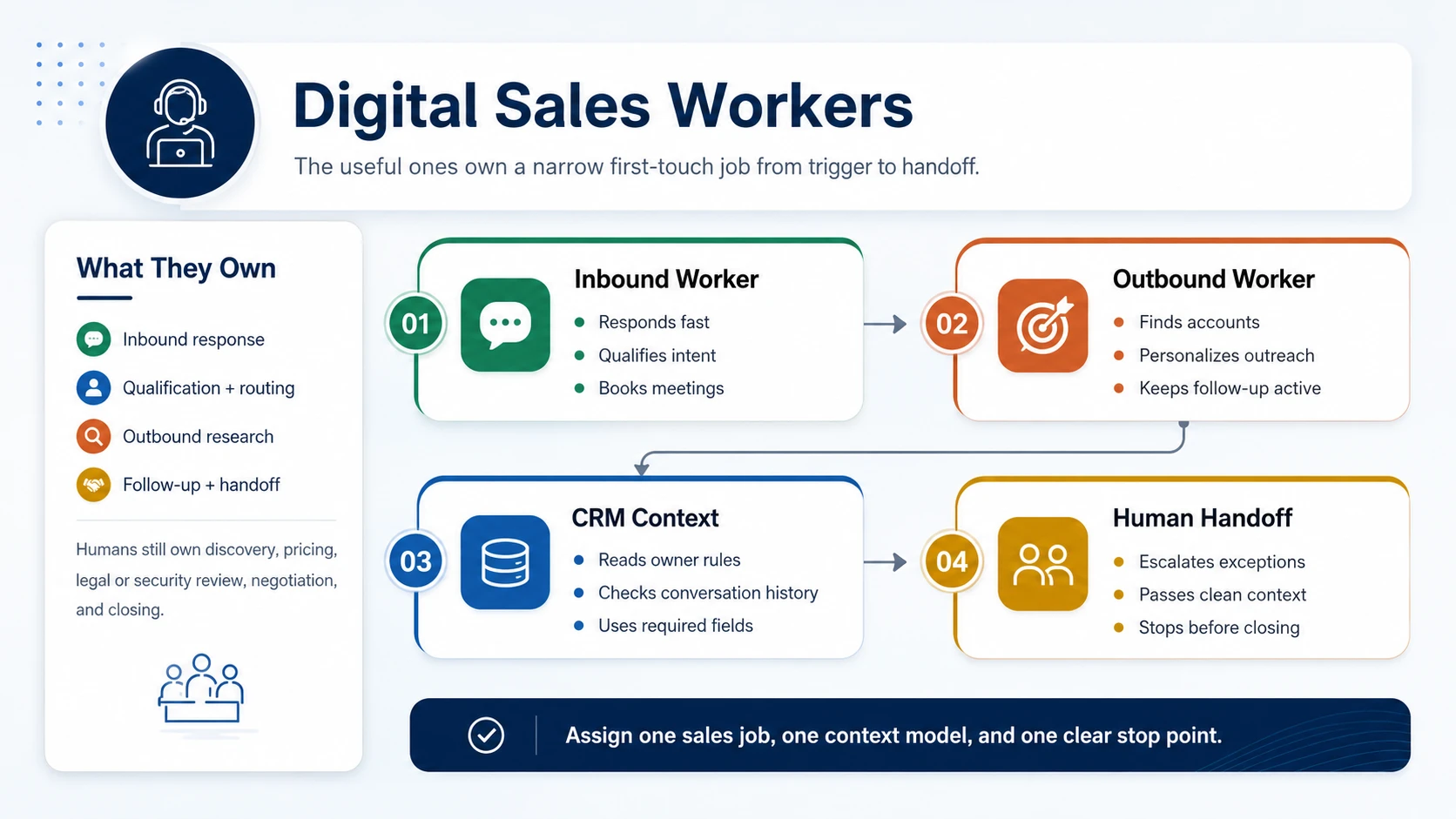
Digital sales workers are AI systems that own repeatable first-touch sales work, not just assist a rep with prompts or task reminders. The right digital sales worker can qualify inbound leads, run outbound prospecting, follow up consistently, and hand clean context to a human closer. The wrong one is just another software layer that still depends on manual execution.
If you are evaluating this category, do not start with feature lists. Start with ownership: who owns the work, who owns the context, who owns the handoff, and who owns the guardrails?
Key Takeaways
– A digital sales worker should own repeatable first-touch sales work, not only generate suggestions.
– The real buying question is whether you need workflow ownership, workflow control, or rep assistance.
– Inbound and outbound should stay separate: Alim is for inbound qualification and routing, Vera is for outbound pipeline creation.
– A useful evaluation model is the four ownership test: work, context, handoff, and governance.
– Teams should buy digital sales workers when the leak is execution consistency, not when the real problem is undefined CRM logic or unclear qualification rules.
What A Digital Sales Worker Actually Is
The term sounds vague because many vendors use worker, agent, assistant, and automation almost interchangeably. That creates buying confusion.
Salesforce defines a digital worker as an AI application that acts like a virtual employee for complex tasks. In sales, that matters only when the system can do more than recommend an action. It needs to execute a defined part of the workflow reliably enough that a manager can assign ownership to it.
That is the difference between:
- a sequencing tool that reminds a rep to send a message;
- a workflow automation layer that updates fields and routes records;
- a digital sales worker that actually performs first-touch sales work inside defined rules.
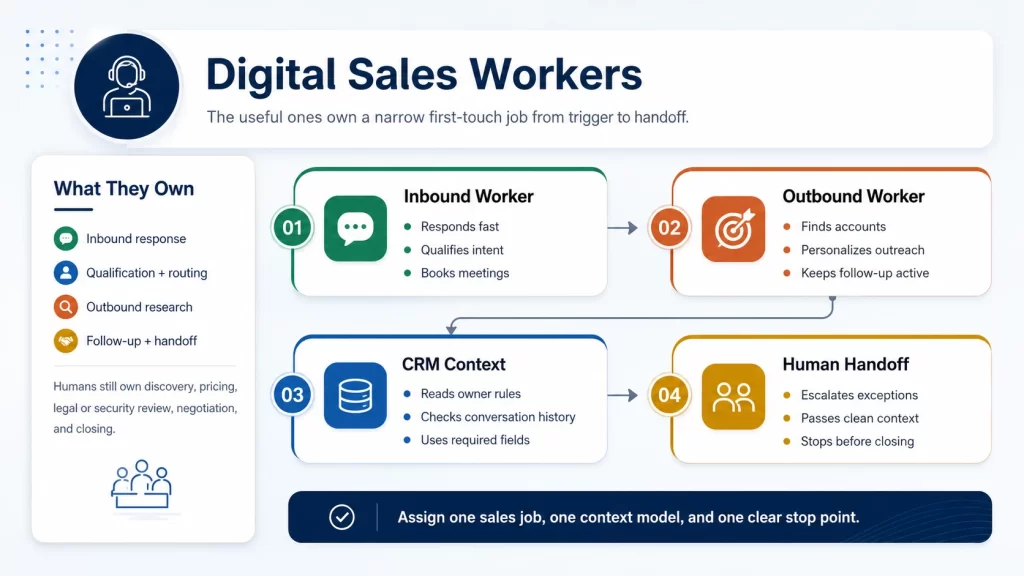
The simplest definition is this: a digital sales worker is an AI operating layer that owns a repeatable sales job from trigger to handoff.
That job might be inbound qualification. It might be outbound prospecting. It should not be “everything in sales.”
Which Workflows Digital Sales Workers Should Own
The best digital sales workers own narrow, high-frequency, first-touch jobs that humans often execute inconsistently.
Here is the right split:
| Workflow | Good digital-worker fit | Why it fits | Human owner after handoff |
|---|---|---|---|
| Inbound first response | Yes | Speed and consistency matter more than rep improvisation | AE, SDR, or closer |
| Inbound qualification and routing | Yes | Rules, context capture, and calendar logic can be structured | Human closer or account owner |
| Outbound sourcing and research | Yes | High-volume repetitive work benefits from automation and scoring | SDR, AE, or founder after positive signal |
| Personalized outbound follow-up | Yes | The worker can keep the cadence active and context-aware | Human closer after reply or booked meeting |
| Pricing negotiation | No | Too much nuance, risk, and approval complexity | Human seller |
| Legal or security review | No | Requires policy judgment and real stakeholder ownership | Human team |
| Deep discovery and solution design | No | High-context, high-trust conversations still need humans | Human seller |
For GrowthEffect, that ownership stays explicit.
- Alim is the inbound digital sales worker for response, qualification, routing, meeting booking, and CRM sync.
- Vera is the outbound digital sales worker for sourcing, enrichment, research, scoring, personalized outreach, follow-up, and CRM handoff.
- Humans still own discovery, pricing, procurement, legal or security review, negotiation, and closing.
That separation matters more than the label.
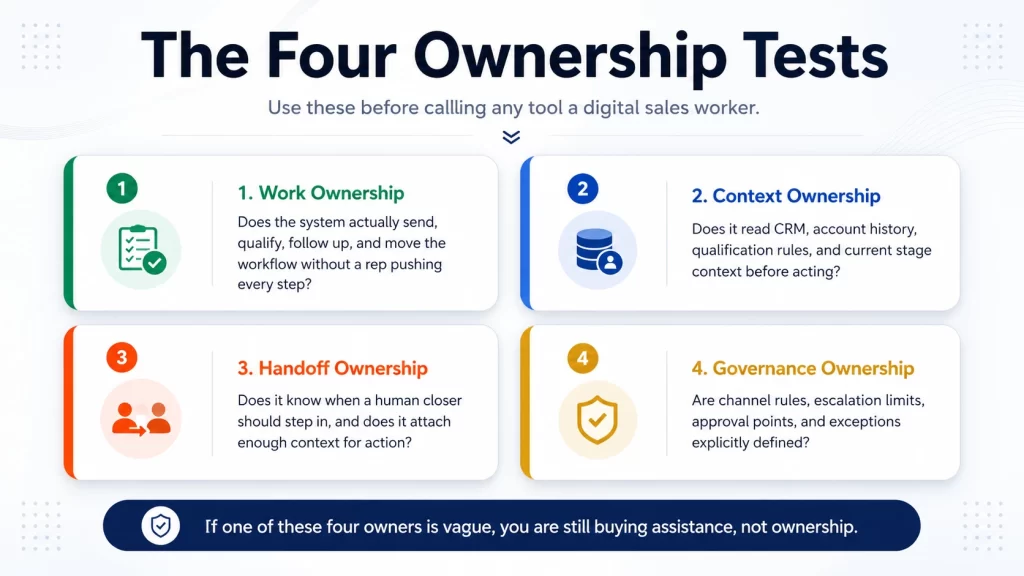
Use The Four Ownership Tests Before You Buy
Most teams ask whether a platform has AI. That is too weak. Ask whether the platform passes four ownership tests.
1. Work ownership
Does the system only recommend the next action, or does it actually perform the work?
A real digital sales worker should be able to run a defined workflow like first response, lead qualification, outbound research, or follow-up without waiting for a rep to push every step manually.
2. Context ownership
Does the system read enough context before acting?
That means CRM history, account data, routing rules, qualification criteria, prior conversations, and current stage logic. HubSpot Sales Automation is useful for workflow control, but workflow control alone is not the same as a worker owning the conversation layer.
3. Handoff ownership
Does the system know when to stop and pass the conversation to a human?
This is where many “AI sales” tools break. They can send messages, but they do not define what counts as ready for a rep, what context must be attached, or when escalation is mandatory.
4. Governance ownership
Does the team have clear rules for limits, exceptions, and approvals?
That includes channel boundaries, qualification rules, CRM field ownership, escalation triggers, and human-review moments. If governance is missing, the tool will amplify the mess.
Use this test to separate a digital worker from a generic assistant, sequencing layer, or workflow engine.
Related GrowthEffect Workflow
If you are not yet sure whether the leak is inbound response, outbound execution, or CRM handoff, start with the GrowthEffect revenue leak scan. It helps map whether the problem is qualification, routing, outreach consistency, or handoff quality before you buy another system.
When Digital Sales Workers Beat Software-Only Automation
Digital sales workers outperform software-only automation when the team knows the job, but cannot execute the job consistently.
That usually looks like this:
- inbound leads arrive after hours and wait too long for a useful response;
- reps skip qualification steps or capture partial CRM context;
- outbound prospecting happens in bursts and then disappears;
- follow-up quality drops after the first touch;
- human closers receive weak handoffs with missing notes, missing fit signals, or missing urgency context.
In those conditions, workflow software alone does not solve the real leak. It may move records more neatly, but it still assumes a person will perform the work on time and with discipline.
That is why outbound worker models like 11x Alice or Artisan’s AI sales agent get attention. Buyers are not only asking for better dashboards. They are trying to assign first-touch sales work to a system that can keep running.
The important question is not whether the tool claims autonomy. It is whether the workflow boundaries are clear enough for autonomy to help.
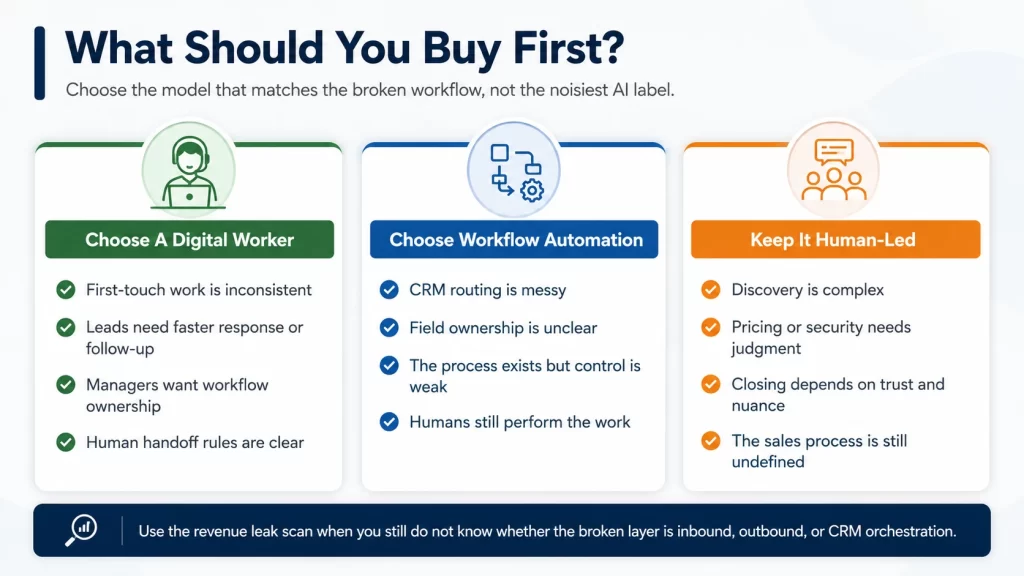
When A Digital Sales Worker Is The Wrong First Purchase
Do not buy a digital sales worker first when the actual problem is basic sales process ambiguity.
This is the wrong first move when:
- Nobody agrees on what a qualified lead looks like.
- CRM stages, field ownership, and routing logic are still messy.
- The handoff point from AI to human is undefined.
- Sales, RevOps, and marketing disagree on channel rules.
- Leadership wants AI to cover for a missing sales process.
In those cases, the first purchase should be workflow cleanup, qualification design, routing logic, or basic governance.
This is also where many teams confuse digital workers with pure workflow automation. If your main leak is record routing and approval logic, you may need a workflow-control layer before you need a worker. If your main leak is rep follow-up discipline, you may only need sequencing. If the work itself is not happening reliably, that is when a digital sales worker becomes the right category.
For adjacent evaluation, see AI sales automation tools or best AI sales agents after you define which layer should own the job.
How To Evaluate Inbound, Outbound, And Full-Funnel Models
Not every digital sales worker should own the same motion.
Use this decision table:
| If your main problem is… | Best digital-worker model | Why |
|---|---|---|
| Inbound leads wait too long for response | Inbound worker | The leak is speed, qualification, routing, and booking |
| Outbound pipeline depends on rep energy | Outbound worker | The leak is sourcing, research, personalized outreach, and follow-up |
| Both inbound and outbound first-touch are inconsistent | Split full-funnel model | Separate ownership keeps the workflows clearer and safer |
| CRM process is broken but selling work already happens | Workflow automation first | Fix orchestration before adding worker autonomy |
| The team wants AI to close deals end to end | Human-led model with selective AI | Closing still needs human ownership |
This is why GrowthEffect uses separate workers instead of one vague all-in-one promise.
- Choose Alim when the leak is inbound response, qualification, routing, meeting booking, and CRM sync.
- Choose Vera when the leak is outbound prospecting, research, personalization, follow-up, and pipeline creation.
- Use both only when both first-touch layers are already defined and you want humans focused on qualified conversations instead of repetitive execution.
The Buying Standard: Hire A Worker, Not Another Dashboard
The commercial value of a digital sales worker is not that it sounds more advanced than automation. The value is that a manager can assign a real sales job to it.
That means the buying standard should be operational:
- What exact workflow will this worker own?
- Which inputs does it read before acting?
- Which outputs must it create before handoff?
- Which exceptions force a human step-in?
- Which KPI proves it is creating qualified conversations rather than just activity?
If the answers are vague, the team is still buying software assistance, not workflow ownership.
That does not make the tool bad. It just means you should judge it like software, not labor.
The cleanest way to evaluate a vendor is to ask for one narrow workflow and inspect the handoff quality. If the worker cannot hand a human seller enough context to act confidently, it is not ready to own the job.
See The Workflow On Your Pipeline
If your team wants to see whether a digital sales worker should own inbound qualification, outbound pipeline creation, or both, book a GrowthEffect demo and map the workflow against your current handoff, CRM, and follow-up model.
If you already know the leak is inbound, start with Alim. If the leak is outbound execution, start with Vera. If the leak is still unclear, use the revenue leak scan before choosing the model.
Lead magnet recommendation: AI SDR Readiness Checklist
Follow-up path:
- Identify whether the broken layer is inbound response, outbound execution, or CRM orchestration.
- Define the handoff rules and the minimum context a human must receive.
- Test whether Alim, Vera, or a split model maps cleanly to that workflow.
FAQ
What are digital sales workers?
Digital sales workers are AI systems that own repeatable first-touch sales tasks such as inbound qualification, outbound prospecting, follow-up, and handoff within defined rules and guardrails.
Are digital sales workers the same as AI SDR tools?
Not exactly. Some AI SDR tools behave like digital workers, but many still act more like rep-assist or sequencing systems. The difference is workflow ownership, not the label.
When should a company buy a digital sales worker?
Buy one when the sales process is defined but execution is inconsistent. Do not buy one to hide unclear qualification rules, broken CRM ownership, or undefined handoff logic.
Should one digital sales worker handle both inbound and outbound?
Usually no. Inbound and outbound have different triggers, guardrails, and handoff rules. Separate ownership is often safer and easier to manage.
What should humans still own?
Humans should still own discovery, pricing, procurement, legal or security review, negotiation, and closing.
Leave a Reply