AI account research for sales turns company information, current events, and relationship history into a brief a seller can use before outreach. A useful brief explains fit, timing, likely stakeholders, supporting sources, and unanswered questions. It keeps observed facts separate from assumptions about a buyer’s needs.
For a small B2B sales team, the goal is practical: decide which account deserves attention, what you can credibly say, and what still needs checking. A longer company summary is not necessarily a better research result.
In this guide: a repeatable research workflow, a copyable account-brief template, a fictional worked example, and a checklist for evaluating AI research software. The method is an editorial framework, not a claim of measured customer results.
What should an AI account research brief contain?
Start with six elements: account fit, a relevant event or context, likely stakeholders, evidence, unknowns, and the next action. Each important claim should be traceable to a source and a date. Keep the brief short enough that a seller can review it before approving an approach.
- Fit: which targeting criteria the company meets and which remain uncertain.
- Timing: what changed, when it happened, and why it could matter to your offer.
- People: current roles, possible involvement, and whether buying authority is actually confirmed.
- Evidence: the original source, what it says, and when you checked it.
- Unknowns: gaps and conflicting information that could change your decision.
- Next action: research another fact, ask a discovery question, prepare a draft, or exclude the account.
This differs from enrichment. Enrichment may add a headcount or job title; research explains whether that information supports a relevant conversation. Lead qualification then assesses the opportunity against explicit criteria. See our AI lead qualification workflow for that separate decision.
A four-step workflow: collect, verify, separate, review
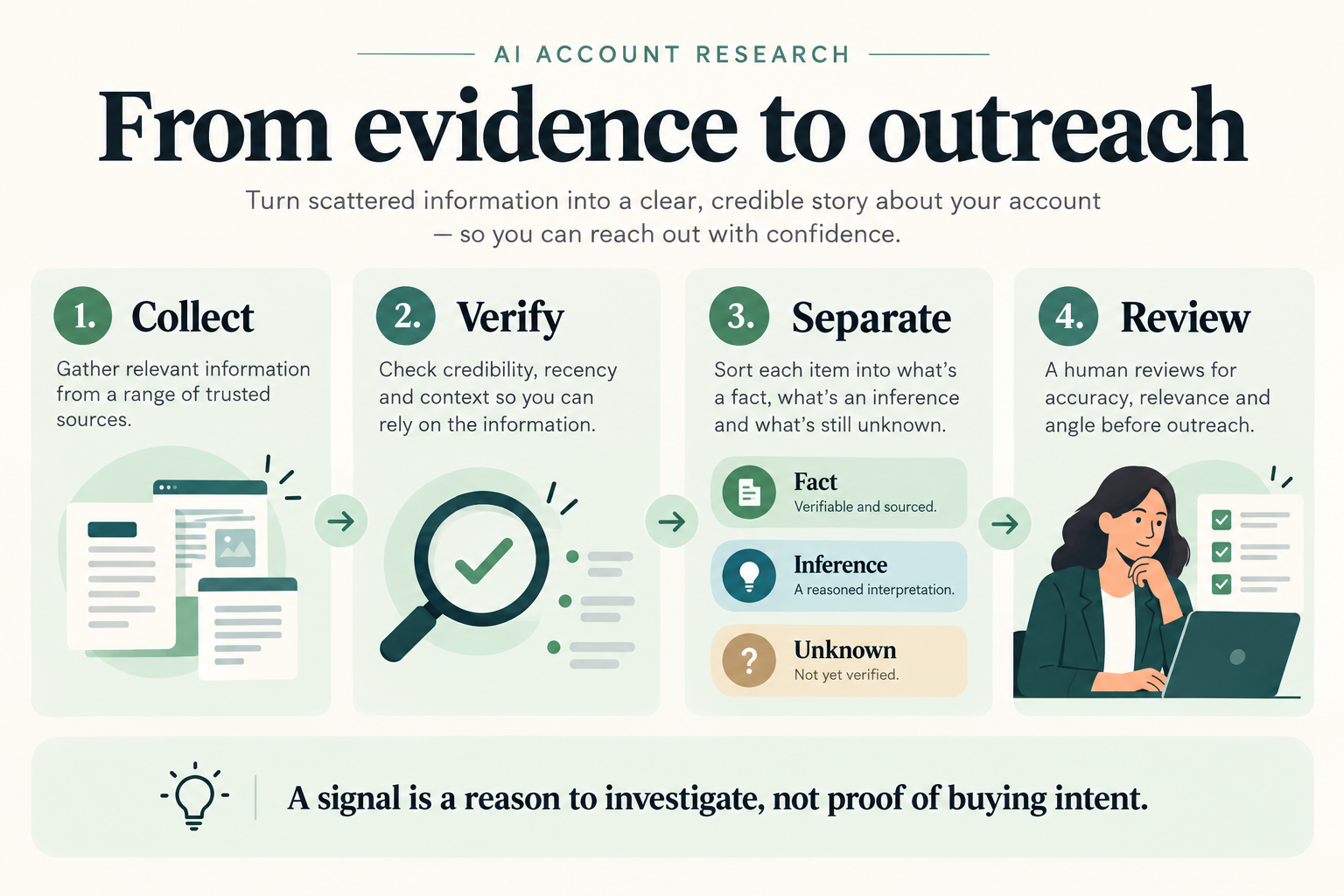
Collect relevant evidence, verify its context and recency, separate facts from hypotheses, and review the proposed action. A signal is a reason to investigate, not proof of buying intent. Open the full-size workflow image.
1. Collect only the context needed for the decision
Define the segment, offer, and decision first. If you sell warehouse software to distributors, you need evidence about distribution operations and relevant responsibilities. A founder’s unrelated social post adds little to that decision.
Use company product pages, current careers pages, official announcements, and relevant public filings where available. Add authorized CRM notes and previous conversations so the brief reflects the relationship you already have. Respect source permissions and collect only relevant professional information.
Give the agent specific questions rather than asking it to research everything. For example: “Does this business operate its own distribution facilities? Which source supports that? If this is unclear, return unknown.” A missing answer should trigger a narrower search, not an invented explanation.
2. Verify source, company identity, and recency
Confirm that the source refers to the right company, subsidiary, location, and person. Similar business names and outdated profiles can contaminate an otherwise fluent brief.
Record three dates where possible: when the event happened, when the source was published, and when you checked it. A page found today may describe a change from two years ago. If a date is unavailable, record that limitation instead of treating the source as recent.
Set freshness rules for the specific fact. A current job opening deserves a new check before mentioning it; a company’s founding year usually does not need the same cadence. There is no single freshness threshold that makes every sales signal reliable.
Product documentation illustrates useful controls. Salesforce’s account research overview describes cited research that sellers can refine and choose to save. Citations make a claim inspectable; they do not automatically make the interpretation correct.
3. Separate facts, inferences, and unknowns
Use explicit labels. “The company has five open SDR roles” can be a fact supported by its careers page. “The company may need a repeatable onboarding process” is an inference. “The sales leader has budget for a new tool” remains unknown unless the buyer or another reliable source confirms it.
Do the same for people. A Head of Sales title suggests potential relevance; it does not prove decision authority, budget ownership, or involvement in this project. Salesloft’s guide to seller action agents explains why company information, relationship history, and conversations need to be considered together when interpreting priorities and influence.
When sources conflict, preserve both with their dates and explain what needs resolving. Do not average contradictory job titles or quietly replace a current CRM fact with an older web result.
4. Review the next action before outreach
Ask whether the proposed message says more than the evidence supports. Replace claims about internal pain with a relevant question. Avoid implying that you know the recipient’s private priorities or that an observed event guarantees urgency.
Keep the research brief separate from permission to act. An approved account does not automatically mean every contact, channel, message, or CRM update is approved. Assign an owner for ambiguous cases and carry suppression and previous-reply context into the review.
A copyable account research template
Use the following structure in your CRM or research document. The fields are a recommended operating template, not a promise that every tool exports this exact format.
- Company and domain: exact entity, relevant business unit, and market.
- Research question: the decision this brief should support.
- ICP fit: met criteria, exclusions, and missing evidence.
- Verified observations: each fact with its source URL, event date, publication date, and date checked.
- Interpretation: why the observations could matter to your offer, labeled as hypotheses.
- Stakeholders: current title and evidence; possible role in the decision; confirmed role if known.
- Relationship context: owner, prior conversations, existing opportunities, and contact restrictions.
- Conflicts and unknowns: facts that require another source or a buyer conversation.
- Suggested question: a concise question that tests the hypothesis.
- Review status: reviewer, decision, and next permitted action.
Keep links attached to individual claims, not only in a bibliography. A reviewer should be able to identify which source supports which statement without reconstructing the agent’s research.
Worked example: turn a hiring signal into a question
Fictional example: Northstar Ops is an invented B2B software company. The observations below are hypothetical teaching inputs, not findings about a real business, a customer case study, or a claim of campaign results.
Assume you sell a sales onboarding service. Your research inputs are a company careers page listing five SDR openings and a leadership page naming a Head of Sales. You have no buyer conversation or CRM opportunity.
- Supported fact: the hypothetical careers page lists five openings. In a real brief, save its URL and check whether the positions are still open.
- Supported fact: the leadership page names a Head of Sales. In a real brief, verify the current role and correct person before contact.
- Hypothesis: planned hiring could create onboarding work. The openings do not prove five hires will happen, that onboarding is broken, or that an external service is wanted.
- Unknown: hiring timeline, onboarding owner, budget, existing process, and buying authority.
- Next question: “How are you planning to onboard the SDRs you are recruiting?”
A weak draft would say, “Your rapid growth is overwhelming your sales team, and you need our onboarding solution.” That invents both the problem and its severity. A more defensible draft mentions the observed openings and asks how the team is approaching onboarding, provided the observation is current and outreach is appropriate.
If the careers page has removed the roles, do not keep using that trigger because it produced a compelling message. Recheck the account’s fit and choose another verified context or hold the draft. Research should be allowed to conclude that no timely angle was found.
How to evaluate AI account research tools
Evaluate the output on your own accounts before comparing promises of speed. Use the same research questions and source restrictions for each tool. Include straightforward companies, ambiguous businesses, stale information, and an account with conflicting evidence.
- Traceability: can you open the source behind each material claim?
- Identity accuracy: did the system find the correct entity and current person?
- Uncertainty handling: can it say “unknown” and explain a conflict?
- Relevance: does the brief answer your specific sales question?
- Control: can a reviewer correct the brief before it becomes a message or CRM change?
- Handoff: are sources, caveats, and relationship notes preserved for the next seller?
- Operating cost: what do research, data access, retries, and review time cost together?
HubSpot’s AI-powered prospecting documentation shows research prompts and selected data sources as configurable inputs. Its time-bounded examples are useful design patterns, not universal rules for what counts as purchase intent.
For a practical pilot, manually review a small, deliberately varied sample before expanding. Record unsupported material claims divided by material claims checked, briefs accepted without factual corrections divided by briefs reviewed, and reviewer minutes per accepted brief. These are proposed quality measures, not industry benchmarks.
Track commercial outcomes separately: relevant replies, qualified conversations, and opportunities with agreed qualification criteria. A faster brief or a higher send count does not establish that the research generated qualified pipeline. Compare similar segments and disclose sample size, observation period, and any other changes to the campaign.
Where Vera fits in an evidence-led workflow
Vera is GrowthEffect’s sales agent. The GTM research and intelligence workflow describes structuring and comparing findings while keeping sources and uncertainties visible. Users define permitted sources and review conclusions and target criteria before campaigns or CRM changes.
For strategic accounts, the account-based selling workflow connects company, person, CRM, and signal context. Start with a clear research question and review the evidence with your team. Confirm the sources, connected systems, and actions available in your workspace rather than assuming every possible integration or data field is included.
To evaluate the fit, book a demo around one of your real research questions. Bring your targeting rules and an example of a brief your sellers would trust. Review current pricing and credit allowances alongside data costs and human review time. Credits should not be treated as a guaranteed number of qualified accounts or meetings.
Frequently asked questions
Can account research help with inbound leads too?
Yes. The same evidence checks can help a seller prepare for an inbound conversation. The workflow differs: use information the lead supplied and existing relationship context before inferring needs from public signals. Qualification and permission to contact remain separate decisions.
Does funding prove a company is ready to buy?
No. A funding announcement establishes the announced event. Available budget, a relevant problem, and willingness to buy still require evidence. Treat it as a research lead, then test the business hypothesis.
What if the AI cannot find enough information?
Return a partial brief with explicit gaps. Ask one narrower question or send the account to a reviewer. Do not fill empty fields with plausible claims merely to complete a template.
Should research automatically overwrite CRM fields?
Define field ownership and review rules first. Preserve existing verified information, source dates, and conflicts. An AI-generated interpretation should not silently become a confirmed buyer fact.
Editorial review: October 16, 2026. Vendor documentation informs the product examples; the template, pilot measures, and fictional walkthrough are GrowthEffect editorial recommendations. This article does not report a hands-on vendor benchmark or customer performance result.
Leave a Reply