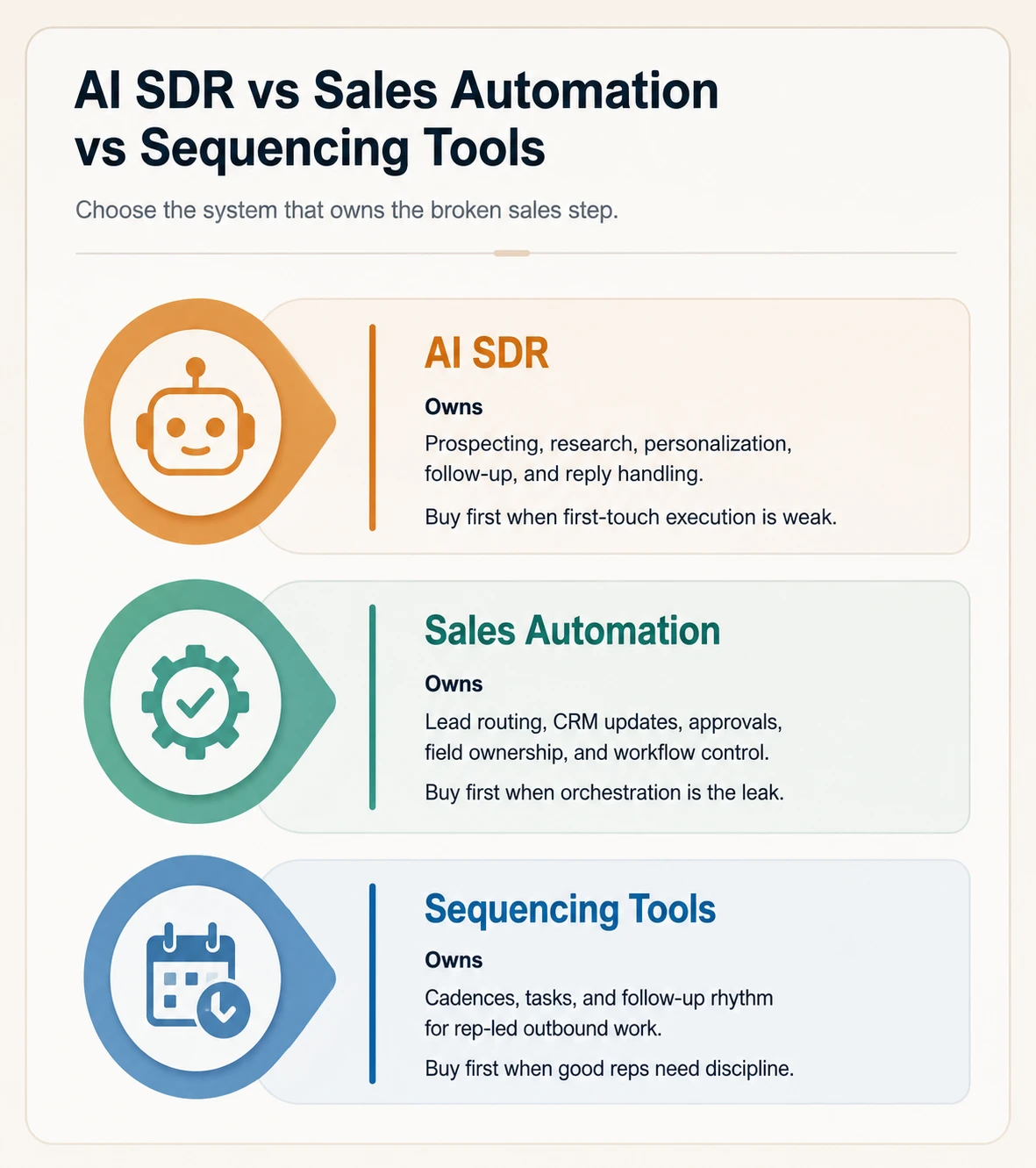
If you are choosing between an AI SDR, a sales automation platform, and sequencing tools, start with the workflow that is actually broken. Buy an AI SDR when first-touch pipeline creation is inconsistent. Buy sales automation when routing, CRM updates, and handoff logic are the problem. Buy sequencing tools when good reps already know what to do, but outbound follow-up lacks structure.
This is not a feature-count decision. It is an ownership decision: which system should own prospecting, routing, follow-up, and handoff in your sales process?
Key Takeaways
– AI SDRs are best when a team needs a system to own first-touch sales work such as prospecting, personalization, follow-up, and meeting creation.
– Sales automation platforms are best when the leak is inside workflow control: routing, field ownership, CRM updates, approvals, and process consistency.
– Sequencing tools are best when reps still own the work, but need cadence, task, and follow-up discipline.
– Many teams buy sequencing tools expecting autonomy, or buy AI SDRs before fixing CRM ownership and qualification rules.
– The right first purchase depends on whether your bottleneck is execution, orchestration, or rep consistency.
What Each Category Actually Buys
Most teams collapse these categories into one bucket called “sales AI.” That is where bad buying decisions start.
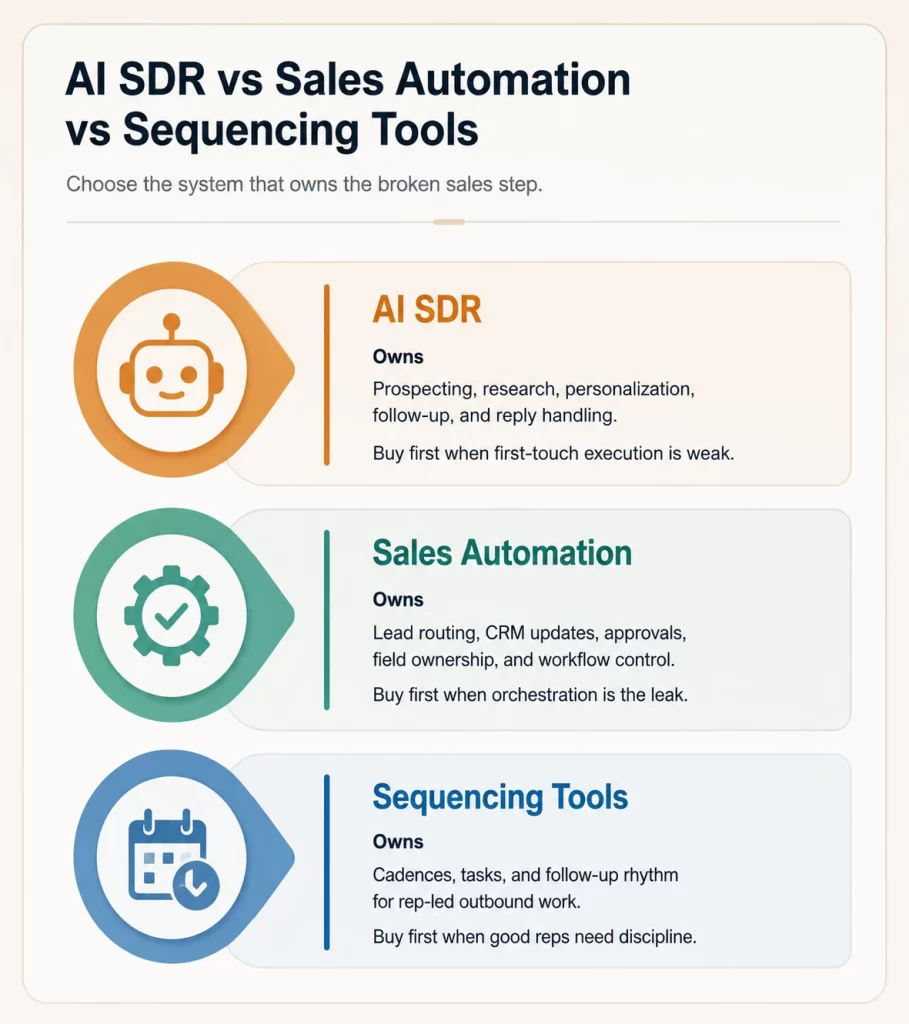
An AI SDR is closer to a digital worker. It should own repeatable first-touch sales work such as sourcing, research, personalization, follow-up, reply classification, qualification steps, and handoff. A sales automation platform is closer to a workflow-control layer. It governs routing, CRM actions, alerts, approvals, and cross-system process logic. Sequencing tools are usually closer to rep enablement. They help people run structured outbound cadences, but the rep still owns the message judgment, timing decisions, and much of the workflow.
Official vendor positioning reinforces that split. HubSpot Sales Automation frames automation around workflows, lead management, and process support. Salesforce Agentforce Sales positions AI agents inside CRM context and governed workflows. Outreach and Salesloft position themselves around revenue execution and orchestration, which is different from promising that a digital worker will own first-touch pipeline creation end to end.
Use this table to separate the three lanes clearly:
| Category | What it should own | Best fit when | Weakest fit when |
|---|---|---|---|
| AI SDR | Prospecting, research, personalization, follow-up, reply handling, meeting creation, CRM handoff | The team needs first-touch execution to happen without depending on rep consistency | CRM ownership, routing rules, or qualification logic are still unclear |
| Sales automation | Routing, task creation, CRM updates, field mapping, approvals, notifications, handoff control | The process breaks inside CRM, lead ownership, or internal workflow design | The team expects it to behave like a digital worker and create pipeline by itself |
| Sequencing tools | Rep cadences, task reminders, structured follow-up, templates, activity rhythm | Good reps already know the motion, but outreach consistency is weak | The team needs autonomy, deep qualification logic, or multi-system workflow ownership |
The practical question is simple: are you trying to automate the work, the process, or the rep rhythm?
Buy AI SDR First When First-Touch Execution Is Broken
Buy an AI SDR first when the problem is not knowing what the process should be. Buy it when the problem is that the process does not happen consistently enough.
This usually shows up as:
- outbound prospecting starts strong, then stalls;
- reps spend more time researching than talking to buyers;
- follow-up quality drops after the first message;
- reply handling is slow or inconsistent;
- managers cannot trust that every target account receives the right first-touch treatment.
That is where an AI SDR makes sense. The value is not just “AI writes emails.” The value is workflow ownership across the repetitive first-touch layer.
For GrowthEffect, that outbound lane belongs to Vera: sourcing, enrichment, research, scoring, personalized outreach, follow-up, and CRM handoff. That is an execution layer, not only a cadence tool.
Related GrowthEffect Workflow
If outbound pipeline creation is the broken layer, Vera is the GrowthEffect AI sales representative built to handle sourcing, enrichment, research, scoring, personalized outreach, follow-up, and CRM handoff.
Use this path when the issue is not “we need a better template,” but “we need first-touch outbound to run reliably.”
An AI SDR is a bad first buy when:
- Nobody agrees on what a qualified lead looks like.
- CRM fields and ownership rules are already broken.
- The sales team has not defined who takes over after a positive reply.
- The real leak is inbound routing, not outbound creation.
That last point matters. If the bottleneck is inbound qualification, routing, and meeting booking, the better lane is not outbound AI SDR. It is an inbound workflow layer such as Alim, which is a different job entirely.
Buy Sales Automation First When Routing, CRM, And Handoff Are The Leak
Buy sales automation first when the work is happening, but the system around the work keeps dropping context.
This is the right lane when:
- inbound leads are captured, but not assigned correctly;
- hot leads reach sales without qualification context;
- CRM updates depend on rep discipline instead of workflow rules;
- routing between marketing, SDR, AE, and RevOps is slow or inconsistent;
- approvals, ownership, and field mapping are unclear.
That is where a sales automation platform earns its keep. You are not asking it to act like a digital seller. You are asking it to keep the process clean.
This is also why the query cluster around AI SDR and sales automation is often misunderstood. A team searching for “AI SDR” may really be describing a routing or orchestration problem. In that case, a workflow layer can create more value than another outbound tool.
GrowthEffect keeps that separation explicit. Vera handles outbound pipeline creation. Alim handles inbound response, qualification, routing, meeting booking, and CRM sync. Humans still own discovery, pricing, procurement, legal or security review, negotiation, and closing.
If your leak is lead ownership and CRM handoff rather than prospecting, a sales automation layer or a dedicated inbound system should usually come before an outbound AI SDR. The related GrowthEffect workflow is closer to AI CRM automation than to a pure outbound software purchase.
Buy Sequencing Tools First When Reps Already Know The Motion
Buy sequencing tools first when the strategy is fine, the reps are competent, and the main failure is cadence discipline.
This is the best first purchase when:
- the SDR team already has a defined ICP and message angle;
- reps need structured follow-up across email and tasks;
- managers want activity consistency and visibility;
- the team is not ready to hand first-touch ownership to AI yet;
- compliance or approval needs still require a human to stay in the loop on every message.
Sequencing tools are useful because they create rhythm. They are weaker when buyers expect them to replace research, qualification, or pipeline ownership by themselves.
That is the common mistake in this category. Teams say they want “sales automation,” but what they really buy is a sequencing layer. The result is better task discipline, but not a real change in who owns the work.
Use this rule:
- If the rep is still the operator, sequencing tools may be enough.
- If the system should own the first-touch work, you are already in AI SDR territory.
- If the problem is task ownership and CRM logic, you are in sales automation territory.
What Should You Buy First? Use This Decision Table
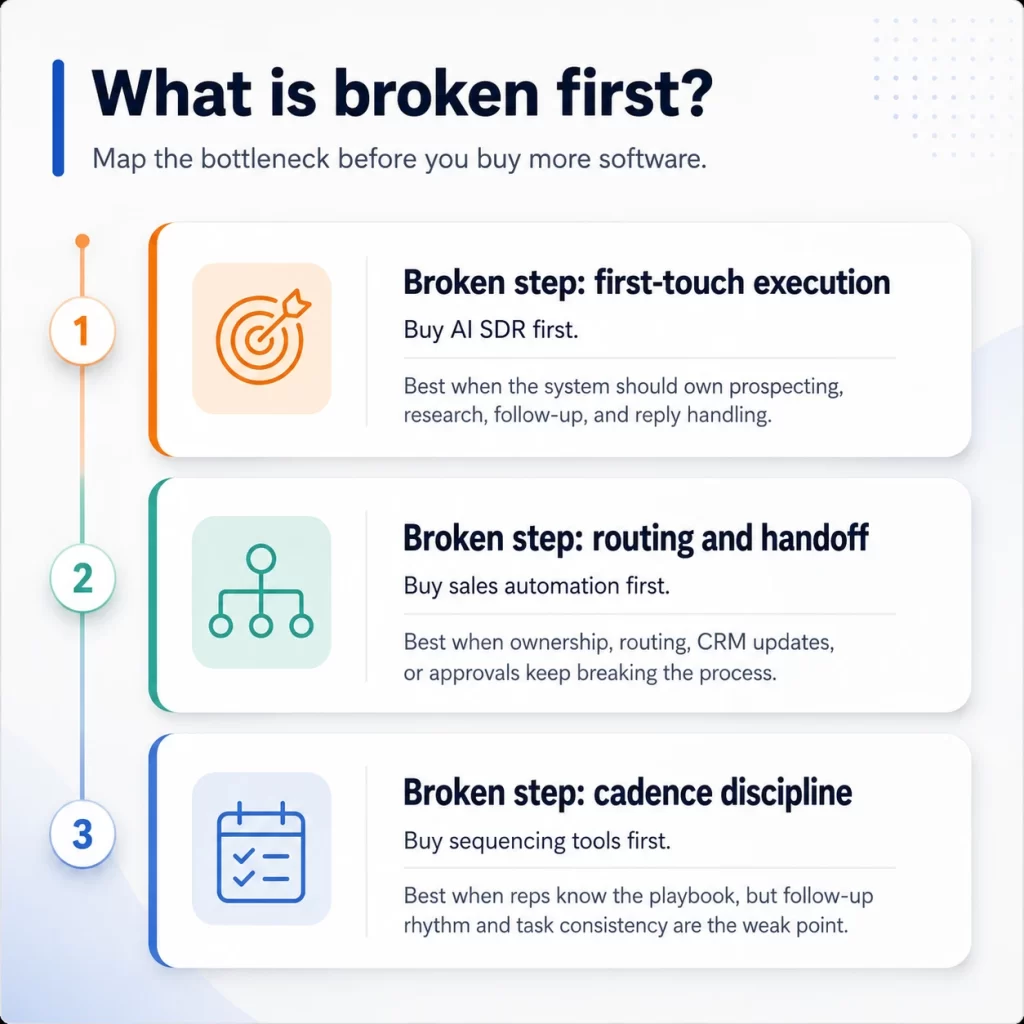
If budget only allows one move, use the broken workflow to choose the category.
| If your main problem is… | Buy first | Why |
|---|---|---|
| Outbound pipeline creation happens in bursts and then stops | AI SDR | The system needs to own prospecting, research, follow-up, and handoff |
| Leads arrive, but routing and CRM context are inconsistent | Sales automation | The leak is orchestration and control, not message generation |
| Reps know the playbook, but follow-up is sloppy | Sequencing tools | The team needs cadence structure, not autonomy |
| Inbound leads go cold before a human sees them | Inbound qualification workflow | Start with a system like Alim, not outbound AI |
| Leadership wants ROI, but nobody can explain role ownership | Pause the tool purchase | Define ownership, qualification, and handoff before adding software |
This is the real decision logic. Tool pages often compare features. Buyers need to compare ownership models.
Common Buying Mistakes
Here are the mistakes that create the most wasted spend:
1. Buying an AI SDR before fixing CRM ownership
If nobody knows which fields matter, which route is correct, or who owns the next step, an AI SDR will not fix the process. It will expose the process failure faster.
2. Buying sales automation expecting it to create pipeline by itself
Automation platforms can move data, assign owners, trigger tasks, and keep the workflow clean. They do not automatically create thoughtful outreach, account research, or qualified outbound conversations just because workflows exist.
3. Buying sequencing tools and calling it autonomy
A cadence engine is still a rep-assist system. If the human is still responsible for judgment, research quality, and most message adaptation, the team did not buy an AI SDR. It bought better structure.
4. Mixing inbound and outbound responsibilities
Inbound qualification and outbound prospecting should not be described as the same job. The systems can work together, but the ownership should stay explicit. That is why GrowthEffect separates Alim from Vera instead of pretending one generic tool should own every first-touch sales motion.
5. Measuring activity instead of qualified conversations
If the buying team evaluates success by sent messages, automation count, or workflow volume alone, it will pick the wrong category. The actual KPI is qualified conversation quality and how cleanly the handoff reaches a human closer.
See The Workflow On Your Pipeline
If your team needs first-touch outbound execution, start with Vera. If your bigger leak is inbound qualification, routing, and CRM context, start with Alim. If this is an active buying decision, book a GrowthEffect demo and map the category choice against your current outbound, inbound, CRM, and handoff workflow.
If the budget conversation is already live, use the GrowthEffect pricing page after you define which layer should own the job first.
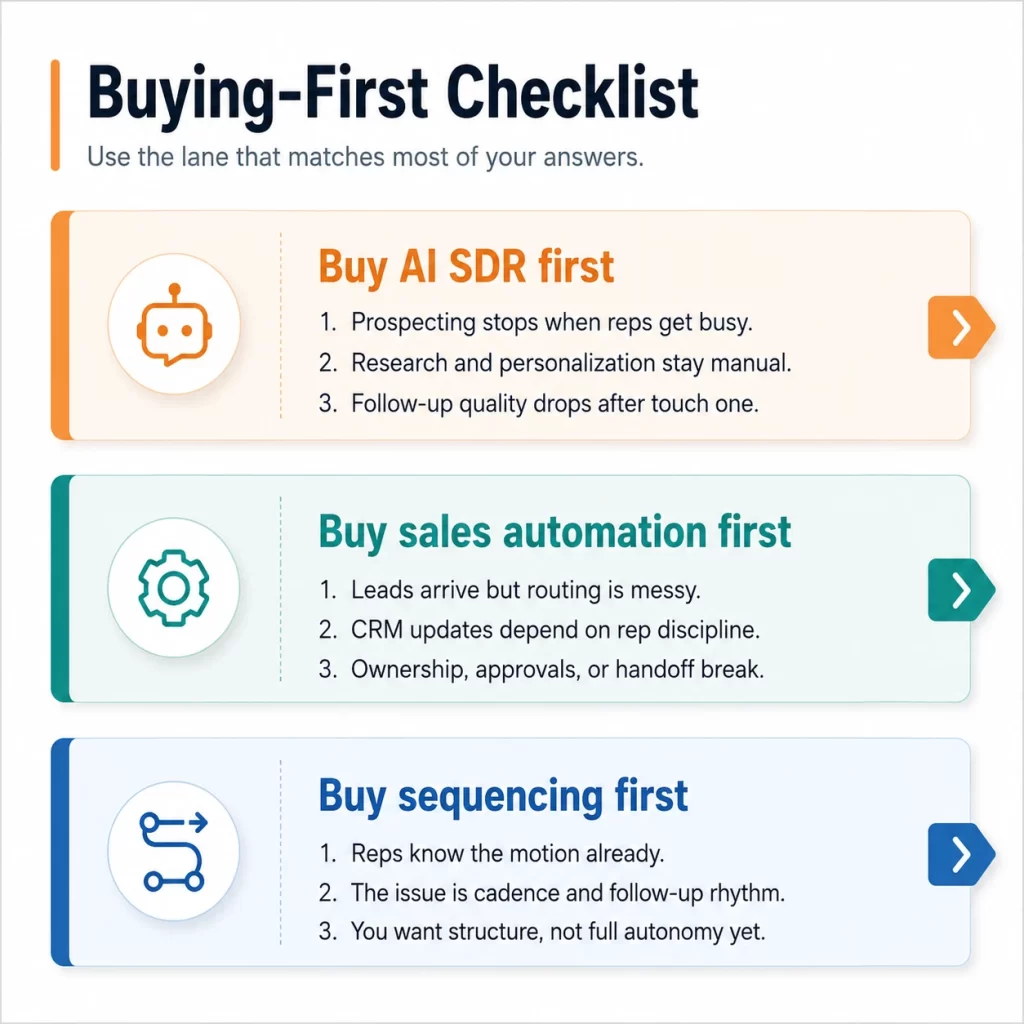
Lead magnet recommendation: AI SDR Readiness Checklist
Follow-up path:
- Identify whether the current leak is first-touch execution, CRM orchestration, or cadence discipline.
- Map the current human handoff and owner model.
- Use the demo to test whether the team needs Vera, Alim, a workflow-control layer, or a sequencing-first interim step.
FAQ
What is the difference between an AI SDR and sales automation?
An AI SDR should own first-touch sales execution such as prospecting, personalization, follow-up, and handoff. Sales automation should own workflow logic such as routing, CRM updates, task creation, approvals, and process control.
Are sequencing tools the same as sales automation platforms?
No. Sequencing tools usually support rep-driven cadence execution. Sales automation platforms are broader workflow layers that manage logic, routing, and system actions across the sales process.
Should I buy an AI SDR or sequencing tool first?
Buy an AI SDR first if the system needs to own first-touch work. Buy sequencing tools first if strong reps already know the motion, but follow-up discipline is inconsistent.
When is sales automation the best first purchase?
Sales automation is the best first purchase when the main leak is lead routing, CRM handoff, field ownership, approvals, and process control rather than outbound execution.
Can one platform replace all three categories?
Some vendors market themselves that way, but most teams still need to decide which layer owns execution, orchestration, and cadence. A tool can overlap categories, but the buying decision still needs a clear ownership model.
Leave a Reply