Inbound AI Sales Agents: How They Work
Introduction
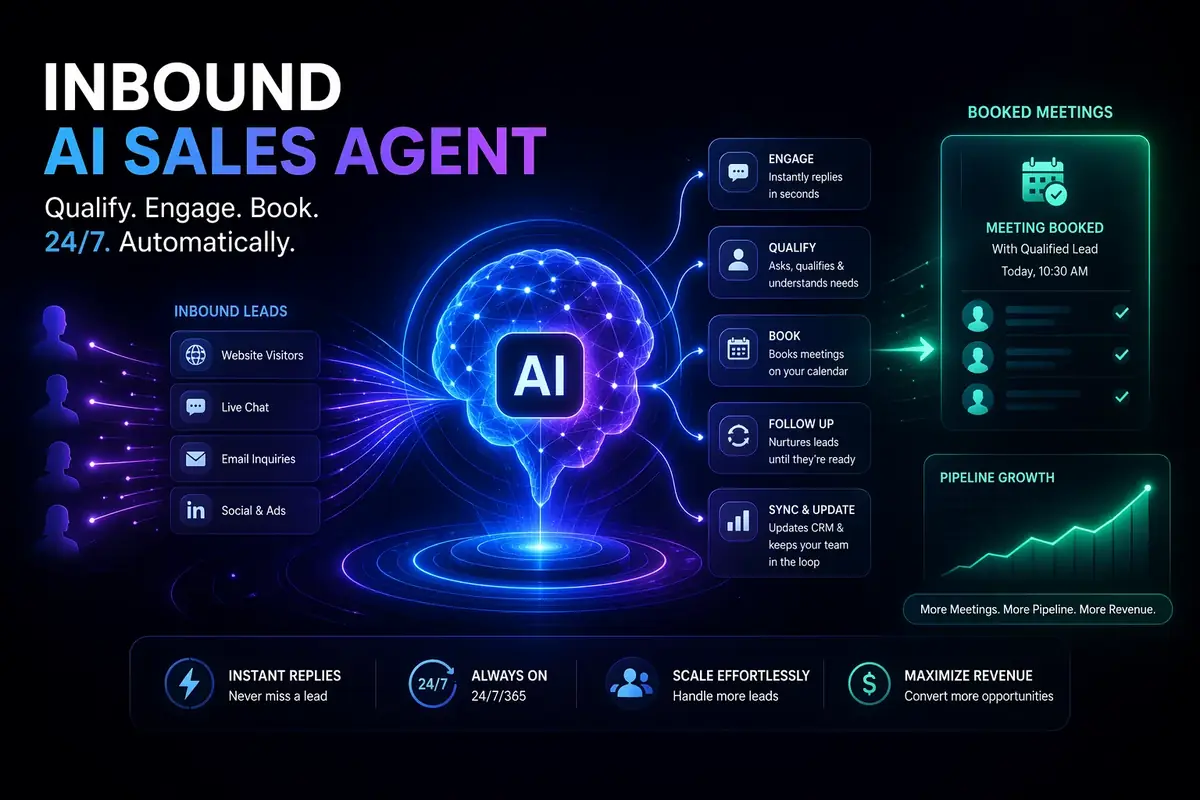
Most companies do not lose revenue because they lack demand. Instead, inbound AI sales agents solve this by responding instantly, qualifying leads through natural conversation, and routing serious buyers to the right closer without waiting for a human SDR.
Furthermore, a lead fills out a form at midnight. Meanwhile, someone sends a message through WhatsApp. Similarly, a prospect asks a question on Instagram. Your team sees it hours later, or even the next business day. By then, the buyer has already spoken to a competitor, lost interest, or moved on.
Consequently, an inbound AI sales agent captures that intent while it is still hot. It books meetings without manual handoff.
In this article, we break down how inbound AI sales agents work, what the architecture looks like, and how GrowthEffect’s Alim turns inbound demand into qualified pipeline.
Table of Contents
- What Is an Inbound AI Sales Agent?
- How Alim Works as an Inbound AI Sales Agent
- Inbound AI Sales Agent Architecture
- Step-by-Step Inbound Workflow
- Inbound AI Sales Agent vs Human SDR
- Real Use Cases for Inbound AI Sales Agents
- Benefits of Inbound AI Sales Agents
- FAQ
- Ready to Deploy an Inbound AI Sales Agent?
- Conclusion
What Is an Inbound AI Sales Agent?
Specifically, an inbound AI sales agents is a digital sales worker that handles incoming leads automatically. It responds to prospects, qualifies intent, answers questions, collects key information, updates the CRM, and books meetings with the right human closer.
Moreover, unlike a basic chatbot, an inbound AI sales agent does not simply follow a fixed script. For that reason, it understands context, remembers previous interactions, checks qualification criteria, and decides the next best action based on the lead’s answers.
For example, if a prospect asks about pricing, the agent does not send a generic reply. Instead, an inbound AI sales agent can ask about company size, use case, and budget before routing the lead to sales. If the prospect is not ready, it can nurture them. If the prospect is qualified, it can book a meeting directly.
Therefore, that is the core difference: an inbound AI sales agent is not just a chat widget. It is an autonomous qualification and conversion layer for inbound demand.
How Alim Works as an Inbound AI Sales Agent
Notably, Alim is GrowthEffect‘s inbound AI sales agent. It is built for companies that receive inbound interest but cannot respond, qualify, and route every lead fast enough.
Additionally, Alim responds to inbound leads in under 20 seconds across channels such as WhatsApp, Instagram DMs, Facebook Messenger, email, and web forms. Consequently, it qualifies each lead using BANT-style or custom qualification criteria, answers product and service questions from your company knowledge base, and books meetings on a human closer’s calendar when the lead is ready.
Furthermore, Alim is especially useful when your team has inbound demand but loses opportunities because of slow response times, manual qualification, missed messages, weekend gaps, or after-hours inquiries.
In simple terms:
In short, Alim captures the lead, qualifies the lead, answers the lead, routes the lead, and books the meeting.
Inbound AI Sales Agent Architecture
Inbound AI Sales Agent architecture illustrates how leads are captured, qualified, and converted automatically using AI. By combining real-time responses, intelligent qualification, and CRM integrations, it enables a fully automated and scalable inbound sales process.
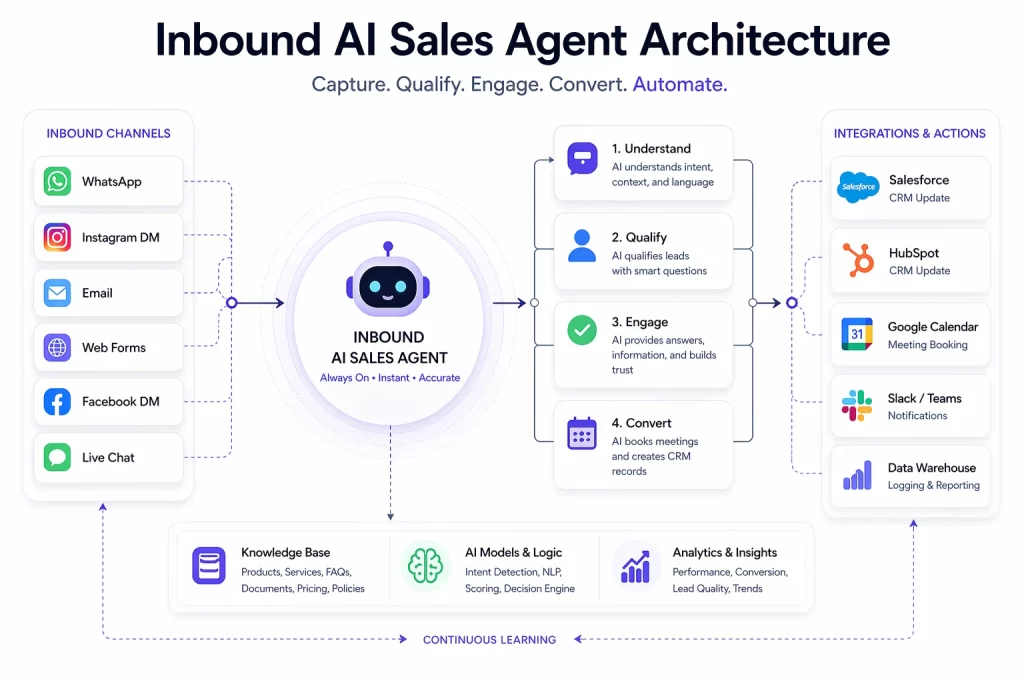
This architecture shows how an inbound AI sales agent captures leads from multiple channels, qualifies them using AI, and automatically syncs data with CRM systems while booking meetings in real-time.
Importantly, understanding the architecture matters because inbound AI sales agents are not just message responders. They need memory, reasoning, integrations, and safety rules to work reliably.
Therefore, a strong inbound AI sales agent usually has five core layers: memory, decision engine, action layer, integration layer, and learning loop.
1. Memory Layer: How the Inbound AI Sales Agents Remembers Context
Firstly, the memory layer stores the information the agent needs to respond accurately. This includes your company knowledge base, product details, pricing logic, ICP definitions, qualification criteria, past lead conversations, and CRM data.
When a lead sends a message, the agent retrieves relevant context before replying. Consequently, this allows the conversation to feel specific rather than generic.
For instance, if a prospect asks whether your product supports a specific use case, the inbound AI sales agent can pull the relevant answer from your knowledge base instead of guessing.
2. Decision Engine: How the Inbound AI Sales Agents Chooses the Next Step
The decision engine evaluates the lead’s intent, fit, urgency, and qualification status.
For example, it asks questions like:
- Is this person a serious buyer?
- Are they asking a support question or showing buying intent?
- Do they match the company’s ICP?
- Does the agent need more qualification details?
- Should the agent schedule a meeting now?
- Does the situation require human escalation?
Therefore, this reasoning layer is what separates an inbound AI sales agent from a scripted chatbot. Meanwhile, the agent does not blindly follow a fixed path. It adapts based on the conversation.
3. Action Layer: How the Inbound AI Sales Agent Executes
Once the decision engine chooses the next step, the action layer executes it.
Specifically, this can include:
- Sending a reply on WhatsApp
- Responding to Instagram or Facebook DMs
- Sending an email follow-up
- Asking qualification questions
- Updating CRM fields
- Creating a deal or contact record
- Booking a calendar meeting
- Sending confirmation details
- Escalating the conversation to a human sales rep
Subsequently, the action layer turns the agent’s reasoning into real sales activity.
4. Integration Layer: How the Inbound AI Sales Agent Connects to Your Stack
Next, the integration layer connects the inbound AI sales agent to the tools your team already uses.
For example, this can include HubSpot, Salesforce, Pipedrive, Google Calendar, WhatsApp, email, website forms, and social messaging channels.
Conversely, without integrations, the agent would only reply to messages. Therefore, with integrations, it becomes part of the sales operation. It can read lead data, update records, log activities, create tasks, and book meetings without manual work.
5. Learning Loop: How the Inbound AI Sales Agent Improves Over Time
Importantly, a strong inbound AI sales agent improves by learning from outcomes.
Furthermore, it can track which leads convert, which objections appear often, which qualification paths work better, and which handoff rules create better meetings.
Ultimately, over time, the agent becomes more aligned with your sales process, your ICP, and your most common buyer questions.
Step-by-Step Inbound Workflow
A step-by-step inbound workflow ensures that every lead is handled instantly and consistently by AI from the first interaction to final conversion.
Instead of relying on manual processes, AI sales agents capture leads, understand intent, qualify prospects, and trigger the next best action in real time, creating a seamless and scalable sales pipeline.
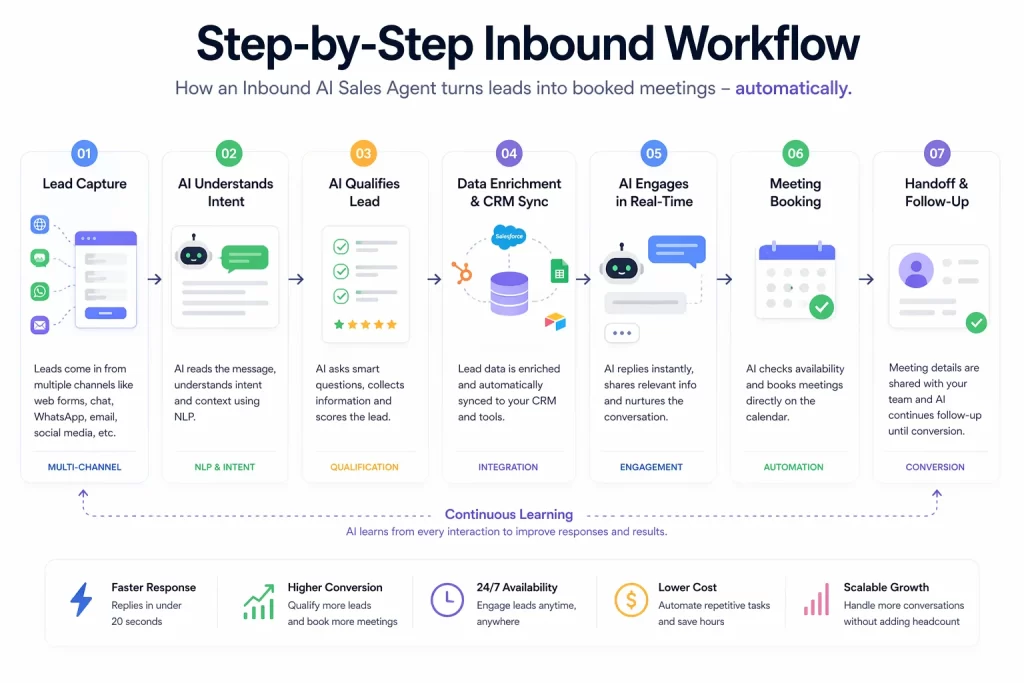
Overall, an inbound AI sales agent follows a clear workflow from first message to booked meeting.
Step 1: Lead Capture by the Inbound AI Sales Agent
Initially, the system captures incoming leads from channels such as website forms, WhatsApp, Instagram DMs, Facebook Messenger, email, and landing pages.
For example, each new inquiry becomes an inbound signal. The inbound AI sales agent identifies where the lead came from, what they asked, and whether the message suggests buying intent.
Consequently, a lead asking “How much does this cost?” or “Can I book a demo?” should be handled differently from someone asking a general informational question.
Step 2: Instant Response by the Inbound AI Sales Agents
Importantly, speed is the first major advantage of an inbound AI sales agent.
Instead of waiting for a human rep to respond, the agent replies immediately. As a result, this keeps the buyer engaged while their intent is still fresh.
In fact, Alim targets a response in under 20 seconds. This matters because inbound leads are often comparison shopping. If your team waits too long, the buyer may already be speaking with another company.
Step 3: Intent Detection by the Inbound AI Sales Agents
After the first response, the agent identifies the prospect’s intent.
Common intent categories include:
- Pricing inquiry
- Demo request
- Product question
- Service inquiry
- Support request
- Partnership request
- Low-fit or irrelevant inquiry
Therefore, the inbound AI sales agent then decides whether to qualify, answer, route, or escalate.
Step 4: AI Lead Qualification by the Inbound AI Sales Agent
Next, the agent qualifies the lead using BANT-style or custom criteria.
This can include:
- Budget
- Authority
- Need
- Timeline
- Company size
- Industry
- Use case
- Current process
- Urgency
- Decision-maker involvement
Nevertheless, the goal is not to interrogate the lead. The goal is to qualify naturally through conversation.
For example, instead of asking “What is your budget?” immediately, the agent might ask:
“Got it. To point you in the right direction, are you looking to solve this for a small team, or is this for a larger sales operation?”
As a result, this keeps the conversation human while still collecting useful sales data.
Step 5: Knowledge-Based Answering
Inbound leads often ask repetitive questions.
They may ask about pricing, features, setup, integrations, timelines, limitations, or whether the product fits their specific business.
In particular, the agent answers using your company knowledge base. Therefore, this reduces the workload on your team and gives prospects immediate clarity.
However, if the question is too specific, sensitive, or outside the approved knowledge base, the agent can escalate to a human.
Step 6: Routing and Escalation
However, not every lead should go to sales.
A good inbound AI sales agent separates serious buyers from low-fit leads, support requests, spam, and unqualified inquiries.
Qualified leads can be routed to the right closer. Unqualified leads can be nurtured, tagged, or politely disqualified. Support-related questions can be redirected to the proper team.
Ultimately, this keeps your sales team focused on conversations that actually matter.
Step 7: Meeting Booking by the Inbound AI Sales Agent
Once the lead is qualified and ready, the agent checks calendar availability and books a meeting directly.
It can send confirmation details, update the CRM, add notes for the closer, and include the qualification summary so the human salesperson enters the call with context.
Consequently, this removes the usual handoff friction between form fill, qualification, and meeting booking.
Step 8: CRM Update and Follow-Up
After the conversation, the agent logs the activity in the CRM.
It can update fields such as lead source, qualification status, company size, use case, budget range, timeline, and meeting status.
Meanwhile, if the lead does not book immediately, the agent can follow up later with relevant next steps.
Inbound AI Sales Agent vs Human SDR
| Dimension | Human SDR | Inbound AI Sales Agent |
|---|---|---|
| Response time | Depends on workload and working hours | Under 20 seconds |
| Availability | Business hours | 24/7 coverage |
| Channel coverage | Limited by team capacity | WhatsApp, social DMs, email, and web forms |
| Qualification consistency | Varies by rep | Same process every time |
| CRM updates | Often delayed or incomplete | Automatic logging |
| Meeting booking | Manual back-and-forth | Direct calendar booking |
| Cost structure | Salary, benefits, turnover, management | Fixed monthly software cost |
| Scalability | Requires more hiring | Handles more conversations without adding headcount |
Importantly, the goal is not to remove human closers. The goal is to protect them from repetitive qualification work and make sure they spend time with qualified buyers.
Human salespeople should focus on high-value conversations. The inbound AI sales agent handles the speed, filtering, routing, and repetitive follow-up.
Real Use Cases for Inbound AI Sales Agents
SaaS Company With Too Many Inbound Leads
For example, a SaaS company receives hundreds of form fills, demo requests, and product questions every month. The sales team cannot respond to all of them quickly.
Alim responds instantly, asks qualification questions, identifies serious buyers, and books meetings only when the lead is ready. Additionally, the team stops wasting time on cold or low-fit inquiries and focuses on qualified calls.
Agency Missing Leads After Hours
Similarly, a growth agency receives Instagram and WhatsApp inquiries outside working hours. By the time the team replies the next day, many prospects are gone.
Alim provides 24/7 inbound coverage, answers basic questions, qualifies intent, and books calls even when the team is offline. In other words, an inbound AI sales agent operates as your after-hours qualification layer.
B2B Company With Messy Lead Routing
In contrast, a B2B company has leads coming from multiple forms, ad campaigns, and social channels. Some go to sales, some go to support, and some get lost.
Alim centralizes the qualification layer. Consequently, the inbound AI sales agent detects lead type, routes the inquiry correctly, updates the CRM, and gives the team visibility into what happened.
Company With Repetitive Buyer Questions
Lastly, a company gets the same questions again and again: pricing, setup time, integrations, process, and next steps.
Alim answers these questions using the company knowledge base and escalates only when needed. As a result, this reduces manual workload while keeping the buyer engaged.
Benefits of Inbound AI Sales Agents
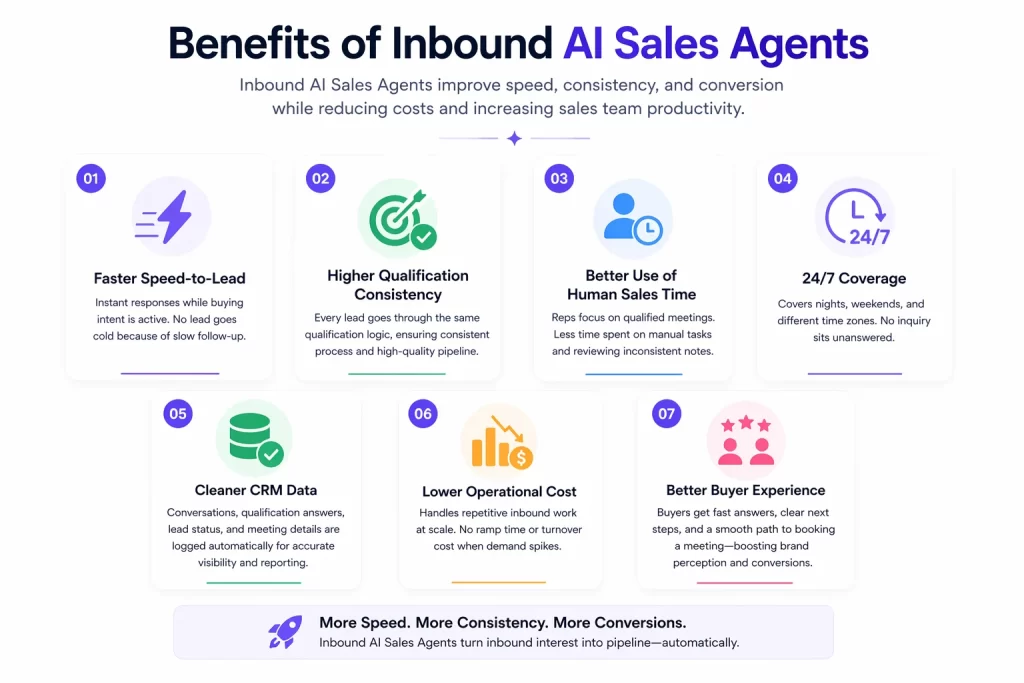
Inbound AI sales agents transform how teams handle inbound demand by combining speed, consistency, and automation.
Instead of relying on manual follow-ups and fragmented processes, AI ensures every lead is handled instantly, qualified accurately, and moved forward in the pipeline without delays resulting in higher conversions and more efficient sales operations.
Faster Speed-to-Lead
The biggest benefit is instant response. In fact, when prospects show interest, the agent replies while the buying intent is still active. Consequently, no lead goes cold because of slow follow-up.
Higher Qualification Consistency
Every lead goes through the same qualification logic. Therefore, this prevents missed questions, inconsistent notes, and subjective rep-by-rep variation. As a result, your sales process stays aligned across every channel.
Better Use of Human Sales Time
Importantly, your closers do not need to chase every form fill or answer repetitive questions. Instead, they can focus on qualified meetings. In addition, managers spend less time reviewing inconsistent rep notes.
24/7 Coverage
Even though inbound demand does not only arrive during business hours, an inbound AI sales agent covers nights, weekends, and different time zones. For this reason, no inquiry sits unanswered until Monday morning.
Cleaner CRM Data
Furthermore, the agent logs conversations, qualification answers, lead status, and meeting details automatically. In fact, this improves sales visibility and reporting. Likewise, forecasting becomes more reliable when data stays consistent.
Lower Operational Cost
Instead of hiring more SDRs to cover every channel, the inbound AI sales agent handles repetitive inbound work at scale. Additionally, there is no ramp time or turnover cost when demand spikes.
Better Buyer Experience
Ultimately, the buyer gets fast answers, clear next steps, and a smoother path to booking a meeting. Notably, this experience reflects directly on your brand perception and conversion rates.
FAQ
What is an inbound AI sales agent?
Indeed, an inbound AI sales agent is an autonomous digital worker that responds to incoming leads, qualifies them, answers questions, updates CRM records, routes conversations, and books meetings.
How is it different from a chatbot?
A chatbot usually follows fixed scripts. Meanwhile, an inbound AI sales agent understands context, checks qualification criteria, uses a knowledge base, and decides the next best action based on the conversation.
What channels can it cover?
Alim can handle inbound conversations across channels such as WhatsApp, Instagram DMs, Facebook Messenger, email, and web forms.
Can it qualify leads?
Indeed, yes. Alim can qualify leads using BANT-style criteria or a custom qualification framework based on your sales process.
Can it book meetings?
Indeed, yes. Once a lead is qualified and ready, Alim can check calendar availability and book a meeting directly with the right human closer.
Will it say something wrong to leads?
Alim works from your company knowledge base and defined escalation rules. If a question is outside the approved scope, the agent can route the conversation to a human. For more common questions, visit our FAQ page.
Does it replace the sales team?
However, no. It replaces repetitive inbound handling, not strategic selling. Human closers still handle the high-value sales conversations.
How long does deployment take?
Finally, deployment depends on your channels, CRM, knowledge base, and qualification logic. In most cases, the goal is to configure the agent quickly and start handling inbound conversations without a long hiring or onboarding cycle.
Ready to Deploy an Inbound AI Sales Agent?
For instance, if your team is losing leads because of slow response times, missed messages, manual qualification, or inconsistent follow-up, Alim is the right starting point.
As a result, Alim helps you build an inbound process that never sleeps:
- Respond to inbound leads in under 20 seconds
- Qualify prospects through natural conversation
- Answer buyer questions from your knowledge base
- Route serious leads to the right human closer
- Book meetings directly on the calendar
- Update your CRM automatically
- Cover WhatsApp, social DMs, email, and web forms
- Keep inbound demand from slipping through the cracks
Alim: Inbound AI Sales Agent
24/7 lead response, AI qualification, knowledge-based answering, CRM updates, and meeting booking.
Book a Demo
Therefore, see how Alim turns inbound leads into qualified meetings automatically.
Conclusion
Inbound leads are expensive to generate and easy to lose. If your team responds too late, asks inconsistent questions, forgets CRM updates, or misses after-hours inquiries, demand turns into leakage.
An inbound AI sales agent fixes that leakage. It captures every lead, responds instantly, qualifies intent, answers questions, routes serious buyers, and books meetings without waiting for manual follow-up.
Ultimately, for teams that already have inbound demand, Alim turns lead response from a human bottleneck into an automated revenue system.
If you need outbound AI outreach too, see Vera, our outbound AI sales agent that runs personalized cold outreach at scale.
Want more like this?
Explore our blog for guides on AI agents, sales automation, and inbound strategy.
Leave a Reply