AI Sales Agent Examples: Real Use Cases & Workflows
Introduction
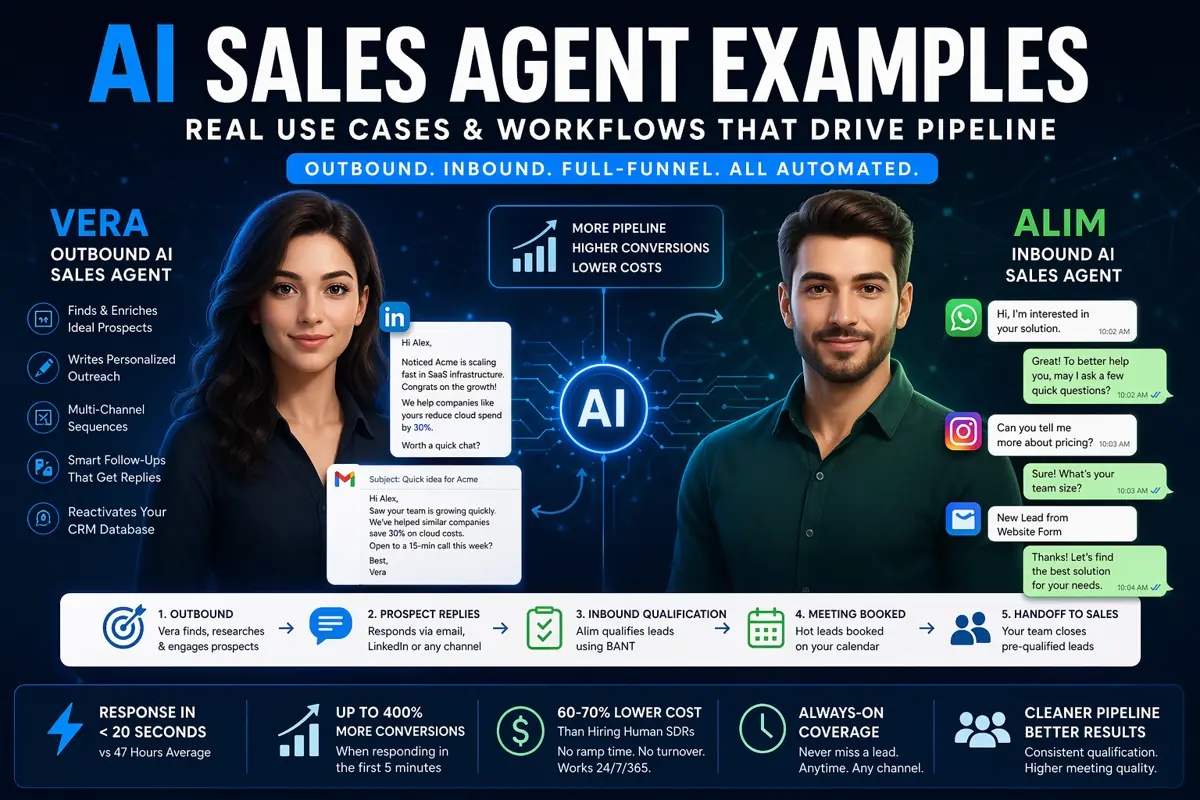
An AI sales agent is no longer a concept reserved for enterprise sales teams. Today, B2B companies of all sizes are deploying an AI sales agent to qualify inbound leads, run outbound prospecting, and book meetings autonomously, around the clock. This article covers real AI sales agent examples, breaking down exactly how each one works, where it fits into your sales process, and what real deployment looks like across different business models.
Table of Contents
- What Is an AI Sales Agent?
- Why AI Sales Agents Matter for B2B Teams
- Key Problems Companies Face Without an AI Sales Agent
- The Solution: How AI Sales Agents Work in Practice
- AI Sales Agent Workflow: Step-by-Step
- Real AI Sales Agent Use Cases
- Benefits of an AI Sales Agent: Data-Backed
- Strategic Insights: What Most Teams Miss
- FAQ
- Conclusion
What Is an AI Sales Agent?
An AI sales agent is an autonomous system that executes core sales development tasks including prospecting, lead qualification, follow-up, and meeting booking without requiring human input. Unlike chatbots or basic automation tools, a well-built AI sales agent understands conversational context, adapts dynamically to each interaction, and completes full end-to-end workflows independently. In short, an AI sales agent does the job of an SDR, not just the admin around it.
Why AI Sales Agents Matter for B2B Teams
Speed determines whether a deal lives or dies and it is the single clearest reason why deploying an AI sales agent has become urgent. According to Harvard Business Review, the average company takes 47 hours to respond to a new inbound lead by which point most buyers have already spoken to a competitor.
Meanwhile, B2B buying cycles have compressed considerably. Forrester reports that buyers complete 60 to 70 percent of their research before ever contacting sales. Consequently, when they do reach out, they expect an immediate and intelligent response.
An AI sales agent eliminates the gap between when a lead signals intent and when your team acts on it. As a result, deploying an AI sales agent is no longer just a competitive advantage it is becoming the baseline expectation for any revenue-driven business.
Key Problems Companies Face Without an AI Sales Agent
Most growth-stage companies aren’t losing deals because their product is weak. Instead, they’re losing because of operational failure in the middle of the funnel. In practice, here are the most common failure points:
- Slow lead response: Human SDRs working 9 to 5 routinely miss leads that arrive outside business hours.
- Inconsistent qualification: Different reps ask different questions, which results in uneven pipeline quality and unpredictable close rates.
- SDR churn: The average SDR tenure is 14 months. Each time someone leaves, the ramp cycle restarts typically two to three months of lost productivity.
- Outbound paralysis: Teams recognize they need consistent outbound, but the manual research, personalization, and follow-up workload is unsustainable at scale.
- Leaky CRM: Companies accumulate thousands of dormant contacts that are never re-engaged because no bandwidth exists to act on them.
This is where most companies fail: they treat these as people problems when they are fundamentally process and capacity problems exactly what an AI sales agent is built to solve. See how GrowthEffect solves this →
The Solution: How AI Sales Agents Work in Practice
This infographic illustrates how GrowthEffect’s AI sales agents Vera (outbound) and Alim (inbound) work together in a closed-loop system to generate and convert pipeline efficiently.
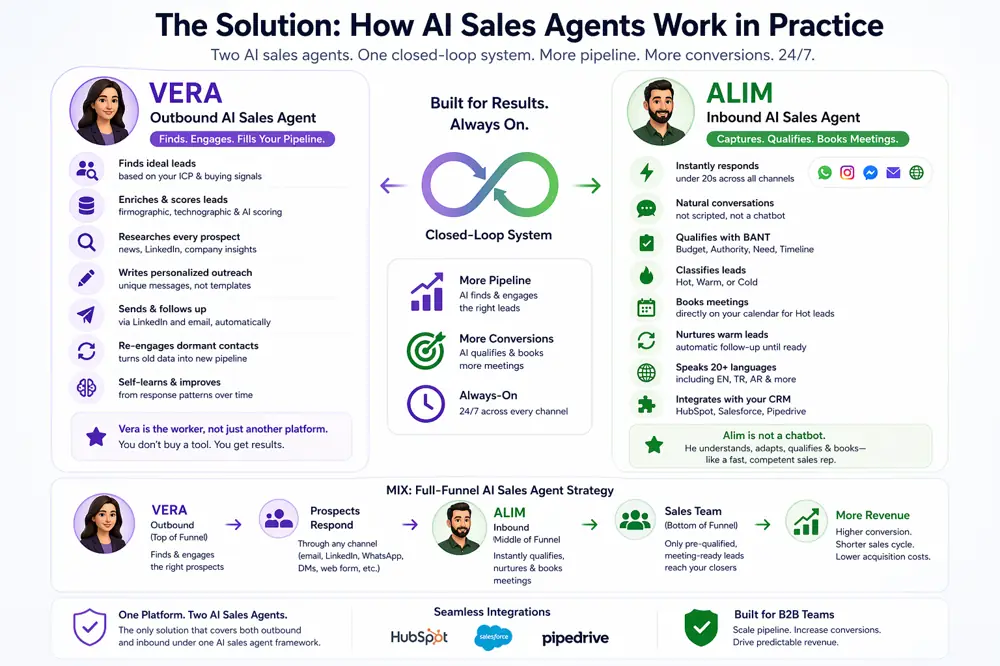
GrowthEffect AI builds two purpose-built AI sales agents Vera for outbound and Alim for inbound. Together, they form a closed-loop sales system that generates pipeline and converts it simultaneously, around the clock.
Vera: Outbound AI Sales Agent
Vera is GrowthEffect’s outbound AI sales agent. She autonomously manages the full outbound pipeline generation workflow from sourcing leads to sending hyper-personalized messages without a human in the loop.
What Vera does as an outbound AI sales agent:
- Sources leads based on your ICP (industry, company size, job title, buying signals)
- Enriches each lead profile with firmographic and technographic data
- Scores leads using both rule-based filters and AI-powered soft scoring
- Researches each prospect individually recent news, LinkedIn activity, company context
- Writes unique, personalized outreach messages (not templates)
- Sends via LinkedIn and email, then follows up automatically
- Re-engages dormant CRM contacts to generate pipeline from existing data
- Self-learns from response patterns over time to continuously improve
Notably, Vera is not another Apollo or Outreach. Those platforms still require a human operator they are workflow software, not workers. Unlike those tools, Vera is the worker itself. You don’t buy a platform and then hire someone to run it, because the AI sales agent is the hire.
Alim: Inbound AI Sales Agent
Alim is GrowthEffect’s inbound AI sales agent. He handles every incoming lead across every channel instantly, consistently, and at any hour of the day.
What Alim does as an inbound AI sales agent:
- Responds to new leads in under 20 seconds across WhatsApp, Instagram DMs, Facebook Messenger, web forms, and email
- Engages in natural, context-aware conversation not scripted, not a chatbot
- Qualifies every lead using the BANT framework (Budget, Authority, Need, Timeline)
- Classifies leads as Hot, Warm, or Cold based on qualification output
- Books meetings directly on your sales team’s calendar for Hot leads
- Nurtures Warm leads with automatic follow-up until they’re ready to convert
- Operates in 20+ languages including Turkish, English, and Arabic
- Integrates natively with HubSpot, Salesforce, and Pipedrive for clean CRM handoffs
The most common objection GrowthEffect hears is “we tried chatbots and they didn’t work.” However, Alim is fundamentally not a chatbot. Chatbots follow rigid script trees and break down when a user says something unexpected. Alim, on the other hand, has genuine language understanding, adapts to unpredictable responses, runs full BANT qualification, and books the meeting directly. In practice, it feels like talking to a fast, competent sales rep.
Mix: Full-Funnel AI Sales Agent Strategy
Running Vera and Alim together creates a closed-loop AI sales agent system. Vera fills the top of funnel through targeted outbound. When those prospects respond through any inbound channel, Alim catches them instantly and qualifies them automatically.
As a result, your human closers only interact with leads that are pre-qualified and meeting-ready. GrowthEffect is currently the only platform that covers both outbound and inbound under a single AI sales agent framework and that unified coverage is the core strategic advantage.
AI Sales Agent Workflow: Step-by-Step
Below is a visual breakdown of how an AI sales agent manages outbound prospecting, inbound qualification, and meeting booking in a fully automated workflow.
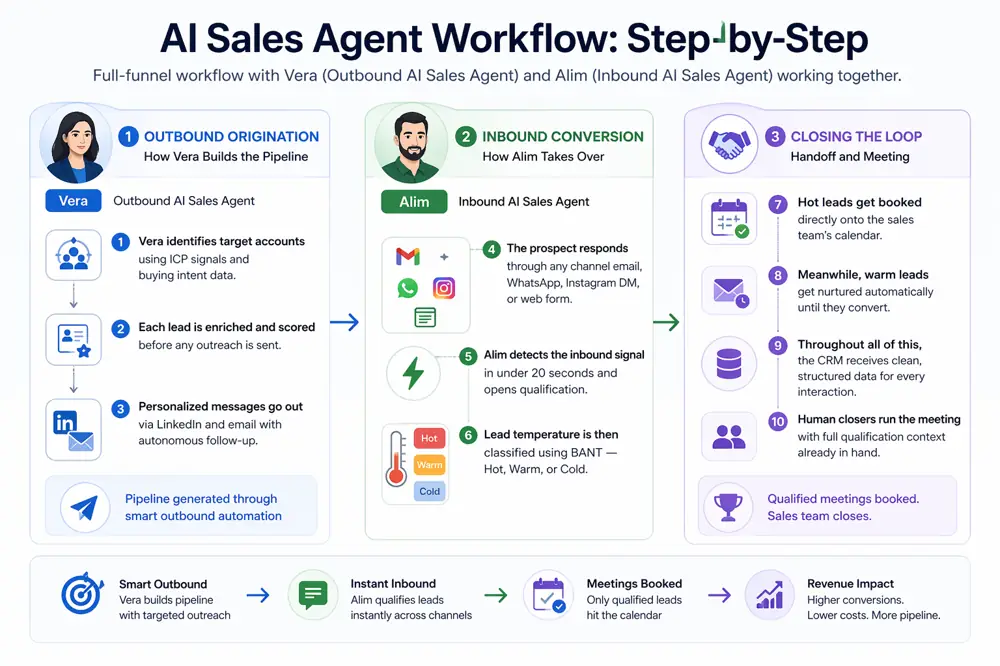
This workflow demonstrates how AI sales agents eliminate response delays and ensure only qualified leads reach your sales team.
Here is exactly what the full-funnel AI sales agent workflow looks like when both agents are deployed together.
Outbound Origination: How Vera Builds the Pipeline
- Vera identifies target accounts using ICP signals and buying intent data.
- Each lead is then enriched and scored before any outreach is sent.
- Personalized messages go out via LinkedIn and email with autonomous follow-up.
Inbound Conversion: How Alim Takes Over
- The prospect responds through any channel email, WhatsApp, Instagram DM, or web form.
- Alim detects the inbound signal in under 20 seconds and opens qualification.
- Lead temperature is then classified using BANT — Hot, Warm, or Cold.
Closing the Loop: Handoff and Meeting
- Hot leads get booked directly onto the sales team’s calendar.
- Meanwhile, warm leads get nurtured automatically until they convert.
- Throughout all of this, the CRM receives clean, structured data for every interaction.
- Human closers run the meeting with full qualification context already in hand.
Real AI Sales Agent Use Cases
The following AI sales agent examples illustrate how companies across different GTM motions deploy these systems to solve real pipeline problems.
Use Case 1: SaaS Company Losing Inbound Leads to Slow Follow-Up
This is one of the most common AI sales agent examples in B2B SaaS. A company generating 200+ inbound leads per month had a critical leak: average response time exceeded four hours. By the time an SDR reached out, prospects had already explored competitors. After deploying Alim as their inbound AI sales agent, every lead received a response in under 20 seconds, BANT qualification was fully automated, and the sales team only handled meeting-ready conversations. As a direct result, lead-to-meeting conversion improved substantially within the first month.
Use Case 2: Agency Scaling Outbound Without Headcount
Among outbound AI sales agent examples, this one stands out for its simplicity. A growth marketing agency needed to run consistent outbound to fill its own pipeline but couldn’t justify hiring a dedicated SDR. The manual prospecting and personalization workload was already unsustainable for their stretched team. By deploying Vera as their outbound AI sales agent, they gained always-on coverage: automated sourcing, enrichment, personalized messaging, and follow-up with zero additional headcount.
Use Case 3: Founder Bottlenecked by Manual Qualification
A 20-person B2B services company had a founder personally handling all sales conversations. Consequently, every inbound inquiry created delays and dropped opportunities. After deploying Alim as their AI sales agent, the qualification layer became fully automated: the system engaged leads across WhatsApp and email, ran BANT qualification, and escalated only high-intent prospects. The founder was therefore able to focus entirely on closing.
Use Case 4: Sales Team Sitting on Dead CRM Data
A mid-market company had over 4,000 contacts in their CRM that had never been properly followed up. Rather than letting that data sit idle, their AI sales agent ran re-engagement campaigns across the entire database with personalized outreach based on each contact’s prior activity, company changes, and current buying signals. Previously dormant data was transformed into active pipeline.
Benefits of an AI Sales Agent: Data-Backed
The following data-backed breakdown highlights how AI sales agents outperform traditional SDR teams in speed, cost, consistency, and pipeline generation.
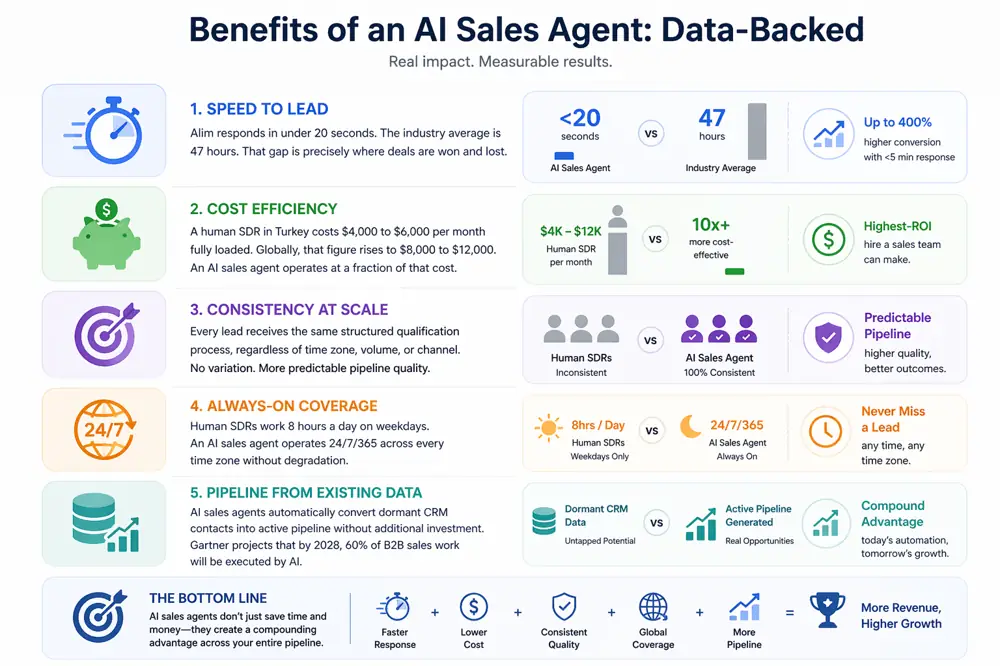
These performance gains explain why AI sales agents are rapidly replacing traditional SDR workflows in modern B2B sales teams.
Speed to Lead
Alim responds in under 20 seconds. The industry average is 47 hours (Harvard Business Review). That gap is precisely where deals are won and lost. Furthermore, Deloitte research shows that responding within the first five minutes of lead contact increases conversion rates by up to 400% compared to a 30-minute delay.
Cost Efficiency
A human SDR in Turkey costs $4,000 to $6,000 per month fully loaded. Globally, that figure rises to $8,000 to $12,000. An AI sales agent, however, operates at a fraction of that cost with no ramp period, no sick days, and zero turnover risk making it one of the highest-ROI hires a sales team can make.
Consistency at Scale
Every lead receives the same structured qualification process, regardless of time zone, volume, or channel. One of the core advantages of an AI sales agent is precisely this: since there is no variation based on rep experience, mood, or bandwidth, the output is ultimately more predictable pipeline quality across the board.
Always-On Coverage
Human SDRs work 8 hours a day on weekdays. An AI sales agent, by contrast, operates 24/7/365 across every time zone without degradation meaning Vera and Alim never miss a lead regardless of when it arrives.
Pipeline from Existing Data
Most companies are sitting on CRM databases that are never re-engaged. An AI sales agent automatically converts those dormant contacts into active pipeline without requiring additional investment. Gartner projects that by 2028, 60% of B2B sales work will be executed by AI. Companies building AI-native sales processes today will therefore compound this advantage well ahead of the market.
Strategic Insights: What Most Teams Miss
The Real Competitive Window
Most conversations about AI sales agent examples focus on efficiency gains: faster follow-up, lower cost per lead, fewer hours wasted on manual tasks. Those benefits are real, but they miss the deeper strategic shift: competitive positioning at the exact moment of buyer intent.
The window between when a buyer signals interest and when they commit to a conversation is narrowing rapidly. An AI sales agent compresses this window to near-zero which is, in effect, the same as capturing demand that your competitors simply cannot reach in time.
The Compounding Advantage of Self-Learning Systems
There is also a second-order effect that few teams consider: pipeline quality improvement over time. Because Vera’s architecture is self-learning, her targeting and personalization improve continuously as she processes more outreach and observes response patterns. In other words, the system gets better without additional investment. Human SDR teams, by contrast, plateau or churn they do not compound in the same way.
How an AI Sales Agent Reshapes Your Hiring Strategy
Deploying an AI sales agent fundamentally changes what your human team is built to do. When qualification and prospecting are automated, you stop hiring SDRs altogether and start hiring closers exclusively. As a result, the talent profile shifts and the compensation structure shifts with it. Over time, this is a structural cost and performance advantage that compounds as the market for SDR talent becomes more expensive and unpredictable.
Explore GrowthEffect → | Read more on the blog →
FAQ
1. What Is the Difference Between an AI Sales Agent and a Chatbot?
The best way to understand this distinction is through concrete AI sales agent examples. A chatbot follows a fixed decision tree and breaks when a user says something unexpected. An AI sales agent, however, understands natural language, adapts to the conversation, executes structured qualification frameworks like BANT, books meetings, and integrates with your CRM. The outcomes are entirely different: a chatbot gives you a response, while an AI sales agent gives you a qualified pipeline.
2. Can an AI Sales Agent Work Across Multiple Channels Simultaneously?
Yes. Alim operates concurrently across WhatsApp, Instagram DMs, Facebook Messenger, web forms, and email. Vera runs outreach across LinkedIn and email in parallel. Both agents handle multiple conversations simultaneously with no degradation in quality or response time.
3. How Does an AI Sales Agent Qualify Leads?
Alim uses the BANT framework to qualify every inbound lead: Budget (can they afford it), Authority (are they the decision-maker), Need (do they have the problem you solve), and Timeline (when are they looking to act). Based on this qualification, each lead is classified as Hot, Warm, or Cold, with automated routing to the appropriate next step.
4. Do I Still Need a Human Sales Team If I Deploy an AI Sales Agent?
Yes. An AI sales agent handles prospecting, qualification, and meeting booking — the top and middle of your funnel. Human closers remain essential for consultative selling, negotiation, and relationship management. Importantly, the model shifts from hiring people to prospect and qualify, to hiring people exclusively to close. This typically produces a smaller but significantly higher-performing sales team.
5. How Long Does It Take to Deploy an AI Sales Agent?
Vera and Alim are both deployed in days, not months. There is no ramp period comparable to a human SDR which typically requires two to three months to reach full productivity. Once integrated with your CRM and configured to your ICP and qualification criteria, both AI sales agents begin operating immediately.
Ready to See How Vera and Alim Performs on Your Pipeline?
The right starting point depends on your immediate constraint. If outbound pipeline is insufficient or dependent on a small, overextended SDR team, start with Vera — GrowthEffect’s outbound AI sales rep. If inbound leads are going unanswered or taking hours to qualify, start with Alim — GrowthEffect’s inbound AI sales rep. If both are problems, deploy both. One platform, full outbound and inbound coverage.
👉 Vera Outbound AI Sales Rep — Autonomous prospecting, signal-based personalisation, multi-channel sequencing, self-learning architecture
👉 Alim Inbound AI Sales Rep — 24/7 qualification across WhatsApp, Instagram, email, and web forms
👉 Pricing — Full cost breakdown and plan details
👉 FAQ — Common questions on setup, ICP definition, and channel coverage
👉 Discover how AI is transforming sales processes in our latest AI sales automation insights.
Conclusion
The AI sales agent examples in this article share one thing in common: they are all operational decisions available today, not future concepts. Companies deploying Vera and Alim are already running always-on outbound prospecting, qualifying inbound leads in seconds, and booking pipeline while competitors are still hiring and training human SDRs. As a result, the gap between teams that automate their sales development layer and those that don’t will compound quickly. If your pipeline still depends on inconsistent human SDR output, then the question is no longer whether to deploy an AI sales agent. It is how much pipeline you have already lost by waiting.
Want more like this?
Explore our blog for guides on AI agents, sales automation, and inbound strategy.
Leave a Reply